



About Bartolomeo Veneto
- portrait
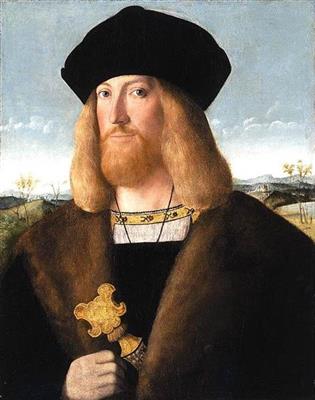
Half-Venetian, half-Cremonese by his own description, Veneto produced some of the finest northern Italian portraits of the early 16th century.
Where to see Bartolomeo Veneto
Collection holdings are reported here; current display varies. Check with each museum before visiting.
-
2 recorded works
Louvre
Paris, France
-
2 recorded works
National Gallery
London, United Kingdom


-
2 recorded works
Fitzwilliam Museum
Cambridge, United Kingdom
-
2 recorded works
Museum of Fine Arts, Houston
Houston, United States
-
2 recorded works
National Gallery of Canada
Ottawa, Canada
-
1 recorded work
Isabella Stewart Gardner Museum
Boston, United States
-
1 recorded work
Städel Museum
Frankfurt, Germany
-
1 recorded work
Museum of Fine Arts Boston
Boston, United States
-
1 recorded work
Gemäldegalerie Berlin
Berlin, Germany
-
1 recorded work
Glasgow Museums Resource Centre
Glasgow, United Kingdom


View all 18 museums
-
1 recorded work
J. Paul Getty Museum
Los Angeles, United States
-
1 recorded work
Pinacoteca di Brera
Milan, Italy
-
1 recorded work
Galleria Nazionale d'Arte Antica
Rome, Italy
-
1 recorded work
National Gallery of Art
Washington D.C., United States
-
1 recorded work
Kelvingrove Art Gallery and Museum
Glasgow, United Kingdom
-
1 recorded work
Detroit Institute of Arts
Detroit, United States
-
1 recorded work
Musée du Petit Palais
Avignon, France
-
1 recorded work
Thyssen-Bornemisza Museum
Madrid, Spain


Frequently Asked Questions
Where can I see Bartolomeo Veneto's work?
Bartolomeo Veneto's paintings are held in several European and North American public collections. In Italy, examples of his work can be found at the Accademia Carrara (Bergamo), the Pinacoteca di Brera (Milan), the Uffizi Gallery (Florence), and the Galleria Borghese (Rome). Other European museums with works by Bartolomeo Veneto include the Louvre (Paris), the Bayerische Staatsgemäldesammlungen (Munich), the Städel Museum (Frankfurt), and the National Gallery (London). In the United States, you can view his paintings at the Metropolitan Museum of Art (New York), the Philadelphia Museum of Art, and the National Gallery of Art (Washington, D.C.). These collections offer opportunities to study Bartolomeo Veneto's portraits and allegorical subjects. His relatively small output means that seeing these works in person provides valuable insight into his artistic style and technique.What techniques or materials did Bartolomeo Veneto use?
Bartolomeo Veneto was an Italian painter who worked during the early 16th century. Technical analysis of his paintings has revealed information about his methods. Veneto primed his panels with a layer of gesso, a common practice at the time. He then applied an imprimatura, a thin tinted layer, on top of the gesso. This toned ground would have provided a smooth and slightly coloured surface on which to paint. Infrared reflectography has revealed underdrawing in some of his works, suggesting a careful planning stage. He employed oil paints, applying them in thin layers to build up colour and form. Veneto was skilled at creating realistic textures and details, particularly in fabrics and jewellery. He often used glazes, transparent layers of paint, to add depth and luminosity to his colours. His attention to detail and careful application of paint resulted in highly polished and refined surfaces. Some scholars suggest he may have been a pupil of Gentile Bellini, which could explain the influence of the Venetian style in his work.Who did Bartolomeo Veneto influence?
Bartolomeo Veneto's artistic impact is somewhat difficult to trace with certainty. While he was a skilled portraitist, his style appears to have been more of a synthesis of existing trends than a source of innovation. His influences included the work of Giovanni Bellini, Leonardo da Vinci, and Albrecht Dürer. Veneto seems to have absorbed elements from each of these masters, blending them into his own distinctive approach to portraiture. He borrowed Bellini's use of colour, Leonardo's sfumato technique (subtle gradations of light and shadow), and Dürer's attention to detail. It is difficult to identify specific artists who were directly influenced by Bartolomeo Veneto. His career was relatively short, and he did not establish a workshop or school of followers. Some scholars have suggested possible connections with later Lombard painters, but these connections remain speculative. Veneto's importance lies primarily in his own artistic output, rather than in his role as a teacher or trendsetter. His portraits offer a fascinating glimpse into the appearance and fashion of his time.What is Bartolomeo Veneto's most famous work?
It is difficult to name Bartolomeo Veneto's single most famous work, as his body of work is not extensive and lacks firm attribution. He is best known for his portraits of fashionable women, often identified by art historians through inscriptions and symbolic details. Examples of works attributed to him include *Portrait of a Lady* in the National Gallery, London; *Flora* in the Städel Museum, Frankfurt; and *Portrait of a Lady as Saint Catherine* in the Indianapolis Museum of Art. These paintings display his skill in rendering textures and surfaces, particularly the luxurious fabrics and jewels worn by his sitters. He also produced religious paintings, such as *Virgin and Child*, but these are less well known. His style blends influences from Venetian and Lombard painting, reflecting the artistic currents of his time.What style or movement did Bartolomeo Veneto belong to?
Bartolomeo Veneto's artistic affiliations are complex, with elements of Venetian, North European, and Lombard styles. His early works, such as the 1502[1] *Madonna and Child*, show the influence of Giovanni Bellini, suggesting he trained in Venice. Some scholars believe he may have been a pupil of Gentile Bellini. The presence of the surname "Venetus" in his 1505 signature suggests he may have left Venice around that time. Later, Leonardesque elements appear in his portraits, leading scholars to believe he worked in or near Milan, possibly from around 1520. These portraits display an intense use of light, objective clarity in detail, and a focus on the subject's presence. The style shows a general affinity with that of Northern Europe, possibly through the influence of Dürer and Jacopo de’ Barbari. Some scholars suggest influences from Padua, Mantua, and Ferrara, during the early 16th century. He is not mentioned by Vasari or Ridolfi.What was Bartolomeo Veneto known for?
Bartolomeo Veneto was a painter active in Venice and the Veneto region of northern Italy during the first three decades of the 16th century. He is best known for his portraits, particularly those of women. Veneto's style is characterised by its attention to detail and realistic representation of his subjects. He often depicted his sitters in elaborate clothing and jewellery, demonstrating his skill in rendering textures and surfaces. His work shows the influence of several artists, including Giovanni Bellini, Leonardo da Vinci, and Albrecht Dürer. This makes Veneto an interesting example of the artistic exchange that occurred in the Veneto. Despite his artistic talent, little is known about Veneto's life. His biography has been reconstructed primarily from his signed and dated works, as well as from a few documentary sources. These sources suggest he travelled and worked in various cities, including Venice, Ferrara, and Milan. He is not mentioned in Giorgio Vasari's *Lives of the Artists*. He is, however, discussed in Marcantonio Michiel's *Notizia d'opere di disegno*, a collection of notes on artworks in private collections.What is Bartolomeo Veneto known for?
Bartolomeo Veneto is known for his portraits. He was documented in Ferrara from 1505[1]-08, possibly in Padua around 1510-12, and active near Milan by the 1520s.
Sources
Where to See guide aggregates verified holdings of Bartolomeo Veneto's works across the following collections.
- [1] wikipedia Wikipedia: Bartolomeo Veneto Used for: biography.
- [2] book Beard, Lee, 1973- author, Butler, Adam, author; Van Cleave, Claire, author; Fortenberry, Diane, author; Stirling, Susan, author, Beard, Lee, 1973- author, Butler, Adam, author; Van Cleave, Claire, author; Fortenberry, Diane, author; Stirling, Susan, author - The Art Book_ New Edition, Mini Format Used for: biography.
- [3] book Jennifer D. Milam, Historical Dictionary of Rococo Art Used for: stylistic analysis.
- [4] book Museum of Fine Arts, Houston, Italian paintings XIV-XVI centuries in the Museum of Fine Arts, Houston Used for: biography.
- [5] book Norma Broude, The Expanding Discourse Used for: biography.
- [6] book Cole, Bruce; , Titian and Venetian Painting, 1450-1590 Used for: biography, stylistic analysis.
- [7] book Cole, Bruce, Titian and Venetian painting _ 1450-1590 Used for: biography.
- [8] book Titian, Susanna Biadene, Mary Yakush, Italy) Palazzo Ducale (Venice, National Gallery of Art (U. S.), Terisio Pignatti, Titian, Prince of Painters _ [Palazzo Ducale, Venice, 2 June - 7 October 1990 ; National Gallery of Art, Washington, 28 Octo Used for: biography.
Editorial overseen by Solis Prints. Sources verified 2026-09-30. Click a source for details, or hover over [N] in the page above to preview.
Editorial standardsMethodologyCorrectionsAI disclosureAbout the editorial team