Composition with Red, Yellow and Blue by Piet Mondrian
Manaò tupapaú by Paul Gauguin
Walking Man by Auguste Rodin
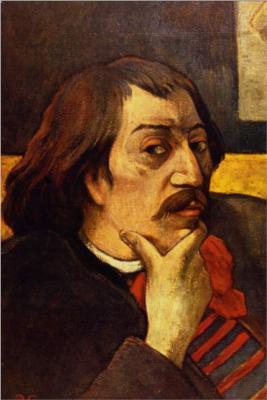
The Painter of Sunflowers by Paul Gauguin
A Converted British Family Sheltering a Christian Missionary from the Persecution of the Druids by William Holman Hunt
The Swan by Hilma af Klint
Pia de' Tolomei by Dante Gabriel Rossetti
Stephen Báthory at Pskov by Jan Matejko
Our English Coasts by William Holman Hunt
Skarbiec wawelski by Leon Wyczółkowski
Italian Hill Town by Arthur Bowen Davies
Birch Forest by Gustav Klimt

Symbolism

68 artists · 1880–1910

Symbolism[5] emerged in France during the 1880s as a decisive rejection of naturalism, realism, and the positivist faith in observable fact. Where the Impressionists had chased light across haystacks, the Symbolists turned inward, pursuing the invisible architecture of dreams, myths, and spiritual states. The movement drew its earliest energy from poetry. Charles Baudelaire, Stephane Mallarme, and Paul Verlaine had already argued that language should evoke rather than describe, and painters soon adopted the same principle: suggestion over statement, mood over documentation. Jean Moreas formalised these ideas in his 1886 Symbolist Manifesto, published in Le Figaro. From Paris the impulse spread to Brussels, Vienna, Oslo, and Munich. Artists as different as Gustave Moreau[11], Odilon Redon[16], Edvard Munch[14], and Gustav Klimt[15] shared the conviction that art should make the unseen felt. Their subjects (femmes fatales, biblical visions, psychological anguish, erotic mysticism) look wildly varied on the surface, yet each channels the same ambition: to bypass the eye and reach the mind. By the time the movement waned around 1910, it had laid the philosophical groundwork for Expressionism, Surrealism, and abstraction.

Key Ideas

  • Suggestion Over Description

    The Symbolists believed that art should never state its meaning directly. A painting or poem should function like music: producing feeling through rhythm, colour, and association rather than literal depiction. Mallarme captured this in his directive to paint the effect a thing produces rather than the thing itself.

  • The Inner World as Subject

    Naturalism had made the external world the proper territory of art. Symbolism reversed that hierarchy. Dreams, hallucinations, spiritual longings, and erotic obsessions became legitimate subjects. Odilon Redon's floating eyeballs, Munch's screaming figures, and Moreau's jewel-encrusted tableaux all insist that the truest reality is interior.

  • Myth and Archetype as Visual Language

    Symbolist painters returned to mythology, religion, and literature. Salome, Orpheus, Ophelia, and the Sphinx recur because these figures carry centuries of accumulated meaning. They function as shorthand for universal experiences that resist straightforward depiction. This reliance on pre-existing narrative distinguished Symbolism from the avant-garde movements that followed.

  • Synthesis of the Arts

    Symbolists aspired to dissolve boundaries between painting, poetry, music, and theatre. Wagner's Gesamtkunstwerk was a touchstone. Painters titled works after poems. The Nabis designed theatre sets, book illustrations, and stained glass alongside easel paintings. A single image might reference a Baudelaire sonnet, a Wagnerian leitmotif, and a medieval altarpiece.

  • Decorative Surface as Spiritual Expression

    Many Symbolists embraced flat, decorative patterning as an alternative to Renaissance illusionism. Klimt's gold-leaf surfaces, Maurice Denis's arabesques, and Puvis de Chavannes's mural-like canvases all sacrifice depth for surface intensity. The Symbolists argued that a painting's material presence could communicate spiritual content more directly than any illusion of three-dimensional space.

Origins

Baudelaire and the Literary Foundation

Symbolism's roots lie in poetry. Baudelaire's 1857 Les Fleurs du Mal introduced correspondences: hidden connections between scents, sounds, colours, and emotions. Mallarme argued the poet's task was to evoke the effect a thing produces, never the thing itself. Verlaine demanded music above all else from verse. These poets gave Symbolism its core doctrine before any painter adopted the term.

Moreau, Redon, and the Parisian Vanguard

Moreau and Redon were making Symbolist art before the label existed. Moreau's mythological watercolours replaced academic narrative clarity with hallucinatory density. Redon produced his noirs (charcoal drawings and lithographs of floating eyes and biomorphic phantoms) throughout the 1870s and 1880s. By the mid-1880s, these two had established the movement's visual poles: mythological density versus psychological strangeness.

The 1886 Manifesto and the Movement's Name

On 18 September 1886, Jean Moreas published his Symbolist Manifesto in Le Figaro. The document gave visual artists a banner to rally around. It defined Symbolist art as hostile to plain description, didactic sentiment, and objective narration. The label provided coherence to scattered tendencies, converting individual experiments into a recognisable programme.

Spread Across Europe

Symbolism spread through personal networks, little magazines, and exhibition societies. In Belgium, Les XX showed Khnopff's sphinx-women alongside French Symbolist painting. In Vienna, Klimt co-founded the Secession in 1897. In Scandinavia, Munch developed his Frieze of Life cycle in Berlin. In Britain, the Pre-Raphaelite legacy ran parallel. By 1900 the movement had touched virtually every European art centre.

In Their Words

“I believe neither in what I touch nor what I see. I only believe in what I do not see, and solely in what I feel.”
Gustave Moreau, Notes on The Life of Humanity, c. 1886
“My originality consists in bringing to life, in a human way, improbable beings and making them live according to the laws of probability, by putting the logic of the visible at the service of the invisible.”
Odilon Redon, A Soi-meme (To Myself), journal, 1867-1915
“Do not paint too much after nature. Art is an abstraction; derive this abstraction from nature while dreaming before it.”
Paul Gauguin, Letter to Emile Schuffenecker, 1888
“Paint not the thing itself but the effect that it produces.”
Stephane Mallarme, Letter to Henri Cazalis, October 1864

All Symbolism Artists

64 artists.

Recommended Reading

  • The Symbolist Movement in Literature

    The Symbolist Movement in Literature

    Arthur Symons · 1899

    The book that introduced French Symbolist poetry to the English-speaking world.

  • Symbolism

    Symbolism

    Robert Goldwater · 1979

    Concise survey of Symbolist visual art across Europe, strong on literary-painterly relationships.

  • Odilon Redon: Prince of Dreams

    Douglas Druick et al. · 1994

    The definitive catalogue of Redon's work from the Art Institute of Chicago retrospective.

  • Lost Paradise: Symbolist Europe

    Lost Paradise: Symbolist Europe

    Jean Clair et al. · 1995

    Covers the full geographic spread with particular strength on Belgian and Scandinavian contributions.

Frequently Asked Questions

  • What is Symbolism in art?
    Symbolism[5] was a late nineteenth-century movement, strongest in France and Belgium between about 1880 and 1910, that turned away from Realism and Impressionism to paint dreams, myths and inner psychological states. Its artists rejected the observable world as a sufficient subject, preferring emblems, allegory and literary reference. The poet Jean Moréas published the movement's manifesto in Le Figaro on 18 September 1886, naming Symbolism and defining its aims.
  • When did Symbolism start?
    Symbolism[5] crystallised in Paris during the 1880s. Gustave Moreau[11], Pierre Puvis de Chavannes and Odilon Redon[16] were already working in a proto-Symbolist manner by 1870, and the movement reached its public form with Moréas's 1886 manifesto. The founding of Les XX in Brussels (1884) gave it a Belgian arm, and by the 1890s it had extended to Vienna through Gustav Klimt[15] and to Britain through Aubrey Beardsley.
  • Who are the most famous Symbolist artists?
    Gustave Moreau[11], Odilon Redon[16], Pierre Puvis de Chavannes, Arnold Böcklin and Fernand Khnopff anchor the movement in France and Belgium. Gustav Klimt[15] led its Viennese branch through the Vienna Secession (founded 1897). Edvard Munch[14] carried Symbolist ideas into Norwegian painting, and Aubrey Beardsley gave it an English graphic form. The Russian Mikhail Vrubel worked in parallel with similar concerns during the same years.
  • What defines the Symbolist style?
    Symbolist paintings share a preference for ambiguity over clarity, and for mythological or literary subjects over the modern life that drove Realism and Impressionism. Formal features vary widely, from Moreau's jewelled surfaces to Puvis's chalky flat murals, but the common ground is suggestion rather than description. Many paintings were deliberately difficult to decode, and the title of a work often carried as much meaning as the image itself.
  • What is the difference between Symbolism and Romanticism?
    Romanticism (c. 1800 to 1850) exalted heightened emotion and the sublime within a naturalistic framework, keeping faith with the visible world even while pushing its limits. Symbolism[5] (c. 1880 to 1910) distrusted the visible world altogether, treating painting as a vehicle for dreams, myth and the unconscious. Romanticism prepared the ground; Symbolism answered a more specifically late-century mood of decadence, pessimism and crisis of faith.
  • Why was Symbolism controversial?
    Official critics treated Symbolism[5] as obscurantist, literary and hostile to the Impressionist project of painting what could be seen. Its frank treatment of sexuality, especially in Klimt and Khnopff, drew censure from both conservative and progressive audiences. The Viennese Secession's 1902 Beethoven Frieze caused a public scandal, and Moreau's Salome paintings were attacked as decadent. Freud's early work emerged into the same cultural moment.
  • Where can I see the best Symbolist paintings?
    The Musée d'Orsay in Paris holds the densest French Symbolist collection. The Musée Gustave Moreau[11], in the artist's former studio, preserves over 25,000 works. The Belvedere in Vienna has Klimt's The Kiss and Judith I. Brussels's Royal Museums of Fine Arts hold Khnopff and Jean Delville. The Munch Museum in Oslo preserves the primary Edvard Munch[14] holding, and the National Gallery of Norway has the original Scream.

Sources

Symbolism editorial draws on the following published scholarship.

  1. [1] book Arthur Symons, The Symbolist Movement in Literature, 1899 Used for: biography, exhibition history, stylistic analysis.
  2. [2] book Robert Goldwater, Symbolism, 1979 Used for: biography, stylistic analysis.
  3. [3] book Douglas Druick et al., Odilon Redon: Prince of Dreams, 1994 Used for: biography, stylistic analysis.
  4. [4] book Jean Clair et al., Lost Paradise: Symbolist Europe, 1995 Used for: biography, stylistic analysis.
  5. [5] wikipedia Wikipedia: Symbolism Used for: biography.
  6. [6] book Brodskaya Nathalia, Brodskaya Nathalia - Symbolism Used for: biography.
  7. [7] book Brodskaïa, Nathalia; , Impressionism and Post-Impressionism Used for: biography.
  8. [8] book Brodskaïa, Nathalia, Impressionism and Post-Impressionism (Essential) Used for: biography.
  9. [9] book Masterpieces of western art : a history of art in 900 individual studies from the Gothic to the present day Used for: biography.
  10. [10] wikipedia Wikipedia: Dante Gabriel Rossetti Used for: biography.
  11. [11] wikipedia Wikipedia: Gustave Moreau Used for: biography.
  12. [12] wikipedia Wikipedia: Hilma af Klint Used for: biography.
  13. [13] wikipedia Wikipedia: Piet Mondrian Used for: biography.
  14. [14] wikipedia Wikipedia: Edvard Munch Used for: biography.
  15. [15] wikipedia Wikipedia: Gustav Klimt Used for: biography.
  16. [16] wikipedia Wikipedia: Odilon Redon Used for: biography.
  17. [17] wikipedia Wikipedia: Paul Gauguin Used for: biography.
  18. [18] wikipedia Wikipedia: Walter Crane Used for: biography.

Editorial overseen by Solis Prints. Sources verified 2026-05-15. Click a source for details, or hover over [N] in the page above to preview.

See Symbolism art in person.

Plan your visit to see Symbolism art →

Take Symbolism home.

See all Symbolism prints →
Back to Discover