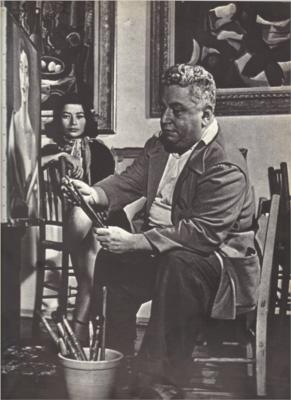
La Leçon de peinture or La Séance de peinture [The Painting Lesson or The Painting Session] by Henri Matisse
The Thinker (Le Penseur) by Auguste Rodin
The Thinker by Auguste Rodin
Flamingo by Alexander Calder
Composition with red, black, yellow, blue and grey by Piet Mondrian
Composition with red, blue, black, yellow and grey by Piet Mondrian
The Dance by Henri Matisse
Composition VIII by Wassily Kandinsky
Triptych by Francis Bacon
Second Version of Triptych 1944 by Francis Bacon
Mobile-Stabile by Alexander Calder
Homage to the Square: Apparition by Josef Albers

Modernism

74 artists · 1860–1970

Modernism[5] was a sweeping transformation in visual art that unfolded between the 1860s and the 1970s. It began with painters in Paris who rejected academic convention and ended with artists across the world dismantling the very idea of what a picture could be. The movement was never a single style. It was a shared conviction that art must answer the conditions of its own time: industrialisation, photography, two world wars, mass media, and the collapse of old certainties about perception and truth. From Manet's flat, confrontational figures to Mondrian's grids of primary colour and Malevich's black square on white, modernist artists stripped away inherited subject matter in pursuit of formal and spiritual essentials. They founded schools and published manifestos (Bauhaus, De Stijl, Suprematism, Constructivism) that collapsed the boundary between fine art, design, and architecture. What links such disparate experiments is a faith that form itself carries meaning, that colour and line can communicate without illustration, and that the artist's task is to make visible what everyday sight overlooks.

Key Ideas

  • The Autonomy of Form

    Modernist artists argued that a painting's lines, colours, and shapes carry their own expressive weight, independent of any story or scene they might depict. This conviction drove successive movements toward abstraction: Cubism fractured objects into geometric planes, Suprematism reduced the canvas to elemental geometry, and De Stijl confined itself to straight lines and primary colours.

  • Art as Spiritual Inquiry

    For many early modernists, abstraction was a spiritual pursuit. Kandinsky's 1911 treatise proposed that colour acts directly on the soul. Hilma af Klint painted enormous abstractions guided by spiritual practice years before Kandinsky or Malevich exhibited theirs. Malevich framed Suprematism as the pursuit of pure feeling beyond material appearances. These artists saw abstraction as a passage toward deeper reality, not away from it.

  • Collapse of Boundaries Between Art and Life

    The Bauhaus insisted that painting, sculpture, architecture, and craft should share a common language. Constructivists applied abstract principles to propaganda posters, typography, and public monuments. Mondrian envisaged a future in which Neoplastic harmony would extend from the canvas to the room and from the room to the city. Modernism treated the artwork not as a precious object sealed off from daily existence but as a prototype for a transformed environment.

  • The Manifesto Impulse

    No previous era produced so many written declarations of artistic intent. Futurist, Vorticist, Suprematist, Constructivist, De Stijl, and Bauhaus manifestos set out principles with aggressive clarity. These texts served a double purpose: they explained unfamiliar work to hostile audiences, and they bound loose networks of artists into identifiable movements.

  • Perpetual Experiment

    Modernism made innovation a structural expectation. Each generation measured itself against the previous one. Impressionism gave way to Post-Impressionism, which gave way to Fauvism and Cubism, which gave way to pure abstraction. This internal momentum produced extraordinary invention at speed, but it also planted the seeds of its own exhaustion. By the 1960s, Minimalism had reduced painting to its final material facts.

Origins

The Salon des Refuses and the Break with Tradition

Modernism's origins are conventionally dated to Paris in the 1860s. The 1863 Salon des Refuses exposed the public to work that defied academic standards. Manet's confrontational canvases became lightning rods. Within two decades, the Impressionists were exhibiting independently. The infrastructure of the modern art world (independent exhibitions, critic-dealer alliances, artist collectives) took shape in this period.

Science, Industry, and the Crisis of Perception

Photography, colour theory, X-ray imaging, and Einstein's relativity papers all contributed to suspicion that visible reality was incomplete. If a camera could record surfaces more accurately than a brush, painters were freed to pursue what photography could not: subjective experience, structural analysis, spiritual intuition. The Cubists dismantled single-point perspective. The Futurists tried to paint speed and simultaneity.

Manifestos, Schools, and the Collective Project

Between 1909 and 1930, an extraordinary density of artistic manifestos appeared. Marinetti's Futurist Manifesto, Malevich's Suprematist writings, the De Stijl founding statement, and the Bauhaus programme each proposed not just an aesthetic but a total reorganisation of art's relationship to society. The Bauhaus gathered painters, architects, weavers, and typographers under one roof.

Abstraction's Parallel Histories

The standard account credits Kandinsky with the first abstract painting around 1911, but the timeline is messier. Hilma af Klint was producing large-scale non-representational work from 1906. Kupka exhibited abstract canvases in Paris in 1912. Delaunay, Picabia, and Dove each arrived at abstraction through different routes. The convergence suggests the move away from representation was a structural response to shared conditions.

In Their Words

“Colour is a power which directly influences the soul.”
Wassily Kandinsky, Concerning the Spiritual in Art, 1911
“By Suprematism I mean the supremacy of pure feeling in creative art.”
Kazimir Malevich, The Non-Objective World, 1927
“Art does not reproduce the visible; rather, it makes visible.”
Paul Klee, Creative Credo, 1920
“The appearance of natural forms changes, but reality remains.”
Piet Mondrian, Natural Reality and Abstract Reality, 1919

All Modernism Artists

60 artists.

Recommended Reading

  • Art Since 1900

    Art Since 1900

    Hal Foster, Rosalind Krauss, Yve-Alain Bois, Benjamin H.D. Buchloh · 2004

    Year-by-year survey of modern and contemporary art. Dense but indispensable.

  • Concerning the Spiritual in Art

    Concerning the Spiritual in Art

    Wassily Kandinsky · 1911

    Founding treatise on abstraction, arguing colour and form communicate directly with the viewer's inner life.

  • The Shock of the New

    The Shock of the New

    Robert Hughes · 1980

    Accessible, opinionated survey linking modernist painting to the social upheavals that shaped it.

  • Hilma af Klint: Paintings for the Future

    Hilma af Klint: Paintings for the Future

    Tracey Bashkoff · 2018

    Landmark Guggenheim catalogue that challenged standard chronologies of modernism.

Frequently Asked Questions

  • What is Modernism in art?
    Modernism[5] is the umbrella term for the succession of avant-garde movements running from roughly 1860 to 1970, beginning with Édouard Manet's Realism and ending with late Abstract Expressionism and Minimalism. The movements share a rejection of academic rules and a belief that painting should be treated as its own object rather than a window onto reality. Each new movement was expected to break with the one before it.
  • When did Modernism start?
    Clement Greenberg's influential 1960 essay 'Modernist Painting' dated the movement to Édouard Manet's Olympia and Déjeuner sur l'herbe, both exhibited in the 1860s. Other historians push the start earlier to Gustave Courbet's 1855 Pavilion of Realism, or later to the first Impressionist exhibition of 1874. What all three accounts share is the 1860s and 1870s as the decade when painting began to question academic tradition.
  • Who are the most famous Modernist artists?
    Modernism[5] produced Édouard Manet, Paul Cézanne, Vincent van Gogh, Henri Matisse[15], Pablo Picasso, Wassily Kandinsky[11], Piet Mondrian[16], Marcel Duchamp, Constantin Brâncuși and Jackson Pollock among its core figures. Each opened or closed a specific movement: Manet broke with academic painting, Cézanne anticipated Cubism, Matisse led Fauvism, Kandinsky reached pure abstraction by 1911, and Pollock took Abstract Expressionism to mural scale.
  • What defines Modernist art?
    Modernist art progressively shed the tools of illusion that painting had used since the Renaissance: linear perspective, modelled volume, continuous narrative and mimetic colour. In their place it put flatness, pure colour, broken form and, after 1910, full abstraction. Clement Greenberg argued this was painting becoming self-critical, using its own means to identify what was unique to the medium and to no other art form.
  • What is the difference between Modernism and modern art?
    'Modern art' is the broad historical category covering everything made between about 1860 and 1970. 'Modernism[5]' is the specific set of ideas, including formal purity and medium-specificity, that animates the major avant-garde movements within that period. All Modernism is modern art; not all modern art is Modernist. Academic painting, Kitsch and regional traditions coexisted with the Modernist avant-garde throughout the period.
  • Why was Modernism important?
    Modernism[5] dismantled a pictorial system that Western painting had operated within for four and a half centuries, clearing the ground for abstraction, conceptual art and the many practices that followed after 1970. Its institutional apparatus, including the Museum of Modern Art (founded 1929), critical journals such as Partisan Review, and commercial galleries in Paris, London and New York, built the infrastructure through which contemporary art still reaches its audience.
  • Where can I see the best Modernist art?
    The Museum of Modern Art in New York was founded in 1929 specifically for this purpose and holds the canonical collection, from Cézanne through to Pollock. The Centre Pompidou in Paris has the strongest European holding. Tate Modern in London, the Guggenheim Bilbao and the Stedelijk Museum in Amsterdam are the other essential stops. Chicago's Art Institute holds a significant Matisse and American Modernist collection.

Sources

Modernism editorial draws on the following published scholarship.

  1. [1] book Hal Foster, Rosalind Krauss, Yve-Alain Bois, Benjamin H.D. Buchloh, Art Since 1900, 2004 Used for: biography, stylistic analysis.
  2. [2] book Wassily Kandinsky, Concerning the Spiritual in Art, 1911 Used for: biography.
  3. [3] book Robert Hughes, The Shock of the New, 1980 Used for: biography.
  4. [4] book Tracey Bashkoff, Hilma af Klint: Paintings for the Future, 2018 Used for: biography, notable works, stylistic analysis.
  5. [5] wikipedia Wikipedia: Modernism Used for: biography.
  6. [6] book Susie Hodge, Art Used for: biography.
  7. [7] book Art Chantry, Art Chantry Speaks Used for: biography.
  8. [8] book Wassily Kandinsky, Concerning the Spiritual in Art, 1911 Used for: exhibition history, stylistic analysis, technique.
  9. [9] book Robert Hughes, The Shock of the New, 1980 Used for: stylistic analysis.
  10. [10] wikipedia Wikipedia: Amedeo Modigliani Used for: biography.
  11. [11] wikipedia Wikipedia: Wassily Kandinsky Used for: biography.
  12. [12] wikipedia Wikipedia: Kazimir Malevich Used for: biography.
  13. [13] wikipedia Wikipedia: Henri Rousseau Used for: biography.
  14. [14] wikipedia Wikipedia: Hilma af Klint Used for: biography.
  15. [15] wikipedia Wikipedia: Henri Matisse Used for: biography.
  16. [16] wikipedia Wikipedia: Piet Mondrian Used for: biography.
  17. [17] wikipedia Wikipedia: Josef Albers Used for: biography.
  18. [18] wikipedia Wikipedia: Paul Klee Used for: biography.

Editorial overseen by Solis Prints. Sources verified 2026-05-15. Click a source for details, or hover over [N] in the page above to preview.

See Modernism art in person.

Plan your visit to see Modernism art →

Take Modernism home.

See all Modernism prints →
Back to Discover