



Charles Gibbons
Most painters arrive at abstraction from painting. Charles Gibbons arrived from architecture. He apprenticed with Arthur Erickson Architects after studying at the University of Manitoba and the University of Calgary, adding environmental psychology to a training that was already unusually broad. The move into painting came in the early 1980s; his first exhibition, in Calgary, showed geometric abstractions that reflected his debt to Sol LeWitt, Kenneth Noland, and Frank Stella.
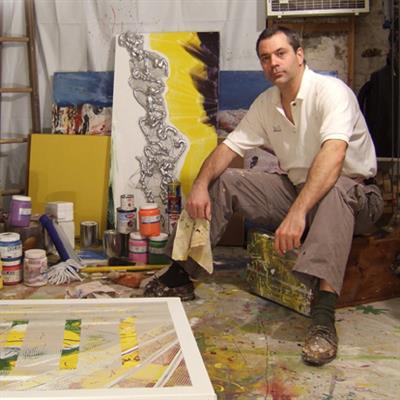
Biography
By the mid-1980s his palette and approach had shifted. The hard-edged geometry gave way to the looser, more atmospheric language of Mark Rothko, Barnett Newman, and Sam Francis. What remained was his interest in structure beneath surface, the architectural instinct, now expressed through layered colour and deliberate contrast rather than through plan and elevation.
His work has since been shown at the Toronto International Art Fair, the Singapore International Contemporary Art Fair, and the Huitai National Art Center in China, and is held in collections across Canada, the United States, Japan, China, and Singapore. He is a member of Visual Arts Ontario and the Alliance for Modern Art.
Timeline
- 1957Born in 1957.
- 1980Began painting in the early 1980s after training in architecture.
- 1980First exhibition in Calgary, featuring geometric abstractions influenced by Sol LeWitt, Kenneth Noland, and Frank Stella.
- 1985Shifted his palette and approach by the mid-1980s, adopting a looser, more atmospheric style reminiscent of Mark Rothko, Barnett Newman, and Sam Francis.
- 2000Exhibited work at the Toronto International Art Fair (year approximate).
- 2000Exhibited work at the Singapore International Contemporary Art Fair (year approximate).
- 2000Exhibited work at the Huitai National Art Center in China (year approximate).
Notable Works
Tap to view larger.
Next stop
Modernism →
Explore the artists and ideas of Modernism.
Related Artists


Frequently Asked Questions
What is Charles Gibbons known for?
Charles Gibbons is known for his geometric abstractions and, later, his more atmospheric style. His early work reflected the influence of Sol LeWitt, Kenneth Noland, and Frank Stella. Later, his style shifted towards the language of Mark Rothko, Barnett Newman, and Sam Francis.What should I know about Charles Gibbons's prints?
Charles Gibbons was active during a period when the print market catered to a broad audience. Mass-produced prints were common, and publishers often prioritised appealing to popular tastes over artistic merit. As John Ruskin noted in 1872, the market was flooded with sentimental or sensational subjects. Publishers often used eye-catching titles to attract buyers, and they readily borrowed titles or created variations on popular works. Size was also important, as prints were expected to be large enough to fill a wall and resemble fine art when framed. While specific details about Gibbons's printmaking techniques are not provided, it is worth noting some general information about printmaking. The artist usually decides to limit an edition. Each print in a limited edition is typically numbered and signed in pencil, following established conventions. These conventions, while not legally binding, are expected by customers, especially those paying a considerable sum for a print.What style or movement did Charles Gibbons belong to?
Without more information about Charles Gibbons's work, it is difficult to place him definitively within a specific movement. However, some general information about related movements may be useful. Modernism[1] rejected historical precedent. Figures such as Walter Gropius and Le Corbusier sought to design objects as if nothing similar had come before. Modernists often favoured simple forms, machine-made aesthetics, and undecorated surfaces. Art Deco, while sharing some characteristics with Modernism, incorporated geometrical proportions and symmetry, pursuing beauty through simple forms. The International Style of the Bauhaus, along with movements such as the "Esprit Nouveau", influenced Art Deco designers. Post-Modernism emerged later, questioning Modernism's tenets. Architects like Robert Venturi and Denise Scott Brown incorporated historical details and decorative elements into their designs. Charles Jencks famously declared the death of Modern architecture in 1972, marking a shift towards Post-Modernism.What techniques or materials did Charles Gibbons use?
Information about Charles Gibbons's techniques and materials is scarce. However, some sources discuss the materials and approaches of other artists, which may provide context. Some artists favour artist-quality paints for their colour saturation, permanence, and stability. Hog hair brushes, particularly filberts and flats, are preferred by some for their springy resistance on the canvas and their suitability for broader applications of oil paint. Grounds can include gessoed MDF, primed canvas stuck to MDF, and primed canvas, all of artist quality. Some artists find emotional and practical value in priming and stretching their own canvases. J. M. W. Turner, for example, developed his oil painting techniques from his prior experience as a watercolourist, utilising transparent washes and optical mixing. He favoured light-toned, absorbent surfaces. Turner also used white primings consisting of lead white in whole egg medium or lead white in oil. Other artists, such as Reynolds, used megilp, a solution of mastic resin in turpentine and linseed oil. Gainsborough favoured warm, red-brown grounds and employed rapid strokes of black, umber, lake, or white paint, followed by thin washes of colour.Where can I see Charles Gibbons's work?
I am unable to provide specific locations for Charles Gibbons's work. My current knowledge base does not include details about where his pieces are held. However, I can offer some general information about how to locate artwork. Public collections like museums are a common place to view art. For example, the British Museum in London and the Vatican Museum in Rome hold extensive collections of historical sculpture. Researching museum websites and catalogues may reveal whether they possess works by Gibbons. Additionally, some artwork is located in situ, meaning it remains in its original location. Cathedrals, for example, sometimes contain original sculpture. If Gibbons created work for a specific building or area, it may still be there. Further research into Gibbons's biography and commissions might provide more specific leads.Who influenced Charles Gibbons?
Few details are known about Charles Gibbons's early training. It is likely that his father, a joiner in York, gave him drawing lessons. He may also have received drawing lessons in London. Gibbons established his first cabinetmaking business in Saint Martin’s Lane in the early 1750s. During these years, he completed the Gentleman and Cabinet-Maker’s Director (first edition 1754, with revised editions in 1755 and 1762). This pattern book influenced the development of English Rococo furniture and stimulated its spread in the American colonies and Europe. The Director includes French designs in the styles of Louis XV, more traditional English designs that are defined by deep carving, examples that involve Chinese latticework and lacquer, and others with Gothic detailing. In addition to furniture, Gibbons designed wallpaper, chimneypieces, silverware, and carpets. He also created entire furnishing programmes for grand interiors, collaborating at times with Robert Adam and William Chambers.Why are Charles Gibbons's works important today?
Charles Gibbons's works are important because they speak to contemporary dilemmas surrounding race, class, and culture. Revisiting earlier texts provokes an eerie feeling; internal relations of race, class, and culture have been transformed by struggles, yet some things have not changed that much. In 1967, one writer observed that "the lived experience of the immigrant teenager is a little like that of the traveller whose routes in and out of the home take him along extended bridges across deep and dangerous chasms". It would be anachronistic to note how the terms of this account anticipate the theme of travelling cultures. The consistency of analytical attention to Black Britain as a local site of diaspora formation demands that, rather than frame this strand of work through a general theory of postcoloniality, the question is how the story of the intervening period is broadly understood. It is the story of how England became other than what it always imagined itself to be and, in a twist to sociology’s immigration narrative, how the third generation "became black because they could not go back". Revisiting diaspora-based writings casts a range of contemporary dilemmas in a critical light.What was Charles Gibbons's art style?
Initially, Charles Gibbons's art style consisted of hard-edged geometry. By the mid-1980s, his style shifted to a looser, more atmospheric approach, using layered colour and deliberate contrast.When was Charles Gibbons born?
Charles Gibbons was born in 1957[1].
Sources
Editorial draws on the following primary and tertiary references for Charles Gibbons.
- [1] wikipedia Wikipedia: Charles Gibbons Used for: biography, birth dates, death dates, identifiers, movement attribution, nationality.
- [2] book downmagaz.net, downmagaz.net Used for: biography.
- [3] book Landauer, Susan, The not-so-still life : a century of California painting and sculpture Used for: biography.
- [4] book 1892-1968, Panofsky, Erwin,, Tomb sculpture: four lectures on its changing aspects from ancient Egypt to Bernini Used for: biography, stylistic analysis.
Editorial overseen by Solis Prints. Sources verified 2026-09-30. Click a source for details, or hover over [N] in the page above to preview.
Editorial standardsMethodologyCorrectionsAI disclosureAbout the editorial team