



Charles Sheeler
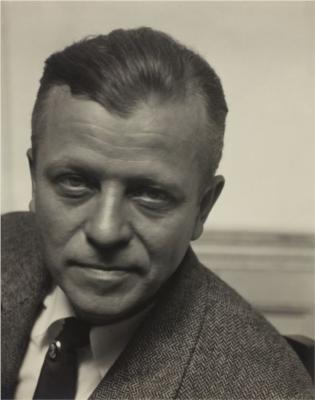
Sheeler taught himself photography with a five-dollar Brownie camera. He was already a trained painter, having studied at the Pennsylvania Academy of Fine Arts under Thomas Anshutz, but the camera gave him something painting could not: a way of looking at industrial objects without sentiment.

Biography
In 1927 Ford hired him to photograph the River Rouge plant in Dearborn, Michigan. The factory was the largest in the world, covering two thousand acres, designed to produce the new Model A from raw materials to finished car on a single site. Sheeler spent six weeks photographing it. The resulting images made smokestacks and conveyor belts look like cathedrals. They were published in magazines, exhibited in galleries, and became some of the most reproduced industrial photographs of the twentieth century.
He turned the photographs into paintings, applying the clean geometry of Cubism to American factories, grain elevators and skyscrapers. The style was called Precisionism: hard edges, flat planes, no visible brushwork, no people. The buildings are the subject. They are rendered with a clarity that makes them look more real than photographs, which was the paradox Sheeler spent his career exploring.
His close friend Morton Schamberg, a painter who shared his interest in machinery, died in the 1918 influenza epidemic. The loss pushed Sheeler further into the work. Between 1926 and 1931 he also shot celebrity portraits and fashion for Vogue and Vanity Fair, which paid better than painting and kept him in contact with a world that had nothing to do with factories.
He collaborated with Paul Strand on Manhatta, a 1921 film of New York City that is one of the earliest American avant-garde films. It runs six minutes.
Timeline
- 1883Born in Philadelphia, Pennsylvania. He studied industrial drawing at the School of Industrial Art before training in painting at the Pennsylvania Academy of the Fine Arts.
- 1909Visited the Paris home of Michael and Sarah Stein at 26, where encounters with early Cubist works by Picasso and Braque inspired several years of Cubist experimentation.
- 1910Rented an eighteenth-century stone house in Doylestown, Pennsylvania at 27 with his friend Morton Schamberg. Taught himself photography around this time, beginning a parallel career documenting architecture.
- 1920Collaborated with photographer Paul Strand at 37 on the short film "Manhatta" in New York, emphasising dramatic viewpoints and abstract compositions of the modern cityscape.
- 1927Spent six weeks at 44 documenting the Ford Motor Company's River Rouge plant in Michigan, producing photographs and paintings that became defining images of American Precisionism.
- 1940Completed a series of six paintings commissioned by Fortune magazine at 57, for which he spent a year travelling across America and photographing industrial subjects.
- 1959Suffered a debilitating stroke at 76 in Irvington-on-Hudson, New York, effectively ending his artistic career after more than five decades of work.
- 1965Died at 82 following a second stroke. His dual practice in painting and photography had established him as a central figure of American Precisionism.
Notable Works
Tap to view larger.
Next stop
Modernism →
Explore the artists and ideas of Modernism.
Charles Sheeler prints
Hand-finished archival prints from Charles Sheeler's body of work.


Related Artists


Take Charles Sheeler home.
See all Charles Sheeler prints →Frequently Asked Questions
Charles sheeler art movement?
Charles Sheeler's style of painting was called Precisionism. This style applied the clean geometry of Cubism to American factories, grain elevators and skyscrapers, using hard edges, flat planes, and no visible brushwork.What was charles sheeler known for?
Charles Sheeler was known for applying the clean geometry of Cubism to American factories, grain elevators and skyscrapers. His style, called Precisionism, featured hard edges, flat planes, no visible brushwork, and no people, with the buildings themselves as the subject.When was charles sheeler born?
Charles Sheeler was born in 1883 in United States. Charles Sheeler died in 1965, aged 82.Who is charles sheeler?
Charles Sheeler was a painter and photographer known for applying the clean geometry of Cubism to American factories, grain elevators, and skyscrapers. He also shot celebrity portraits and fashion for Vogue and Vanity Fair between 1926 and 1931.Who was charles sheeler?
Charles Sheeler was a trained painter who studied at the Pennsylvania Academy of Fine Arts under Thomas Anshutz. He taught himself photography and used the camera to look at industrial objects without sentiment.
Sources
Editorial draws on the following primary and tertiary references for Charles Sheeler.
- [1] book Jesse Bryant Wilder, Art History For Dummies Used for: biography.
- [2] book Beard, Lee, 1973- author, Butler, Adam, author; Van Cleave, Claire, author; Fortenberry, Diane, author; Stirling, Susan, author, Beard, Lee, 1973- author, Butler, Adam, author; Van Cleave, Claire, author; Fortenberry, Diane, author; Stirling, Susan, author - The Art Book_ New Edition, Mini Format Used for: biography.
- [3] book Fred S. Kleiner, Gardner's Art through the Ages Used for: biography.
Editorial overseen by Solis Prints. Sources verified 2026-09-27. Click a source for details, or hover over [N] in the page above to preview.
Editorial standardsMethodologyCorrectionsAI disclosureAbout the editorial team