Sacred and Profane Love by Titian
Bacchus and Ariadne by Titian
Statue of Bartolomeo Colleoni by Andrea del Verrocchio
Angel of the Annunciation by Fra Angelico
Annunciation by Fra Angelico
Loggia del Mercato Nuovo by Andrea del Verrocchio
Danaë by Antonio da Correggio
Adoration of the Magi by Andrea Mantegna
San Zeno Altarpiece by Andrea Mantegna
Camera di San Paolo by Antonio da Correggio
Christ Blessing by Giovanni Bellini
Madonna della tenda by Raphael

Renaissance

24 artists · 1400–1600

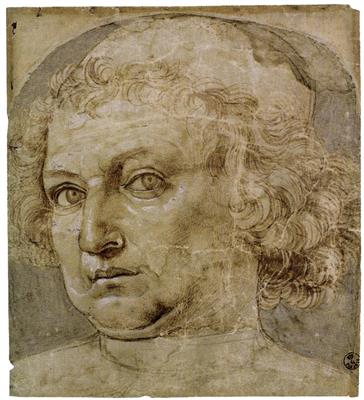
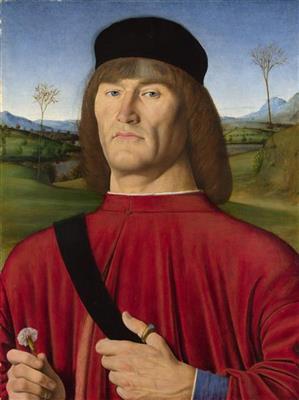
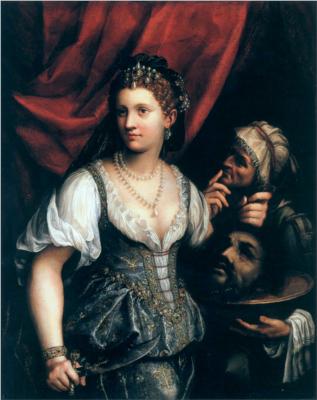
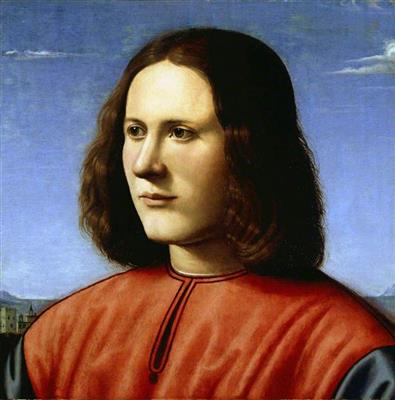
The Renaissance[5] was a period of artistic and intellectual transformation that swept through Italy between roughly 1400 and 1600, then spread across Europe. Its defining impulse was the rediscovery of classical Greek and Roman culture: its philosophy, its architecture, its concern with the observable world. Painters and sculptors stopped treating the human body as a symbol and started treating it as a physical fact, measurable in space, subject to gravity and light. Filippo Brunelleschi demonstrated linear perspective in Florence around 1420, giving artists a mathematical system for representing depth on a flat surface. Leon Battista Alberti codified these ideas in his 1435 treatise On Painting. Oil paint, adopted from Flemish practice, allowed Venetian painters like Giovanni Bellini and Titian to build colour in translucent layers, producing effects of atmosphere that fresco could not match. The movement depended on money. The Medici banking dynasty funded work in Florence. Pope Julius II commissioned the Sistine Chapel ceiling and the Raphael Rooms in Rome. The Venetian Republic decorated its churches and civic buildings with equal ambition. Across two centuries, the Renaissance replaced the flat, symbolic visual language of the medieval period with an art grounded in observation, anatomy, and geometry.

Key Ideas

  • Sacred and Profane Love — Renaissance

    Linear Perspective and the Geometry of Space

    Before the 1420s, European painters had no consistent method for representing three-dimensional space. Brunelleschi changed this with a demonstration outside the Florence Baptistery: a small painted panel proved that parallel lines converging to a single vanishing point could reproduce the appearance of real architecture on a flat surface. Alberti published the theory in 1435. Masaccio's Holy Trinity fresco was among the earliest monumental applications. Perspective placed the viewer at a fixed point, creating an implicit contract between artist and audience. Space became rational, measurable, and human-centred.

  • Bacchus and Ariadne — Renaissance

    Humanism and the Elevated Artist

    Humanism, the intellectual movement that recovered classical texts, reshaped what artists were expected to know. The medieval craftsman worked anonymously within a guild system. The Renaissance artist was a named individual with intellectual credentials. Alberti argued that painters should study geometry, history, and poetry. Leonardo kept thousands of pages of notes on anatomy, optics, and hydraulics. Artists negotiated directly with powerful patrons and signed their work. Classical mythology entered the repertoire alongside Christian narrative. Botticelli's Birth of Venus depicted a pagan goddess at monumental scale.

  • Statue of Bartolomeo Colleoni — Renaissance

    Oil Paint and Venetian Colour

    Tempera, the dominant medium of early Renaissance Florence, dried fast and produced flat, opaque surfaces. Oil paint, refined in the Low Countries by van Eyck, behaved differently. It dried slowly, allowing artists to blend tones on the panel itself, and could be applied in thin translucent glazes. The Venetian school adopted oil enthusiastically. Giovanni Bellini used it to unify figures with landscape in atmospheric light. Titian pushed it further, building form through successive layers of colour rather than contour drawing. Where Florence emphasised line (disegno), Venice emphasised colour (colorito).

  • Angel of the Annunciation — Renaissance

    Patronage and the Economics of Genius

    Renaissance art was expensive. The Medici used commissions to reinforce their authority in republican Florence. Cosimo de' Medici funded the reconstruction of San Marco. Lorenzo supported Botticelli and the young Michelangelo. In Rome, Pope Julius II commissioned Michelangelo for the Sistine ceiling and Raphael for the Stanze. Venice operated differently: the state itself acted as patron. In every case, the relationship between patron and artist shaped what was made, where it was placed, and what it meant.

  • Annunciation — Renaissance

    Anatomy, Observation, and the Body

    Renaissance artists studied the human body with a rigour previously reserved for theology. Leonardo dissected at least thirty corpses, recording muscles and organs in drawings of extraordinary precision. Michelangelo's anatomical understanding informed every figure he carved or painted. Mantegna demonstrated extreme foreshortening in his Lamentation over the Dead Christ. This insistence on direct observation extended beyond anatomy. Artists studied drapery on clay models and drew from life. The goal was convincing physical presence: figures that occupied space, bore weight, and responded to light as real bodies do.

Origins

Florence and the Recovery of Antiquity

The Renaissance began in Florence for specific, material reasons. The city was wealthy from banking and the wool trade. Its republican structure encouraged civic competition. Florentine scholars and artists systematically recovered and studied ancient texts, sculptures, and architectural forms. Brunelleschi measured Roman buildings. Donatello studied classical statues to understand contrapposto. Scholars promoted the studia humanitatis. This was not a sudden awakening. It was an organised, collective project pursued by people who believed classical knowledge could be deliberately recovered. Florence provided the money, the institutions, and the competitive energy.

The Workshop System and Technical Innovation

Renaissance art emerged from workshops, not academies. Verrocchio ran a bottega where Leonardo, Botticelli, and Perugino trained. Masters secured commissions and painted the most important passages. Assistants handled the rest. Technical innovation happened within this structure. Perspective, Alberti's theoretical writings, and oil paint all passed through workshops as practical knowledge. The Renaissance did not reject the craft tradition. It expanded it with mathematical theory and direct observation, producing artists who were both skilled tradespeople and educated thinkers.

The Papacy, Venice, and Expansion Beyond Florence

By 1500, the centre had shifted. Pope Julius II brought Michelangelo, Raphael, and Bramante to Rome. Venice developed its own distinct tradition. The Bellini family established a workshop tradition emphasising oil painting and atmospheric colour. Giovanni Bellini's late work influenced Giorgione and Titian. Mantua produced Mantegna's frescoes. Urbino fostered Piero della Francesca and Raphael's early training. The Renaissance was a Florentine invention, but it became an Italian phenomenon and, eventually, a European one.

From Sacred to Secular, and Everything Between

The Renaissance did not abandon religious art. The majority of surviving works depict Christian subjects. What changed was the range of additional subjects and how sacred subjects were treated. Classical mythology returned for major commissions. Portraiture expanded from donor figures to independent likenesses. Sacred art itself changed: the Madonna became a young woman in a recognisable room, holding a physically convincing infant, in a landscape that obeyed perspective and atmospheric recession. The sacred did not disappear. It was joined by the secular, and both were rendered with the same commitment to observed reality.

In Their Words

“Painting contains a divine force that not only makes absent men present, but moreover makes the dead seem almost alive.”
Leon Battista Alberti, De pictura (On Painting), 1435
“Where the spirit does not work with the hand, there is no art.”
Leonardo da Vinci, Notebooks
“In my opinion painters owe to Giotto exactly the same debt they owe to nature.”
Giorgio Vasari, Lives of the Most Excellent Painters, Sculptors, and Architects, 1550
“The painter will produce pictures of little merit if he takes the works of others as his standard; but if he will apply himself to learn from the objects of nature he will produce good results.”
Leonardo da Vinci, Notebooks

All Renaissance Artists

20 artists.

Recommended Reading

  • Painting and Experience in Fifteenth-Century Italy

    Painting and Experience in Fifteenth-Century Italy

    Michael Baxandall · 1972

    Examines how the social and commercial conditions of quattrocento Italy shaped how paintings were made and understood.

  • History of Italian Renaissance Art

    History of Italian Renaissance Art

    Frederick Hartt and David Wilkins · 1969

    The standard survey, organised chronologically by region and artist.

  • Lives of the Most Excellent Painters, Sculptors, and Architects

    Lives of the Most Excellent Painters, Sculptors, and Architects

    Giorgio Vasari · 1550

    The first art-historical biography. Partisan but indispensable primary source.

  • The Art of the Italian Renaissance

    The Art of the Italian Renaissance

    Peter Murray · 1963

    Concise, clearly written introduction covering architecture, sculpture, and painting.

Frequently Asked Questions

  • What is the Renaissance?
    The Renaissance[5] was a European cultural movement that ran from roughly 1400 to 1600, centred first on Florence and then on Rome, Venice and the Low Countries. It revived the art, literature and philosophy of classical Greece and Rome, and produced a new emphasis on naturalistic observation, linear perspective, and the human figure studied from life. Painters moved from flat gold-ground panels to illusionistic space built through geometry.
  • When did the Renaissance start and end?
    Art historians date the Early Renaissance[5] to Florence around 1400, with Lorenzo Ghiberti's competition panel for the Baptistery doors (1401) as a conventional starting point. The High Renaissance centred on Rome between roughly 1495 and 1520, ending with the death of Raphael. The Late Renaissance (sometimes called Mannerism) extended to about 1600, when Caravaggio and the Carracci family ushered in the Baroque.
  • Who are the most famous Renaissance artists?
    Leonardo da Vinci, Michelangelo Buonarroti and Raphael Sanzio form the traditional High Renaissance[5] trio. Earlier figures include Masaccio, Donatello, Fra Angelico, Sandro Botticelli and Piero della Francesca in Italy, with Jan van Eyck, Hans Memling and Albrecht Dürer working in Northern Europe. Later Venetian masters such as Giovanni Bellini, Giorgione and Titian extended the movement's reach into the sixteenth century.
  • What defines Renaissance art?
    Four features distinguish Renaissance[5] art: one-point linear perspective, codified by Filippo Brunelleschi around 1415 and published by Leon Battista Alberti in 1435; anatomical naturalism based on dissection and life drawing; classical subject matter drawn from Greek and Roman mythology; and the use of oil paint, refined in Flanders and carried into Italy, which allowed slow glazing and subtle tonal modelling.
  • What is the difference between Early, High and Late Renaissance?
    The Early Renaissance[5] (c. 1400 to 1495) was experimental and Florentine, working out perspective and anatomy. The High Renaissance (c. 1495 to 1520) achieved synthesis in Rome under papal patronage, with Leonardo, Michelangelo and Raphael producing balanced compositions of classical clarity. The Late Renaissance or Mannerism (c. 1520 to 1600) deliberately broke that balance, using elongated figures, acid colour and compressed space for emotional effect.
  • Why was the Renaissance important?
    The Renaissance[5] introduced the idea of the individual artist as a named authority rather than an anonymous craftsman. It produced the first systematic treatises on perspective and proportion, founded the modern understanding of anatomical drawing, and set out the iconography of classical mythology that Western painting would draw on for four centuries. Patronage shifted from the church alone to include princes, merchants and civic bodies.
  • Where can I see the best Renaissance paintings?
    The Uffizi Gallery in Florence holds the densest concentration, including Botticelli's Primavera and Birth of Venus, and Leonardo's Annunciation. Rome's Vatican Museums contain Michelangelo's Sistine Chapel ceiling and Raphael's Stanze. London's National Gallery has the Leonardo cartoon and Piero della Francesca's Baptism of Christ. The Louvre holds the Mona Lisa, and the Rijksmuseum in Amsterdam has Northern works by Dürer and Memling.
  • What came before the Renaissance?
    The International Gothic style, refined around the courts of Burgundy and Bohemia between 1370 and 1420, produced elegant elongated figures and decorative gold grounds. In Italy, Giotto di Bondone had already introduced naturalistic weight and emotion in his Arena Chapel frescoes at Padua (1305). Byzantine icon painting, still practised across Crete and Cyprus into the fifteenth century, supplied the formal tradition the Renaissance[5] set out to replace.

Sources

Renaissance editorial draws on the following published scholarship.

  1. [1] book Michael Baxandall, Painting and Experience in Fifteenth-Century Italy, 1972 Used for: biography, stylistic analysis.
  2. [2] book Frederick Hartt and David Wilkins, History of Italian Renaissance Art, 1969 Used for: biography, stylistic analysis.
  3. [3] book Giorgio Vasari, Lives of the Most Excellent Painters, Sculptors, and Architects, 1550 Used for: biography, stylistic analysis.
  4. [4] book Peter Murray, The Art of the Italian Renaissance, 1963 Used for: biography, stylistic analysis.
  5. [5] wikipedia Wikipedia: Renaissance Used for: biography.
  6. [6] book Susie Hodge, Art Used for: biography.
  7. [7] book Susie Hodge, Art: Everything You Need to Know About the Greatest Artists and Their Work Used for: biography.

Editorial overseen by Solis Prints. Sources verified 2026-06-14. Click a source for details, or hover over [N] in the page above to preview.

See Renaissance art in person.

Plan your visit to see Renaissance art →

Take Renaissance home.

See all Renaissance prints →
Back to Discover