

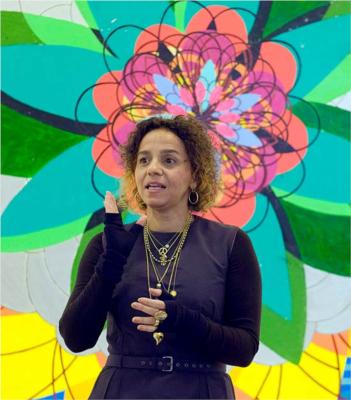
Beatriz Milhazes
In 2012, Beatriz Milhazes's painting Meu Limão (2000) sold at Sotheby's for $2.1 million, making her the highest-priced living Brazilian[1] artist at auction. The result confirmed what the international art world had been concluding for some time: that her synthesis of Brazilian carnival culture, Matissean colour, and hard-edged modernist geometry was unlike anything being made anywhere else.
Biography
Born in 1960[1] in Rio de Janeiro, Milhazes has remained based there throughout her career, working from a studio overlooking the Botanical Garden. Her signature technique involves painting on transparent plastic sheets, allowing the dried paint to be peeled away and transferred to canvas as a collage element. This produces a layered optical quality: circular forms overlapping, geometric patterns pressing against floral motifs. It photographs well but rewards close looking in person.
Her work has been shown at MoMA, the Guggenheim, the Fondation Cartier in Paris, the Beyeler Foundation in Basel, and the Venice Biennale (2003). She received the Chevalier des Arts et des Lettres from the French government in 2007 and Brazil's Order of Ipiranga in 2010. She is widely regarded as the most internationally significant Brazilian[1] painter of her generation.
Timeline
- 1960Born in Rio de Janeiro.
- 2000Created the painting "Meu Limão".
- 2003Exhibited work at the Venice Biennale.
- 2007Received the Chevalier des Arts et des Lettres from the French government.
- 2010Received Brazil's Order of Ipiranga.
- 2012Her painting "Meu Limão" (2000) sold for $2.1 million at Sotheby's.
Notable Works
Tap to view larger.
Next stop
Modernism →
Explore the artists and ideas of Modernism.
Related Artists





Frequently Asked Questions
What is Beatriz Milhazes known for?
Beatriz Milhazes is known for her synthesis of Brazilian[1] carnival culture, Matissean colour, and hard-edged modernist geometry. Her painting Meu Limão (2000) sold at Sotheby's for $2.1 million in 2012, making her the highest-priced living Brazilian artist at auction.What was Beatriz Milhazes's art style?
Beatriz Milhazes's signature technique involves painting on transparent plastic sheets, allowing the dried paint to be peeled away and transferred to canvas as a collage element. This produces a layered optical quality, with circular forms overlapping and geometric patterns pressing against floral motifs.When was Beatriz Milhazes born?
Beatriz Milhazes was born in 1960[1].
Sources
Editorial draws on the following primary and tertiary references for Beatriz Milhazes.
- [1] wikipedia Wikipedia: Beatriz Milhazes Used for: biography, birth dates, death dates, identifiers, movement attribution, nationality.
- [2] book Dorling Kindersley, Artists: Inspiring Stories of the World's Most Creative Minds Used for: stylistic analysis.
- [3] book Beard, Lee, 1973- author, Butler, Adam, author; Van Cleave, Claire, author; Fortenberry, Diane, author; Stirling, Susan, author, Beard, Lee, 1973- author, Butler, Adam, author; Van Cleave, Claire, author; Fortenberry, Diane, author; Stirling, Susan, author - The Art Book_ New Edition, Mini Format Used for: biography, stylistic analysis.
- [4] book Susie Hodge, I Know an Artist Used for: biography.
- [5] book Masterpieces of western art : a history of art in 900 individual studies from the Gothic to the present day Used for: biography, stylistic analysis.
- [6] book Leonor de Oliveira;, Portuguese Artists in London Used for: biography.
- [7] book Hodge, Susie, 1960- author, The short story of women artists : a pocket guide to movements, works, breakthroughs, & themes Used for: biography.
Editorial overseen by Solis Prints. Sources verified 2026-09-22. Click a source for details, or hover over [N] in the page above to preview.
Editorial standardsMethodologyCorrectionsAI disclosureAbout the editorial team