

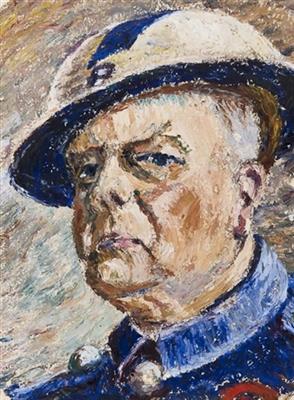
Cyril Power
Cyril Power came to printmaking by an improbable route: he was forty-three years old and had spent two decades as a practising architect before he picked up a linocut tool. He had won the Sloane Medallion in 1900[1], taught at University College London and Goldsmiths, and built a respectable career in architectural education before the modernist currents of the 1920s redirected his energy entirely.
Biography
In 1925[1] he co-founded the Grosvenor School of Modern Art in London, and it was there that he met Sybil Andrews. Their artistic partnership, based out of a shared studio in Hammersmith, produced some of the most kinetically charged British[1] prints of the interwar period. Power's linocuts took the dynamism of Futurism and filtered it through the cool precision of the relief print: the concentric arcs of "The Tube Station" (c. 1932) compress a crowd of commuters into a pattern of pure movement, the figures barely distinguishable from the tunnel geometry around them.
The Redfern Gallery showed Power and Andrews together in 1933[1], cementing their reputations. His subjects were drawn from the velocity of modern life: fairground rides, speedboats, racing cars, the Underground. The formal language was his own invention, built on stacked curves and tightly controlled colour separations that gave each print a near-mechanical energy.
In his final year he set aside the linocut and returned to oil painting, working from the Cornish coast around the Helford River. He died in 1951[1], leaving a body of prints that have since been recognised as a defining contribution to British[1] modernism.
Timeline
- 1872Born in 1872. He later became an architect and printmaker.
- 1900Won the Sloane Medallion.
- 1925Co-founded the Grosvenor School of Modern Art in London.
- 1925Met Sybil Andrews at the Grosvenor School of Modern Art. They formed an artistic partnership.
- 1932Created the linocut print "The Tube Station".
- 1933Exhibited with Sybil Andrews at the Redfern Gallery.
- 1951Died in 1951. He had returned to oil painting in his final year, working on the Cornish coast around the Helford River.
Notable Works
Tap to view larger.
Next stop
Modernism →
Explore the artists and ideas of Modernism.
Related Artists


Frequently Asked Questions
What is Cyril Power known for?
Cyril Power is known for his linocuts, which captured the dynamism of Futurism through the precision of relief printmaking. His prints often depicted the velocity of modern life, such as fairground rides, speedboats, racing cars, and the Underground.What is Cyril Power's most famous work?
Cyril Power is best known for his linocuts, a printmaking technique he embraced during his time at the Grosvenor School of Modern Art. While it is difficult to single out one definitive "most famous" work, several of his prints are particularly well regarded. 'The Eight' (1930[1]) is a frequently cited example, depicting a group of figures on an escalator. Its dynamic composition and use of bold colours are typical of Power's style. Other notable works include 'The Tube Train' (c.1934), and 'Whence and Whither' (1930), which also capture the energy of modern urban life. Power's prints often portray scenes of movement and speed, reflecting the rapid changes of the interwar period. His association with the Grosvenor School, and his exploration of linocut techniques, contributed to a distinctive style that continues to be admired.What should I know about Cyril Power's prints?
Cyril Power is best known for his linocuts from the 1930s. These prints often depict dynamic scenes of modern life, particularly London transport and sporting events. When considering Power's prints, it is important to understand some printmaking conventions. An 'original print' is conceived as a print, and made solely as a print. Each one is individually inked and pulled, making it a 'multi-original' medium. The artist decides the number of prints in the edition. Limited edition prints are often numbered; for example, 12/25 means it is the twelfth print of an edition of 25. This numbering provides an accounting of the number of prints in the edition. The artist usually signs each print in pencil, generally on the bottom margin. The edition number is on the left, the title in the centre, and the signature on the right. The decision to limit an edition is the artist's choice, not always a technical requirement. These claims add value, and customers expect them to be accurate.What style or movement did Cyril Power belong to?
Cyril Power is associated with Art Deco and Modernism[1], artistic movements that gained prominence in the early 20th century. Modernism, which emerged around the turn of the century, embraced newness and a rejection of historical styles. Modernist aesthetics valued purity of form, structure, and a stripping away of inessential elements. Art Deco, which followed, incorporated geometric proportions, symmetry and simplicity. The Bauhaus school and the International Style were influential during this period. These movements favoured clean lines and a sense of order. While Power's specific artistic journey may have encompassed various influences, his work aligns with the broader principles of Art Deco and Modernism. These movements sought to create a new visual language that reflected the changing world.What techniques or materials did Cyril Power use?
Cyril Power is best known for his linocuts, a type of relief printmaking. He produced most of these prints between 1930[1] and 1938, often in collaboration with Sybil Andrews. Power studied architecture at the Architectural Association School in London. After service in World War I, he refocused on art. He studied under Walter Sickert and Claude Flight. Flight's classes at the Grosvenor School of Modern Art promoted linocut techniques as a form accessible to a wider range of artists. Linocuts involve cutting a design into a sheet of linoleum, then inking the raised surface and printing it onto paper. Power's prints often used bold colours and dynamic compositions. These characteristics reflect the influence of Italian Futurism and Vorticism. He frequently depicted scenes of movement, such as sporting events or urban life. His use of colour was carefully planned, with each colour requiring a separate block. Key prints include "The Eight" (1930), "The Tube Train" (circa 1934), and "Speed Trial" (1932).What was Cyril Power known for?
Cyril Power is best known as a British[1] artist associated with the Grosvenor School of Modern Art, and for his linocuts printed in colour. Born in 1872[1], Power originally trained as an architect. He did not begin to seriously pursue art until later in life. He studied at the Slade School of Fine Art, and then, in the 1930s, he became associated with Claude Flight and the Grosvenor School. Power's work often depicted scenes of modern life, particularly transport and urban environments. He had a distinctive style, influenced by Cubism and Futurism, which he applied to linocut printing. His prints are characterised by bold compositions, dynamic lines, and a limited colour palette. Power aimed to capture movement and energy in his images, a quality evident in works such as "The Eight" and "The Merry-Go-Round". He continued to produce linocuts until the outbreak of the Second World War. He died in 1951[1].When did Cyril Power live and work?
Cyril Edward Power was born in 1872[1] and died in 1951[1]. He was an English architect and artist known mainly for his linocuts, produced largely in the 1930s. Power studied architecture at the Architectural Association School in London. He practised as an architect for some years before dedicating himself to art. Around 1908[1], Power began to focus on drawing and painting. He later studied at the Slade School of Fine Art. He is associated with Claude Flight and Sybil Andrews, teaching linocut techniques at the Grosvenor School of Modern Art. Power is best known for his association with the school and his dynamic, modernist linocuts, often depicting urban life and transportation.Where can I see Cyril Power's work?
You can find Cyril Power's work in several museums. In the United States, these include the Charles Hosmer Morse Museum of American Art (Winter Park, Florida), the Los Angeles County Museum of Art (LACMA), the Metropolitan Museum of Art (New York), the Minneapolis Institute of Arts, the Museum of Modern Art (New York), the Virginia Museum of Fine Arts (Richmond), and the Wolfsonian at Florida International University (Miami Beach). In Canada, Power's work can be viewed at the Royal Ontario Museum in Toronto. In the UK, you can find his pieces at the Bakelite Museum (Williton), the Brighton Museum & Art Gallery, the Geffrye Museum (London), the Manchester Art Gallery, the National Museums of Scotland (Royal Museum, Edinburgh), the Victoria & Albert Museum (London), the Towneley Hall Art Gallery (Burnley), the Fitzwilliam Museum (Cambridge), the National Museum of Wales (Cardiff), the National Gallery of Scotland (Edinburgh), the Scottish National Gallery of Modern Art (Edinburgh), the Burrell Collection (Glasgow), and the Leeds City Art Gallery.Where was Cyril Power from?
Cyril Power was British[1]. The Getty Research Institute has observed that postcolonial Britain has transformed into a culture incorporating diversity. English identity no longer comprises the singular scenario of pinstripe suits and clipped high-pitched staccato voices. One of the achievements of imperial culture was to impress on the world the properties of Englishness that encapsulated the identity only of its elite, ruling class. As a result of an increasing emphasis on diversity, English identity has been left almost in a vacuum. People have been so busy deconstructing Englishness and English nationalism according to its identity in the past, that it has been suffering somewhat of an identity crisis. No one is quite sure what properties constitute Englishness any more, aside from the continuing class snobbery of the abject remnants of the pre-war middle and upper classes.Who did Cyril Power influence?
It is difficult to name specific artists who were directly influenced by Cyril Power. Research suggests that Power, along with Claude Flight and Sybil Andrews, developed a style that simplified linocut printmaking. They moved away from colour gradations and imitative shading. Power's style was associated with the Grosvenor School of Modern Art, where Flight taught printmaking. The school promoted a dynamic style inspired by Italian Futurism and Vorticism. This style favoured rhythmic compositions and the depiction of movement, which can be seen in Power's prints of London. Some art historians suggest that the Grosvenor School's emphasis on simplified forms and bold colour may have had a broader impact on printmaking and design in the interwar period. However, specific instances of Power's direct influence on later artists are not well documented. The focus on mass culture and commercial techniques in Pop Art, which developed in England and America in the 1950s, may owe something to the Grosvenor School aesthetic.Who influenced Cyril Power?
Cyril Power, along with Claude Flight and Sybil Andrews, taught at the Grosvenor School of Modern Art. The school promoted the linocut technique, and its aesthetic owed a debt to European modernism, particularly Italian Futurism. Futurism valued speed, dynamism, and the energy of the machine age. These themes are visible in Power's prints, which often depict scenes of urban life, transport, and labour. His style is characterised by bold compositions, simplified forms, and a use of colour to convey movement and rhythm. Power's interest in capturing movement may also owe something to the work of artists like Henri Matisse. Some artists used Matisse's figurative work to move toward abstraction. The French sources for Hans Hofmann's ideas on colour included Matisse, Cézanne, Kandinsky and Delaunay.Who was Cyril Power?
Cyril Edward Power (1872[1]-1951[1]) was a British[1] artist, best known for his linocuts. Power studied at the Slade School of Art in London, then later trained as an architect. After service in World War One, he refocused on art. In 1920s London, Power studied under Claude Flight at the Grosvenor School of Modern Art. Flight's teaching methods emphasised the influence of modern movements such as Futurism on linocut printmaking. Power's prints often depicted dynamic scenes of modern life, including commuters on the London Underground, sporting events, and urban construction. Power frequently collaborated with Sybil Andrews, another student of Claude Flight. Some works were jointly signed with both names; others were issued under the pseudonym "Andrew Power". He also wrote on art and architectural subjects.
Sources
Editorial draws on the following primary and tertiary references for Cyril Power.
- [1] wikipedia Wikipedia: Cyril Power Used for: biography, birth dates, death dates, identifiers, movement attribution, nationality.
- [2] book guggenheim-carlandre00wald Used for: stylistic analysis.
- [3] book Post-impressionism : cross-currents in European painting Used for: biography.
- [4] book Post-impressionism : cross-currents in European painting Used for: biography.
Editorial overseen by Solis Prints. Sources verified 2026-09-22. Click a source for details, or hover over [N] in the page above to preview.
Editorial standardsMethodologyCorrectionsAI disclosureAbout the editorial team