

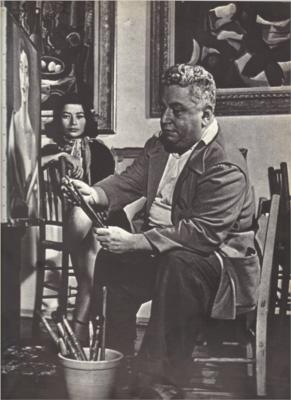
Emiliano Di Cavalcanti
Emiliano Di Cavalcanti was one of the architects of Brazilian[1] modernism, and his role in launching the 1922[1] Semana de Arte Moderna in São Paulo marks a precise before-and-after in the country's cultural history. The week-long festival of music, lectures, and exhibitions was designed to break with academic European tradition and assert a distinctly Brazilian voice. Di Cavalcanti designed the cover of its catalogue, a vivid signal of what was coming.
Biography
Born in Rio de Janeiro in 1897[1], he came from a family connected to the abolitionist movement and grew up in an atmosphere of political and literary debate. He studied law in São Paulo without finishing, spent the early 1920s absorbing Cubism and Fauvism in Paris at the Académie Ranson, and met Picasso, Matisse, Léger, and Braque. But where European modernism often pushed toward abstraction, Di Cavalcanti turned inward: mulatto women at carnival, street vendors, tropical light, the densely populated ordinary life of coastal Brazil. The works are warm, formally confident, and deeply specific to their place.
His politics were Communist and not merely theoretical. He joined the Party and was imprisoned twice for his activities. In 1937[1] he won a Gold medal at the Art Technique Exhibition in Paris for murals at the French-Brazilian[1] Coffee Company. He showed at both the first and second São Paulo Bienals in 1951 and 1953.
Late in life Di Cavalcanti converted from atheism to Catholicism, a turn that surprised his circle. He died in Rio de Janeiro in 1976[1], having spent more than fifty years making paintings that looked at Brazilian[1] society with frankness and visual pleasure in equal measure.
Timeline
- 1897Born in Rio de Janeiro into a family connected to the abolitionist movement.
- 1920Studied Cubism and Fauvism at the Académie Ranson in Paris during the early 1920s, meeting Picasso, Matisse, Léger, and Braque.
- 1922Designed the cover of the catalogue for the Semana de Arte Moderna in São Paulo, at 25.
- 1937Won a Gold medal at the Art Technique Exhibition in Paris for murals at the French-Brazilian Coffee Company.
- 1951Showed work at the first São Paulo Bienal.
- 1953Showed work at the second São Paulo Bienal.
- 1976Died in Rio de Janeiro at 79, after converting from atheism to Catholicism late in life.
Next stop
Modernism →
Explore the artists and ideas of Modernism.
Related Artists


Frequently Asked Questions
What is Emiliano Di Cavalcanti known for?
Emiliano Di Cavalcanti is known for his contribution to Brazilian[1] modernism. He designed the cover for the Semana de Arte Moderna catalogue and created warm, formally confident works specific to their place, depicting mulatto women at carnival, street vendors, and the ordinary life of coastal Brazil.What is Emiliano Di Cavalcanti's most famous work?
It is difficult to identify one single work as Emiliano Di Cavalcanti's 'most famous'. However, he is well known for paintings that celebrate Brazilian[1] culture and identity, often depicting scenes of everyday life with a focus on colour and rhythm. Di Cavalcanti engaged with modernist ideas, while remaining committed to portraying Brazilian subjects. He moved away from European influences, and towards distinctly local themes. His paintings frequently feature samba dancers, carnival scenes, and portraits of women, all rendered in a style that blends elements of cubism, expressionism, and surrealism. These works capture the energy, sensuality, and exuberance of Brazilian life. Di Cavalcanti also worked as an illustrator, journalist, and set designer, further contributing to his status as a significant cultural figure in Brazil.What should I know about Emiliano Di Cavalcanti's prints?
Emiliano Di Cavalcanti (1897[1]-1976[1]) was a Brazilian[1] modernist painter. Although best known for his paintings, he also produced prints, drawings, illustrations, and murals. Di Cavalcanti engaged with printmaking throughout his career. He made woodcuts and lithographs, often featuring themes connected to Brazilian culture and society. These included depictions of samba dancers, bohemian life, and the female form. His style combined elements of European modernism with Brazilian subjects. Di Cavalcanti's prints often display bold lines and simplified forms. Colour played a significant role in his work; he used it to convey emotion and atmosphere. His prints are collected both as individual works and as illustrations in books and periodicals. They offer a more accessible entry point to his oeuvre for collectors, compared to his paintings. His prints contributed to the development of a distinct Brazilian modern art.What style or movement did Emiliano Di Cavalcanti belong to?
Emiliano Di Cavalcanti (1897[1]-1976[1]) is best known as a Brazilian[1] modernist painter. He explored various styles, but his work is most often associated with Brazilian Modernism[1]. Di Cavalcanti's artistic development occurred during a period of significant cultural change in Brazil. He participated in the Week of Modern Art in São Paulo, in 1922[1], a landmark event that marked the formal beginning of the Modernist movement in Brazil. This movement sought to break away from traditional European artistic conventions and create a distinctly Brazilian form of expression. His paintings often featured themes related to Brazilian culture, such as carnival scenes, samba dancers, and portraits of women. Di Cavalcanti's style incorporated elements of Cubism, Expressionism, and Fauvism, which he synthesised into his own unique visual language. He aimed to represent the energy and sensuality of Brazilian life. While he engaged with international trends, his focus remained on depicting Brazilian subjects and experiences.What techniques or materials did Emiliano Di Cavalcanti use?
Emiliano Di Cavalcanti employed a range of materials and methods in his artistic practice. Like many painters, he experimented with diverse painting materials, from traditional fresco, egg tempera, watercolour, and oil to more contemporary acrylics and mixed media. Oil paint was a common choice, often applied to primed cotton duck canvas, sometimes with additional layers of white gesso to create a smooth surface. He also used Masonite boards prepared with multiple gesso coats. Techniques such as impasto and glazing were available to him, influencing the artwork's final appearance. Brushwork could vary from fine and disguised to thick applications with a palette knife, or even stencilled effects. The artist's choices regarding materials and techniques played a role in the aesthetic qualities of his work.What was Emiliano Di Cavalcanti known for?
Emiliano Di Cavalcanti (born in Rio de Janeiro, 1897[1]; died there, 1976[1]) was a Brazilian[1] modernist painter. Di Cavalcanti is known for his depictions of Brazilian life, particularly his sensual and colourful portrayals of women, samba dancers, and bohemian scenes. His style combined elements of cubism, expressionism, and surrealism with distinctly Brazilian themes. Early in his career, Di Cavalcanti was involved with the Semana de Arte Moderna (Modern Art Week) in São Paulo in 1922[1], a landmark event that marked the beginning of Brazilian modernism. He created the catalogue and flag for the event. His work often explored themes of national identity, social issues, and the energy of Brazilian culture. Di Cavalcanti also worked as an illustrator, journalist, and set designer, further contributing to the artistic and cultural scene of Brazil.When did Emiliano Di Cavalcanti live and work?
Emiliano Di Cavalcanti was born in Rio de Janeiro on 6 September 1897[1]. He died in the same city on 26 October 1976[1]. Di Cavalcanti was part of the Semana de Arte Moderna (Modern Art Week) in São Paulo in 1922[1]. This event marked a turning point in Brazilian[1] art, as it rejected traditional European styles and embraced modernism. He created the event's poster and also contributed several works. During his career, Di Cavalcanti explored various themes, including Brazilian identity, social issues, and the female form. He worked as a painter, illustrator, and muralist. He is known for his colourful depictions of Brazilian life, often portraying scenes of samba, carnivals, and everyday people. His style evolved over time, incorporating elements of expressionism and cubism, while maintaining a distinct Brazilian flavour.Where can I see Emiliano Di Cavalcanti's work?
Emiliano Di Cavalcanti's paintings are held in numerous Brazilian[1] museums. These include the Museu de Arte de São Paulo (MASP), which holds works such as "Cinco Moças de Guaratinguetá" (1930[1]). The Museu Nacional de Belas Artes in Rio de Janeiro also has examples of his art. Outside Brazil, Di Cavalcanti's work has been exhibited in various international locations. For example, he participated in the Venice Biennale in 1950, 1952, 1954, and 1964. Major retrospectives have further increased public access to his oeuvre. A significant exhibition was mounted at the Musée d’Art Moderne de la Ville de Paris in 1985. These exhibitions, along with the presence of his pieces in permanent collections, ensure that Di Cavalcanti's artistic contributions are accessible to a broad audience.Where was Emiliano Di Cavalcanti from?
Emiliano Di Cavalcanti was Brazilian[1]. He was part of the surge of Latin American modernism that took place in the early 20th century. Other artists of this movement include Rufino Tamayo of Mexico, as well as Diego Rivera, also of Mexico. Rivera moved from Guanajuato to Mexico City as a child. Tamayo was born in Oaxaca, Mexico, in 1899[1]. He was drawing pre-Columbian objects at the Museo Nacional de Arqueologia, Mexico City, by 1921. Tamayo integrated the forms and slatey tones of pre-Columbian ceramics into his early still lifes and portraits. The first exhibition of Tamayo's work in the United States was held at the Weyhe Gallery, New York, in 1926. The first of his many mural commissions was given to him by the Escuela Nacional de Miisica in Mexico City in 1932.Who influenced Emiliano Di Cavalcanti?
Emiliano Di Cavalcanti's artistic development involved several influences. Early on, his still lifes and figurative work showed the impact of Cézanne, Renoir, and Monet. These artists helped shape his initial approach to form and colour. Later, Di Cavalcanti encountered Cubism, which led him to explore new ideas about form. He also developed an interest in German Expressionism. His exposure to these movements encouraged him to experiment with abstraction and emotional intensity. Di Cavalcanti synthesised these diverse influences into a style that was distinctly his own. He blended elements of European modernism with Brazilian[1] themes. His work often featured depictions of Brazilian life, such as carnival scenes and portraits of women. He created a visual language that reflected both international trends and his own cultural background.Who was Emiliano Di Cavalcanti?
Emiliano Di Cavalcanti (1897[1]-1976[1]) was a Mexican artist. Orphaned by 1911[1], he moved to Mexico City to live with an aunt. She sent him to commercial school. However, Tamayo began drawing lessons in 1915. By 1917, he had left commercial school to devote himself to art. In 1921, he became head of the Department of Ethnographic Drawing at the Museo Nacional de Arqueologia, Mexico City. His duties included drawing pre-Columbian objects in the museum's collection. Tamayo integrated the forms and slatey tones of pre-Columbian ceramics into his early still lifes and portraits of Mexican men and women. The first exhibition of Tamayo's work in the United States occurred at the Weyhe Gallery, New York, in 1926. The Escuela Nacional de Miisica in Mexico City gave him his first mural commission in 1932. In 1936, the artist relocated to New York. The Valentine Gallery in New York gave him shows throughout the late thirties and early forties. Beginning in 1938, he taught for nine years at the Dalton School in New York. In 1948, Tamayo's first retrospective took place at the Instituto de Bellas Artes, Mexico City.Why are Emiliano Di Cavalcanti's works important today?
Emiliano Di Cavalcanti (1897[1]-1976[1]) is important for his contribution to Brazilian[1] modernism. He moved away from European influences, instead drawing inspiration from Brazilian culture and social issues. Di Cavalcanti is known for his depictions of everyday life, particularly his portrayals of women, samba dancers, and scenes from Rio de Janeiro. His work often carries a sense of national identity and social commentary. Di Cavalcanti explored themes of poverty, inequality, and the experiences of marginalised communities. This focus makes his art relevant in contemporary discussions about social justice and cultural representation. Later artists continue to revisit and reinterpret the work of earlier masters. Di Cavalcanti's art provides a lens through which to examine Brazil's past and present. His unique style, which blends elements of cubism, expressionism, and local imagery, continues to influence artists interested in exploring national identity and social themes.
Sources
Editorial draws on the following primary and tertiary references for Emiliano Di Cavalcanti.
- [1] wikipedia Wikipedia: Emiliano Di Cavalcanti Used for: biography, birth dates, death dates, identifiers, movement attribution, nationality.
- [2] book guggenheim-handboo00pegg Used for: biography.
- [3] book guggenheim-masterp00solo Used for: biography.
- [4] book guggenheim-museum00solo Used for: biography.
- [5] book guggenheim-twopri00weis Used for: biography.
Editorial overseen by Solis Prints. Sources verified 2026-09-30. Click a source for details, or hover over [N] in the page above to preview.
Editorial standardsMethodologyCorrectionsAI disclosureAbout the editorial team