


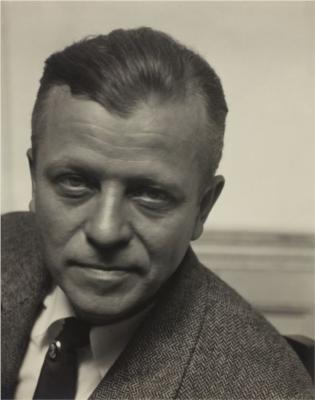
Joseph Stella
Stella accompanied Marcel Duchamp to a plumbing supply store in 1917 to buy the urinal that became Fountain. He was there at one of the defining moments of twentieth-century art, and it was not even his most consequential encounter with a piece of American infrastructure.

Biography
He was born Giuseppe Michele Stella in Muro Lucano, near Potenza, Italy, in 1877. His father and grandfather were attorneys. In 1896 he emigrated to New York to study medicine, following his older brother, a doctor, but abandoned that plan almost immediately and enrolled at the Art Students League, then studied under William Merritt Chase. A return trip to Europe in 1909 exposed him to Fauvism, Cubism and Futurism at exactly the right moment.
The Brooklyn Bridge became his obsession. He first painted it in 1919 after standing alone on the promenade late at night, listening to what he described as "the underground tumult of the trains in perpetual motion" and "the shrill sulphurous voice of the trolley wires". He later wrote that he felt "as if on the threshold of a new religion". His Brooklyn Bridge paintings, of which he made several versions over two decades, use Futurist fragmentation and Gothic verticality to transform an engineering structure into something approaching the sacred.
He was never fully at home in America. He spent long periods in Europe, North Africa and the Caribbean, producing collages from urban ephemera (paper scraps, wrappers with visible branding, bits of street life) that were never exhibited in his lifetime and only discovered by his circle after his death. He died in New York in 1946, at sixty-nine.
Timeline
- 1877Born Giuseppe Michele Stella in Muro Lucano, a hilltop village in southern Italy's Basilicata region.
- 1896Emigrated to New York at 19, arriving at Ellis Island to study medicine, but quickly abandoned it for art classes at the Art Students League.
- 1909Travelled to Europe at 32, spending three years absorbing Futurism, Cubism and the avant-garde scene in Paris and Italy.
- 1918Painted his first depiction of the Brooklyn Bridge at 41 in New York, a subject he would return to throughout his career as a defining motif.
- 1922Completed The Voice of the City of New York Interpreted at 45, a monumental five-panel painting celebrating the dynamism of modern Manhattan.
- 1934Settled in the Bronx at 57 after years of restless travel between New York, Paris and North Africa.
- 1946Died of heart failure in New York at 69, after years of declining health including a serious fall down an elevator shaft the previous year.
Notable Works
Tap to view larger.
Next stop
Futurism →
Explore the artists and ideas of Futurism.
Joseph Stella prints
Hand-finished archival prints from Joseph Stella's body of work.


Related Artists



Take Joseph Stella home.
See all Joseph Stella prints →Frequently Asked Questions
Joseph stella art movement?
Joseph Stella was exposed to Fauvism, Cubism and Futurism, and his Brooklyn Bridge paintings use Futurist fragmentation.What is Joseph Stella's most famous work?
Joseph Stella, an Italian immigrant who arrived in the United States in 1896, is well known for his images of New York City. One of his most recognised works is *The Voice of the City of New York Interpreted*, completed in 1922. This large, five-panel piece presents Stella's vision of modern New York. The central panel depicts an abstract cityscape, including the Flatiron Building. The flanking panels represent Broadway, rendered as an abstraction of colour and light. The remaining panels show the Hudson River harbour and the Brooklyn Bridge, both featuring technological elements such as communication towers and elevated trains. Stella uses a saturated palette and heavy black outlines, giving the work a stained-glass effect. He also adds a predella, detailing the city's tunnels and utility tubes. Another notable work by Stella is *Battle of Lights, Coney Island* (1914). This painting captures the energy of Coney Island at night, with flashing lights and mechanical movement, reflecting Futurist aesthetics.What should I know about Joseph Stella's prints?
Joseph Stella (1877-1946) is best known as a painter associated with Futurism and Precisionism. He is particularly recognised for his depictions of American industrial subjects, especially New York. Stella did produce prints, although they are less well known than his paintings and drawings. These works include lithographs, etchings, and aquatints. His prints often echo themes found in his paintings, such as urban structures and geometric forms. Some of his printmaking was done later in his career. Stella's prints are not as widely discussed as his paintings, but they offer insight into his broader artistic practice. They demonstrate his interest in line, shape, and composition across different media. Collectors interested in Stella's complete output should consider his prints as an extension of his artistic vision. They provide a more complete understanding of his stylistic development and thematic concerns.What style or movement did Joseph Stella belong to?
Joseph Stella is associated with Futurism and Cubism. He encountered the Italian Futurists during a temporary return to Italy in 1910. Futurism, which began in 1909, was an Italian movement that celebrated modernity, technology, speed, and dynamism. The Futurists embraced industry and sought to express the energy of modern life through their art. They often depicted motion by fragmenting forms. Stella's work, such as *The Voice of the City (New York Interpreted)*, completed in 1922, reflects Futurist tenets. The panels representing Broadway capture the intense visual experience of Times Square through a kaleidoscope of colour. The skyscraper and Brooklyn Bridge panels transform these structures into emblems of modernity. Stella also employed Cubist techniques. Cubism, with its emphasis on geometric shapes and multiple perspectives, provided Stella with a visual language to represent the complexities of the modern world. He kept in touch with European trends through the Stieglitz gallery and friendships with artists such as Duchamp and Man Ray.What techniques or materials did Joseph Stella use?
Joseph Stella is known for a variety of approaches. In his Futurist-influenced works, he frequently employed bold colours and dynamic compositions to capture the energy of modern life. Stella experimented with different media, including oil paint, watercolour, pastel, and tempera. He was interested in the physical properties of paint, and in notebooks from the 1930s, he itemised painting characteristics, arranged as binary contrasts. These included absorbent versus non-absorbent surfaces, glazes versus opaque colour, and painting wet-in-wet versus around a contour. He also contrasted tonal and atonal painting, "decorativeness as well as austerity", and "lushness versus acidity". Stella sometimes combined media in a single work, and he explored techniques such as layering and glazing to create depth and luminosity.What was Joseph Stella known for?
Joseph Stella (1877-1946) was an Italian-American painter best known for his depictions of New York City, particularly its technological and architectural marvels. He immigrated to America in 1896 and witnessed the city's modernisation at the turn of the century. Stella's most recognised work is *The Voice of the City (New York Interpreted)*, completed in 1922. This five-panel piece presents an abstraction of New York's towers, including the Flatiron building, alongside representations of Broadway, the Hudson River harbour, and the Brooklyn Bridge. These images feature communication towers, air-venting systems, and elevated trains, celebrating the energy and modernity of the city. Stella temporarily returned to Italy in 1910, where he encountered the Futurists. He maintained contact with European trends, adopting Cubism as his primary artistic language during the 1910s. His *Battle of Lights, Coney Island* (1914) reflects Futurist aesthetics, with flashing lights, repetitive mechanical movements, and a sense of turbulent crowds. Stella transformed his motifs into emblems of modernity, using saturated colours and heavy black lines, reminiscent of medieval stained glass.When did Joseph Stella live and work?
Joseph Stella was born 13 June 1877 and died 5 November 1946. He was an Italian-American Futurist artist. Stella was born Giuseppe Michele Stella in Muro Lucano, Italy. He immigrated to New York in 1896, where he studied medicine and pharmacology, then turned to art. He attended the Art Students League and the New York School of Art. Associated with the Stieglitz circle, Stella became involved with American modernism. He is known for paintings showing the industrialisation of America, especially New York. He also created more traditional still lifes, often of plants. Stella signed the Futurist painting manifesto in 1910, allying himself with that movement. He had a one-man show at Stieglitz Gallery, New York, in 1917. Stella spent most of his life in Paris.When was joseph stella born?
Joseph Stella was born in 1877 in Italy. Joseph Stella died in 1946, aged 69.Where can I see Joseph Stella's work?
Joseph Stella's artworks are held in numerous public collections. In New York City, you can find his pieces at the Metropolitan Museum of Art, the Museum of Modern Art, and the Solomon R. Guggenheim Museum. Stella is also represented in the collection of the Brooklyn Museum. Outside of New York, several institutions hold his work; these include the Los Angeles County Museum of Art (LACMA), the Philadelphia Museum of Art, and the Yale University Art Gallery in New Haven, Connecticut. In Washington, D.C., Stella's work can be viewed at the National Gallery of Art. For those outside of the United States, museums such as the Museo de Arte Moderno in Barcelona and the Kunstmuseum in Zurich also hold pieces by Stella.Where did joseph stella live?
Joseph Stella lived in New York City after emigrating from Italy. He also spent long periods in Europe, North Africa and the Caribbean.Where was Joseph Stella from?
Joseph Stella was from Italy, although he spent most of his career in the United States. He was born to an Italian family, and he grew up in the Italian neighbourhood of New York known as 'Little Italy'. Stella is considered an American artist, even though he maintained ties to the culture of his homeland. Like many American artists of the time, Stella was influenced by the Italian Renaissance; this influence is visible in his paintings. Stella, Cavallon, and Nivola all represent different attitudes toward being transplanted from Italy to America. Stella and others belong to an American culture with a tendency toward the avant-garde. They only sporadically considered questions regarding national traditions.Who did Joseph Stella influence?
Joseph Stella's work had an impact on later generations of Italian artists. After the Second World War, artists alluded to their roots in Futurism, a movement with which Stella was associated. Alberto Burri situated himself in the tradition of Enrico Prampolini through his combinations of materials. Piero Dorazio looked to Giacomo Balla's abstract interpenetrations when working on luminous chromaticism. Lucio Fontana drew inspiration from Filippo Tommaso Marinetti's notion of the incorporeal, broadening his language to move from spatial concepts to a manifesto of the spatial movement for television. Emilio Vedova explored the enigma of Umberto Boccioni's materials, controlling it through theatricality. However, the Guggenheim notes that the Futurists were later identified with Fascism. This association meant that the international systems of historical and critical interpretation abandoned themselves to a factual shift.
Sources
Editorial draws on the following primary and tertiary references for Joseph Stella.
- [1] book guggenheim-masterp00solo Used for: biography.
- [2] book Braun, Emily, 1957-; Asor Rosa, Alberto; Royal Academy of Arts (Great Britain), Italian art in the 20th century : painting and sculpture, 1900-1988 Used for: biography.
- [3] book Penelope J.E. Davies, Walter B. Denny, Frima Fox Hofrichter, Joseph Jacobs, Ann S. Roberts, David L. Simon, Janson's History of Art_ The Western Tradition (8th Edition) Used for: biography.
Editorial overseen by Solis Prints. Sources verified 2026-09-27. Click a source for details, or hover over [N] in the page above to preview.
Editorial standardsMethodologyCorrectionsAI disclosureAbout the editorial team