



Alfred Stieglitz
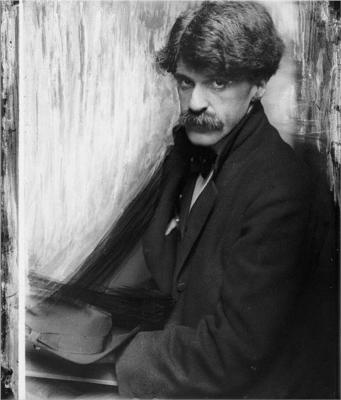
Stieglitz went to Berlin to study engineering and came back a photographer. He had enrolled at the Polytechnikum in 1882, discovered photo-chemistry, bought his first camera, and abandoned the degree plan. His father, a German-Jewish immigrant who had made money in the wool trade, was tolerant of the change but sceptical that photography could be taken seriously as art. Stieglitz spent the next forty years proving it could.
Biography
In 1905 he opened the Little Galleries of the Photo-Secession at 291 Fifth Avenue, known simply as 291. The gallery was three small rooms, but the exhibitions changed American art. Picasso, Matisse, Rodin and Cezanne all received their American debuts there. Stieglitz interspersed controversial work with conventional photography, deliberately setting up arguments between the two so visitors would have to decide what they thought. The method was Socratic. The gallery was a classroom disguised as an exhibition space.
In January 1916, the suffragist Anita Pollitzer brought him a set of charcoal drawings by a young art teacher named Georgia O'Keeffe. Stieglitz exhibited them at 291 without asking O'Keeffe's permission. She found out months later when a friend saw her work on the gallery wall. The two began a daily correspondence that turned into an affair, then a marriage in 1924. Over the next twenty years he made over three hundred portraits of her: clothed and nude, painting and resting, her hands, her neck, her feet.
His own photographs are technically precise and emotionally austere. The Equivalents series, cloud photographs made in the 1920s, are among the earliest examples of intentionally abstract photography. He wanted to prove that a photograph of a cloud could produce the same emotional response as a piece of music, without depicting anything recognisable. He largely succeeded.
Timeline
- 1864Born in Hoboken, New Jersey to German-Jewish immigrant parents. His family moved to Germany in 1881, where he studied engineering before discovering photography.
- 1890Returned to New York at 26 after several years photographing and winning competitions across Europe, determined to prove photography could be a fine art equal to painting.
- 1902Founded the Photo-Secession at 38 in New York after breaking from the Camera Club, uniting a group of photographers committed to advancing the medium as art.
- 1905Opened the Little Galleries of the Photo-Secession at 41, known as "291" for its Fifth Avenue address. The gallery became the first American venue to exhibit Picasso, Brancusi, and other European modernists.
- 1916Exhibited charcoal drawings by Georgia O'Keeffe at 291, at 52, after being shown them by suffragist Anita Pollitzer. He mounted the show without O'Keeffe's initial knowledge.
- 1924Married Georgia O'Keeffe at 60 in New York. Their relationship, documented through decades of correspondence and his photographic portraits of her, became one of the most studied partnerships in American art.
- 1929Opened An American Place gallery at 65 in New York, his final gallery space, which he ran until his death. He championed American modernists including O'Keeffe, Dove, Hartley, and Demuth.
- 1946Died in New York City at 82. Through his galleries, publications, and advocacy over five decades he had fundamentally altered the status of photography and modern art in America.
Notable Works
Tap to view larger.
Where to See Alfred Stieglitz
10 museums worldwide.
-
 3404 works
National Gallery of Art
Washington D.C., United States
Mon–Sat 10:00–17:00, Sun 11:00–18:00 · Free
-
11 works
Metropolitan Museum of Art
New York City, United States
Sun–Tue, Thu 10:00–17:00; Fri–Sat 10:00–21:00; closed Wed · Adults $30, students $17 (pay-what-you-wish for NY residents)
- 10 works
Cleveland Museum of Art
Cleveland, United States
Tue–Sun 10:00–17:00, closed Mondays · Free
-
 3 works
Museum of Modern Art
New York City, United States
Daily 10:30–17:30 (Sat until 19:00; first Fri of month until 20:00) · Adults $30, students $17
- 2 works
J. Paul Getty Museum
Los Angeles, United States
- 2 works
Musée d'Orsay
Paris, France
Tue–Sun 09:30–18:00 (Thu until 21:45); closed Mon · €16 adults

Next stop
Modernism →
Explore the artists and ideas of Modernism.
Alfred Stieglitz prints
Hand-finished archival prints from Alfred Stieglitz's body of work.


Related Artists


Take Alfred Stieglitz home.
See all Alfred Stieglitz prints →Frequently Asked Questions
Did alfred stieglitz have a studio?
In 1905, Alfred Stieglitz opened the Little Galleries of the Photo-Secession at 291 Fifth Avenue. It was known simply as 291.How did alfred stieglitz die?
Alfred Stieglitz died in 1946 at the age of 82.How did alfred stieglitz get into photography?
Alfred Stieglitz discovered photo-chemistry while studying engineering in Berlin. He then bought his first camera and abandoned his degree plan.Is alfred stieglitz associated with pure photography?
Alfred Stieglitz believed in making only straight, unmanipulated photographs. He exposed and printed them using basic photographic processes.What is alfred stieglitz best known for?
Alfred Stieglitz is best known for his photographs. He photographed whatever he saw around him, from the bustling streets of New York City to cloudscapes and the faces of friends and relatives.What is Alfred Stieglitz's most famous work?
Alfred Stieglitz is recognised for his photography and for his role in promoting modern art in America. It is difficult to name a single "most famous work", as his notability stems from a body of work and his activities as a gallerist and publisher. Among his best-known photographs is "The Steerage" (1907). This photograph, taken aboard a ship travelling from New York to Europe, depicts passengers in the lower class section. Stieglitz saw in the arrangement of people, gangways, and objects a composition that excited him. He felt it related to his artistic vision. "The Steerage" is admired for its formal qualities and its social commentary. Another important series is his portraits of Georgia O'Keeffe, his wife. Over several decades, Stieglitz created hundreds of images of O'Keeffe. These photographs explore her personality and artistic identity. They also document their relationship. These portraits are considered significant for their artistic and personal value. Stieglitz's work, in general, helped to establish photography as a fine art form. His images continue to be studied and appreciated for their aesthetic qualities and historical context.What style or movement did Alfred Stieglitz belong to?
Alfred Stieglitz (1864-1946) was a key figure in the development of photography as a fine art. He is associated with the Photo-Secession movement and Pictorialism. Pictorialism was an international style and aesthetic movement that dominated early photography. Pictorialist photographers used soft focus, special printing techniques, and hand manipulation to create images that resembled paintings or etchings. The goal was to give photography artistic status equal to painting. Stieglitz promoted Pictorialism through his gallery, "291", and the journal *Camera Work*. The Photo-Secession was an organisation founded by Stieglitz in 1902 to further the acceptance of Pictorialism in the United States. It was named after the artists' secession movements in Europe, particularly the Vienna Secession. Like those groups, the Photo-Secession sought to break away from academic tradition and promote artistic innovation. Other important members included Edward Steichen, Gertrude Käsebier, and Clarence H. White. However, by the 1910s, Stieglitz moved away from Pictorialism toward straight photography, which emphasised sharp focus and unmanipulated prints. This shift reflected a broader change in artistic tastes, as modernism began to displace earlier aesthetic styles.What was alfred stieglitz famous for?
Alfred Stieglitz is best known for his photographs. He took his camera everywhere, photographing city streets, cloudscapes, and the faces of people around him.When did Alfred Stieglitz live and work?
Alfred Stieglitz (1864-1946) was an American photographer, modern art promoter and publisher. He was born in Hoboken, New Jersey, on 1 January 1864, the first of six children. His family lived in some comfort, allowing them to travel in Europe for extended periods. Stieglitz began his photographic experiments in the 1880s, while studying mechanical engineering in Berlin. He soon abandoned his degree to devote himself to photography. He returned to the United States in 1890, and in 1892, he acquired a photogravure press. He used this to produce the journal *Camera Notes* for the Camera Club of New York. In 1902, Stieglitz broke with the Camera Club to form the Photo-Secession movement. He opened the Little Galleries of the Photo-Secession (also known as "291" after its address) in New York City in 1905. This gallery became a centre for avant-garde art, exhibiting photography alongside modern European painting and sculpture. He also published *Camera Work* (1903-1917), which promoted photography as a fine art. He continued to champion modern art through later galleries, such as the Intimate Gallery and An American Place, until his death on 13 July 1946.When did alfred stieglitz start photography?
Alfred Stieglitz started photography while studying engineering in Berlin. He discovered photo-chemistry in 1882, bought his first camera, and abandoned his degree plan.Where can I see Alfred Stieglitz's work?
Alfred Stieglitz's photographs can be viewed at the Museum of Modern Art[6] in New York; their collection includes "The Flatiron Building" (1903). Stieglitz was active in New York's art scene, and his 291 gallery held some of the earliest exhibitions of European modernists, such as Picasso, Matisse, and Brancusi, in the United States. A show in 2004 at the Musée D'Orsay (Paris) explored Stieglitz's cultural role in New York during the early 1900s; the exhibition catalogue was titled "New York et l'art moderne: Alfred Stieglitz et son cercle". Stieglitz initially adhered to Pictorialism. This movement used manipulation and printing processes to give photographs a painterly aesthetic, with soft tones and diffused effects. Around 1907, Stieglitz moved toward straight photography, which favoured the specific technical and expressive capabilities of the camera without manual intervention. Straight photography often depicted modern life, cities, and machines.Where was Alfred Stieglitz from?
Alfred Stieglitz was born in Hoboken, New Jersey, on 1 January 1864. His parents were German Jewish immigrants. His father, Edward Stieglitz, made his fortune in the wool trade. In 1871, the family moved to New York City. Stieglitz first took up photography during a family trip to Europe in 1883. He enrolled in mechanical engineering at the Technische Hochschule in Berlin. While there, he studied chemistry with Hermann Wilhelm Vogel. Vogel's expertise was in photochemistry. Stieglitz bought his first camera in Berlin, and he began to take photographs of the German countryside. He spent much of the late 1880s in Europe, publishing articles on photography in English and German magazines. He returned to New York in 1890. There, he became a partner in a photoengraving business, the New York Photo-gravure Company. He left the company in 1895 to devote himself to artistic photography.
Sources
Editorial draws on the following primary and tertiary references for Alfred Stieglitz.
- [1] museum Cleveland Museum of Art Used for: museum holdings.
- [2] museum Museum of Fine Arts Boston Used for: museum holdings.
- [3] museum J. Paul Getty Museum Used for: museum holdings.
- [4] museum National Gallery of Art Used for: museum holdings.
- [5] museum Museo Nacional Centro de Arte Reina Sofía Used for: museum holdings.
- [6] museum Museum of Modern Art Used for: museum holdings.
- [7] book Fred S. Kleiner, Gardner's Art through the Ages Used for: biography.
- [8] book Fred S. Kleiner, Gardner's Art through the Ages: A Concise History of Western Art, 2nd ed. Used for: biography.
Editorial overseen by Solis Prints. Sources verified 2026-09-27. Click a source for details, or hover over [N] in the page above to preview.
Editorial standardsMethodologyCorrectionsAI disclosureAbout the editorial team