



Dusan Dzamonja
A work by Dušan Džamonja sits in the Peggy Guggenheim Collection in Venice: a 1959[1] Totem of wood, nails, and glass that looks like something between a tribal fetish and an industrial accident. It is a good introduction to what made him distinctive. He was born in Strumica in 1928[1] and trained at the Fine Art Academy of Zagreb under Vanja Radauš and Fran Kršinić, graduating in 1951 just as Yugoslav modernism was beginning to find its footing.
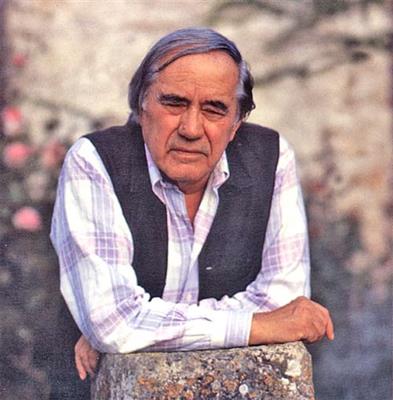
Biography
From the late 1950s, Džamonja developed a signature approach: driving iron nails into wooden forms in dense, bristling configurations, or welding steel into totemic abstract sculptures that carried the weight of ritual objects without referencing any specific tradition. Works entered MoMA in New York and the Tate in London. He represented Yugoslavia at the 1960[1] Venice Biennale.
His largest project was the Sculpture Park near Vrsar in Istria, where he worked between 1964[1] and 1988, installing 26 sculptures across 24,000 square metres of coastal landscape. It remains an open-air museum. His most public monument is the Memorial to the Battle of Kozara (1972) in Kozara National Park, Bosnia, a large-scale welded steel structure that marks one of the bloodiest Partisan engagements of the Second World War.
He won the Rembrandt Prize from the Goethe Foundation in Basel in 1977[1], one of 24 international prizes across his career, and was elected to both the Croatian[1] and Serbian Academies of Sciences and Arts. He died in Zagreb in January 2009[1].
Timeline
- 1928Born in Strumica.
- 1951Graduated from the Fine Art Academy of Zagreb, after studying under Vanja Radauš and Fran Kršinić.
- 1959Created "Totem", a work of wood, nails, and glass, which is now in the Peggy Guggenheim Collection in Venice.
- 1960Represented Yugoslavia at the Venice Biennale.
- 1964Began work on the Sculpture Park near Vrsar in Istria; he worked on it until 1988.
- 1972Created the Memorial to the Battle of Kozara in Kozara National Park, Bosnia.
- 1977Won the Rembrandt Prize from the Goethe Foundation in Basel.
- 2009Died in Zagreb in January, aged 80.
Dusan Dzamonja search answers
The highest-impression searches for this page are looking for identity, spelling, and monument context.
Dusan Dzamonja is often searched as the sculptor connected with Bosnia and Yugoslav memorials. He was born in Strumica in 1928 and is usually described as a Yugoslav or Croatian modernist sculptor.
The same artist is commonly written without diacritics as Dusan Dzamonja and with diacritics as Dušan Džamonja. Searches for both spellings should resolve to this page.
Notable Works
Tap to view larger.
Next stop
Modernism →
Explore the artists and ideas of Modernism.
Related Artists


Frequently Asked Questions
What is Dusan Dzamonja known for?
Dušan Džamonja is known for his abstract sculptures, often totemic in nature, constructed from materials like iron nails and welded steel. His most public work is the Memorial to the Battle of Kozara in Bosnia.What should I know about Dusan Dzamonja's prints?
Dusan Dzamonja (1928[1]-2009[1]) was a Yugoslavian, and later Croatian[1], sculptor best known for his abstract geometric forms. While sculpture was his primary medium, he also produced drawings and prints that explore similar themes. Dzamonja's prints often translate his sculptural ideas into two dimensions. Recurring motifs include spherical and fragmented shapes, exploring the interplay of light and shadow. His prints are not mere reproductions of his sculptures; instead, they represent independent artistic explorations of form and space. Dzamonja worked in a variety of printmaking techniques, including etching and lithography. These methods allowed him to achieve a range of tonal effects and textures, mirroring the surfaces of his three-dimensional works. His prints are characterised by strong contrasts and a sense of depth, achieved through careful manipulation of line and tone. While his sculptures are often monumental in scale, his prints offer a more intimate encounter with his artistic vision. They provide insight into his working methods and the development of his sculptural concepts.What style or movement did Dusan Dzamonja belong to?
Dusan Dzamonja's artistic affiliations are complex, as he engaged with various modernist tendencies rather than adhering strictly to one particular movement. Modernism[1], in art, describes visual expressions that move beyond inherited traditions. Dzamonja's work shares some common ground with Cubism; a style that dissects objects into planes, showing multiple viewpoints simultaneously. Cubism owes a debt to Paul Cezanne's structured surfaces and to African and Iberian sculpture. The style relates to contemporary ideas in physics, mathematics, and philosophy, such as relativity. However, to say that Dzamonja "belonged to" Cubism would be an oversimplification. The rapid succession and coexistence of styles is a characteristic of modernism. Dzamonja's sculptures, with their abstract and often geometric forms, also connect to broader currents within 20th-century sculpture, moving beyond traditional representation.What was Dusan Dzamonja known for?
Dusan Dzamonja (1928[1]-2009[1]) was a Croatian[1] sculptor noted for his abstract, geometric works. He worked in various materials, including iron, bronze, wood, and glass fibre. Dzamonja's sculptures often explored the relationship between positive and negative space, creating dynamic forms with a strong sense of volume. Some of his best-known pieces are large-scale public sculptures, such as those found in Zagreb, Croatia, and other European cities. These monumental works demonstrate his interest in architectural integration and the creation of immersive spatial experiences. Dzamonja also created smaller, more intimate sculptures, as well as drawings and models. His work is characterised by a distinctive visual language that blends modernist abstraction with a sensitivity to materials and craftsmanship. He represented Yugoslavia at the Venice Biennale in 1960[1] and participated in other international exhibitions throughout his career.When did Dusan Dzamonja live and work?
Dusan Dzamonja (1928[1]-2009[1]) was a Croatian[1] sculptor, known for his abstract geometric forms and public monuments. He was born in Strumica, North Macedonia. Dzamonja studied at the Academy of Fine Arts in Zagreb, Croatia, from 1945[1] to 1951. He then completed postgraduate studies with Frano Kršinić. His early work consisted of figurative sculpture, but he shifted toward abstraction during the 1950s. Dzamonja represented Yugoslavia at the Venice Biennale in 1960 and at Expo 67 in Montreal, Canada. His sculptures often incorporate diverse materials such as iron, glass, and wood. He created numerous public sculptures, including monuments commemorating historical events and figures. One example is the monument at Podgarić, Croatia (1967). In addition to sculpture, Dzamonja also produced drawings and architectural projects. He designed his own home and studio, a complex of interconnected pavilions near Vrsar, Croatia. Dzamonja's work is held in museum collections internationally.Where can I see Dusan Dzamonja's work?
Dusan Dzamonja's sculptures are held in collections across Europe. These include the Tate in London, the Museum of Modern Art in New York, and the National Gallery of Bosnia and Herzegovina in Sarajevo. Several open-air sculpture parks also display his large-scale works. These include the Middelheim Open Air Sculpture Museum in Antwerp, Belgium; the Kröller-Müller Museum sculpture park in Otterlo, Netherlands; and the Yorkshire Sculpture Park in Wakefield, UK. Dzamonja designed a sculpture park for his own property near Vrsar, Croatia. It contains around 40 sculptures, and is open to the public. Smaller sculptures and drawings appear occasionally at auction. Catalogues from these sales provide another way to view his output. Major retrospectives have been held, such as the one at the Klovićevi Dvori Gallery in Zagreb in 2013. However, no single permanent collection contains a comprehensive overview of his entire career.Where was Dusan Dzamonja from?
Dusan Dzamonja was born in Strumica, North Macedonia, in 1928[1]. At the time, this area was part of the Kingdom of Yugoslavia. Dzamonja studied sculpture at the Academy of Fine Arts in Zagreb, Croatia, from 1945[1] to 1951. He then completed postgraduate studies with Frano Kršinić. Zagreb remained his primary residence and location for work throughout his career. Although based in Zagreb, Dzamonja maintained connections to his birthplace and the broader region. He participated in numerous exhibitions across Yugoslavia and later in the independent states that emerged after its dissolution. His work often explored themes related to identity, conflict, and the human condition, reflecting the complex history of the Balkans. Dzamonja died in Zagreb in 2009[1].Who did Dusan Dzamonja influence?
Identifying specific artists directly influenced by Dusan Dzamonja is difficult. The concept of artistic influence itself is a complex and sometimes contentious topic in art history. While it is challenging to name artists who explicitly emulated Dzamonja, we can consider the broader context of his work and potential connections. Dzamonja's sculptural practice, particularly his use of assembled materials and exploration of form, shares some common ground with the Dada movement. Dada's "anti-art" stance and embrace of everyday objects had a considerable impact on subsequent generations of artists. Robert Rauschenberg and Joseph Beuys are two artists who engaged with the Dada ethos. Identifying influence is not always straightforward. Art critics and historians sometimes disagree about the extent to which one artist has affected another. The art market can also play a role, as dealers may promote artists as "influencers" to increase sales.Who influenced Dusan Dzamonja?
Dusan Dzamonja's influences are diverse. As a student, he was drawn to Surrealism, Francis Bacon, Hieronymus Bosch, Michelangelo, and Baroque artists. Pablo Picasso was particularly important to him; he admired Picasso's ability to assimilate and personalise the work of others. Dzamonja also noted the impact of Robert Rauschenberg, Jasper Johns, Cy Twombly, and Joseph Beuys on his practice. Rauschenberg's handling of materials, and his approach to objects in relation to painting, were of particular interest. Later, Dzamonja turned to early European abstract art, including Cubism, Piet Mondrian, and Paul Klee. He was especially interested in Klee's engagement with art, reality, symbolism, and literary elements. Dzamonja sought to build on the achievements of other artists and integrate them into his own constructions, evolving his own personal style.Who was Dusan Dzamonja?
Dusan Dzamonja (1928[1]-), was a Macedonian sculptor who lived and worked in Zagreb. He was born in Strumica, Macedonia. Dzamonja exhibited at the Yugoslav Pavilion during the 1960[1] Venice Biennale. His travels included Italy, France, Belgium, Egypt, and Austria. Dzamonja's education included study at the Academy of Fine Arts, Ljubljana. In 1960, he had his first one-man exhibition at the Mala Gallery, Ljubljana. In 1955, he won the Sculpture Prize, Mediterranean Biennale, Alexandria. Later, in 1961, he won the Sculpture Prize, Triennale, Belgrade, and a medal at Morgan's Paint, Rimini. Dzamonja worked in a variety of media. Totem (1959) used wood, nails, and glass. Collective II (1961) and Sphere No. 1 (1963) are bronze sculptures. He is best known for his abstract geometric sculptures in bronze, iron, and wood.Why are Dusan Dzamonja's works important today?
Dusan Dzamonja's sculptures participate in a longer history of twentieth-century art; they can be situated in relation to Dada's expanded definition of art. Dada was a phenomenon in flux, constantly reconstituting and redefining itself. Dada's emphasis on assemblage, collecting, and recycling anticipated the disjuncture that still exists today between the institutions of art and an ever-more threatened ecology. After 1945[1], Dada's ideas exerted a subversive influence, particularly in places with tight state control over art. Dada's oppositional stance made it an ideal subversive voice. Dzamonja's works, created in Communist Yugoslavia, share this critical position. Like Marcel Duchamp's readymades, Dzamonja's art invites a fresh look at the division between art and everyday life. His বিন্যাস sculptures, for example, prompt viewers to reconsider the act of naming and categorising objects as art.What was Dusan Dzamonja's art style?
From the late 1950s, Dušan Džamonja developed a signature style of driving iron nails into wooden forms, creating dense configurations. He also welded steel into totemic abstract sculptures.Which Bosnia monument is linked to Dusan Dzamonja?
His best-known Bosnia and Herzegovina memorial is the Monument to the Revolution at Kozara, a monumental abstract World War II memorial in Kozara National Park.
Sources
Editorial draws on the following primary and tertiary references for Dusan Dzamonja.
- [1] wikipedia Wikipedia: Dusan Dzamonja Used for: biography, birth dates, death dates, identifiers, movement attribution, nationality.
- [2] book Beard, Lee, 1973- author, Butler, Adam, author; Van Cleave, Claire, author; Fortenberry, Diane, author; Stirling, Susan, author, Beard, Lee, 1973- author, Butler, Adam, author; Van Cleave, Claire, author; Fortenberry, Diane, author; Stirling, Susan, author - The Art Book_ New Edition, Mini Format Used for: biography.
- [3] book guggenheim-twopri00weis Used for: biography.
- [4] book Masterpieces of western art : a history of art in 900 individual studies from the Gothic to the present day Used for: biography.
Editorial overseen by Solis Prints. Sources verified 2026-09-30. Click a source for details, or hover over [N] in the page above to preview.
Editorial standardsMethodologyCorrectionsAI disclosureAbout the editorial team