



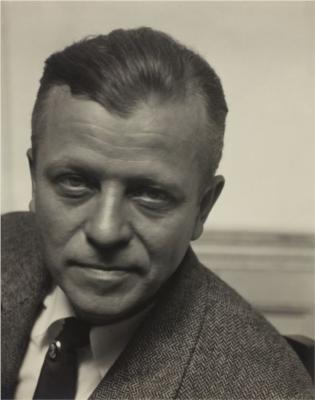
Alfred Maurer
Maurer killed himself weeks after his father died at the age of one hundred. The suicide has been the subject of speculation ever since: whether it was grief, or release from decades of paternal disapproval, or the final consequence of a career that the art world had refused to acknowledge. He hanged himself in the family home in 1932. He was sixty-four.

Biography
He was born in New York in 1868, the son of Louis Maurer, a German-born lithographer. At sixteen his father pulled him out of school to work in the family firm. He hated it. After thirteen years he left for Paris, where he painted representational works that won prizes across Europe: a Salmagundi Club prize in 1900, medals at Buffalo, Liege and Munich.
Then, at thirty-six, he abandoned representation entirely. Exposure to the collections of Gertrude and Leo Stein, and to the paintings of Matisse and the Fauves, converted him to modernism. The shift cost him everything: his international reputation, his commercial viability, and any remaining paternal respect. Stieglitz exhibited him at 291 alongside O'Keeffe, Dove and Hartley, but the American market had little interest in bold experiment.
In 1914, the war forced him back to New York, leaving roughly 250 paintings in his Paris studio. His father refused to pay shipping costs. In 1925, his French landlord sold the entire collection for back rent. Art historian Sheldon Reich later observed that had Maurer remained in Europe, he would be discussed alongside Vlaminck and Derain. Instead he became part of what Reich called "that tragic fraternity of artists who during their lifetimes have suffered the tortures of neglect".
Timeline
- 1868Born in New York City; his father Louis Maurer was a successful Currier & Ives illustrator who would oppose his son's modernist ambitions.
- 1897At 29, left New York for Paris, where he would live for nearly two decades and discover Cezanne, Matisse and the Fauves.
- 1901At 33, won first prize at the Carnegie International Exhibition in Pittsburgh for An Arrangement, a Whistler-influenced painting.
- 1909At 41, exhibited alongside John Marin at Alfred Stieglitz's pioneering 291 gallery in New York, a landmark for American modernism.
- 1913At 45, had his first solo exhibition at Folsom Galleries in New York and showed work in the landmark Armory Show.
- 1914At 46, returned to New York at the outbreak of war and moved back into his parents' home, where domestic tensions overshadowed his creative life.
- 1932Died aged 64 in New York by his own hand, two weeks after the death of his 100-year-old father, having received little recognition in his lifetime.
Notable Works
Tap to view larger.
Where to See Alfred Maurer
6 museums worldwide.
-
 9 works
Crystal Bridges Museum of American Art
Bentonville, United States
Mon/Wed 11:00–18:00, Thu/Fri 11:00–20:00, Sat/Sun 10:00–18:00, closed Tuesdays · Free
-
 11 works
Smithsonian American Art Museum
Washington D.C., United States
Mon–Sun 11:30–19:00 · Free
-
 3 works
Metropolitan Museum of Art
New York City, United States
Sun–Tue, Thu 10:00–17:00; Fri–Sat 10:00–21:00; closed Wed · Adults $30, students $17 (pay-what-you-wish for NY residents)
-
 6 works
National Gallery of Art
Washington D.C., United States
Mon–Sat 10:00–17:00, Sun 11:00–18:00 · Free
-
 2 works
Museum of Fine Arts Boston
Boston, United States
Sun, Mon, Wed, Sat 10:00–17:00, Thu–Fri 10:00–22:00, closed Tuesdays · $30 adults
-
 2 works
New Britain Museum of American Art
New Britain, United States
Tue–Sun 10:00–17:00, Fri 10:00–20:00, closed Mondays · $22 adults
Next stop
Modernism →
Explore the artists and ideas of Modernism.
Alfred Maurer prints
Hand-finished archival prints from Alfred Maurer's body of work.
 Young Woman with Fan - Alfred Henry Maurer
From £28.00
Young Woman with Fan - Alfred Henry Maurer
From £28.00
 Nude (Standing Figure) - Alfred Henry Maurer
From £28.00
Nude (Standing Figure) - Alfred Henry Maurer
From £28.00
 Tulips in a Green Vase - Alfred Henry Maurer
From £28.00
Tulips in a Green Vase - Alfred Henry Maurer
From £28.00
 Landscape with House - Alfred Henry Maurer
From £28.00
Landscape with House - Alfred Henry Maurer
From £28.00
 Still Life with Jardinière - Alfred Henry Maurer
From £28.00
Still Life with Jardinière - Alfred Henry Maurer
From £28.00
 Tree and Rock - Alfred Henry Maurer
From £28.00
Tree and Rock - Alfred Henry Maurer
From £28.00
Related Artists




Take Alfred Maurer home.
See all Alfred Maurer prints →Frequently Asked Questions
What is Alfred Maurer known for?
Alfred Maurer is known for representational works that won prizes across Europe, and later for his bold experiments in modernism. His shift away from representation cost him his international reputation, commercial viability, and his father's respect.What is Alfred Maurer's most famous work?
It is difficult to name Alfred Maurer's single most famous work, as his style shifted considerably during his career. He is known for both early representational works and later modernist experiments. Initially, Maurer gained recognition for his realistic figure paintings and portraits, often executed in a style influenced by Impressionism and the Old Masters. During this period, he produced works such as "An Arrangement" (circa 1901), which won an award at the Carnegie International Exhibition. Around 1905, Maurer encountered the work of European modernists, and his painting style underwent a dramatic change. He began to experiment with Fauvism and Cubism, producing increasingly abstract compositions. Examples from this period include his Fauvist still lifes and his Cubist figure studies. Due to the stylistic range of his output, there isn't one painting that overshadows all others in terms of recognition.What should I know about Alfred Maurer's prints?
Alfred Maurer (1868-1932) was an American modernist painter who experimented with various styles, including Fauvism and Cubism. Information specifically about Maurer's prints is scarce, but some context about printmaking in general may be useful. Printmaking has a long history, dating back to ancient Egypt and China, where stamps and seals were used. As paper became readily available in Europe around the end of the 14th century, printmaking began to flourish. Woodcuts were used for book illustrations, religious icons, and playing cards. During the later part of the 19th century, prints gradually came to be considered a major artistic medium. Artists began to sign their prints, differentiating original graphics from reproductions. They also started to limit the size of editions and use handmade paper. Dealers such as Julius Meier-Graefe, Ambroise Vollard, and Daniel-Henry Kahnweiler recognised the value of prints as a popular art form and encouraged painters and sculptors to make them.What style or movement did Alfred Maurer belong to?
Alfred Maurer (1868-1932) was an American modernist painter who worked in various styles throughout his career. Initially, his artistic approach was rooted in Impressionism, but he moved toward Fauvism after encountering the work of Henri Matisse and the French avant-garde. Later, Maurer explored Cubism, producing paintings with fragmented forms and a reduced colour palette. Modernism came to America in the second decade of the 20th century. It first appeared in New York at 291, the nickname for the Little Galleries of the Photo Secession, the progressive art gallery owned by Alfred Stieglitz. Beginning in 1909, Stieglitz started featuring such seminal Modernists as Picasso, Matisse, Henri Rousseau, Rodin, and Brancusi, as well as African art and children's art. The Armory Show in New York, in 1913, was a key breakthrough Modernist event. Maurer's stylistic shifts reflect the rapidly changing art world of the early 20th century, as artists experimented with new ways of representing reality and expressing their inner visions.What techniques or materials did Alfred Maurer use?
Oil paint was a common material for Alfred Maurer. Artists use mediums and thinners to adjust the qualities of oil paint. Thinners like turpentine or mineral spirits evaporate quickly and do not alter the paint's chemical composition. Mediums, however, do alter the chemical composition by adding oils or varnishes. A common medium can be created by combining one part linseed oil, one part damar varnish, and two or three parts turpentine or mineral spirits. For painting surfaces, artists often use canvas. Some artists use Fredrix Red Label medium-textured canvases. Other options include hardboard panels primed with two coats of acrylic gesso or non-absorbent, canvas-textured paper pads for economical experiments. Sketching equipment can be simple; a clipboard, paper, and a drawing pencil are sufficient.What was Alfred Maurer known for?
Alfred Maurer was an American painter who lived from 1868 to 1932. In the summer of 1905, Maurer, along with the sculptor Mahonri Young, took visitors to see the art collection of Leo and Gertrude Stein while they were away in Florence. Maurer reported that they "shocked some Americans" with the then-early collection of modern art. When asked if he was serious about the art, Maurer affirmed that he was. He would jokingly point to the Portrait of the Artist's Wife by Paul Cézanne, saying that it was obviously finished as it had a frame. Maurer's own work evolved through several distinct phases. Initially, he gained recognition for his representational paintings, often featuring figures in domestic settings. However, he later embraced modernism, experimenting with Fauvism and Cubism. This shift marked a departure from his earlier, more traditional style. Maurer explored abstraction and bold colour palettes, aligning himself with the avant-garde movements of his time.When did Alfred Maurer live and work?
Alfred Maurer was born in New York City on 21 April 1868. He died there on 4 August 1932. Maurer's early artistic education included study at the National Academy of Design, New York, and Académie Julian in Paris around 1897. He remained in Paris until about 1914, and then returned to New York. During his time in France, Maurer exhibited at the Salon d'Automne, where he met Gertrude Stein. He had a one-man show at Vollard's gallery in June 1904, with a catalogue by Roger Marx. He became friendly with Signac, visiting him in Saint-Tropez during the summer. In 1905, he exhibited a Neo-Impressionist canvas at the Independants. A 1908 show at Paul Cassirer's gallery in Berlin was reduced in size and closed earlier than expected. After his return to New York, Maurer's work was included in group shows at the Valentine Gallery in the early 1930s.Where can I see Alfred Maurer's work?
Alfred Maurer's work can be viewed in several museums. In the United States, these include the Metropolitan Museum of Art[6] in New York, the Los Angeles County Museum of Art, the Minneapolis Institute of Arts, the Museum of Modern Art in New York, the Virginia Museum of Fine Arts in Richmond, and the Charles Hosmer Morse Museum of American Art in Winter Park, Florida. You can also find his work at the Wolfsonian at Florida International University in Miami Beach. In Canada, Maurer's pieces are held at the Royal Ontario Museum in Toronto and the Art Gallery of Ontario, also in Toronto. Several European museums also hold his work, such as the Musée National d’Art Moderne, Centre Georges Pompidou, Musée d’Orsay, Musée du Petit Palais, and Musée Rodin, all in Paris. Other European locations include the Musée des Beaux-Arts in Nantes, and the Musée des Beaux-Arts Jules Cheret and Musée Matisse, both in Nice.Where was Alfred Maurer from?
Alfred Maurer was born in 1877 in Nagy Bittse, Hungary. In 1881, at the age of four, he immigrated with his family to New York City, in the United States. By the age of fourteen, Maurer was working as a jeweller's apprentice. He began formal art studies at the National Academy of Design in New York in 1897, and for a year he studied with William M. Chase. Maurer became known as a portrait and figure painter. In 1902, he travelled to Europe. By 1909, he had established a studio in San Diego, California. Maurer founded the San Diego Academy of Art in 1912, and became affiliated with the Theosophical Society. He was also active in the Laguna Beach art colony. From 1921 to 1923, Maurer resided in Silvermine, Connecticut. For the next five years, he divided his time between California and the East Coast.Who did Alfred Maurer influence?
Alfred Maurer's direct influence on other artists is not well documented, but some context can be gleaned from his activities. In the summer of 1905, Maurer, along with sculptor Mahonri Young, took visitors to see the art collection of Leo and Gertrude Stein while the Steins were in Florence. Maurer reported that he and Young "shocked some Americans" with the then-early collection, which included works by Cézanne. The Stein collection, built around Renoir, Cézanne, and Matisse, had an impact on other collectors. Albert Barnes, for example, may have been introduced to Cézanne through the Steins. His collection showed parallels to Leo Stein's preferences, especially regarding Renoir and Cézanne. While Maurer helped introduce Americans to modern art through the Stein collection, the degree of his artistic influence remains uncertain.Who influenced Alfred Maurer?
Alfred Maurer, an American artist, was exposed to a range of influences during his career. Initially, his work showed an Impressionistic style. Later, Maurer's artistic direction shifted. He became one of the early American modernists, exploring Fauvism and Cubism. Henri Matisse, who studied under Gustave Moreau at the École des Beaux-Arts, moved from Impressionism to a greater interest in colour. By 1905, in collaboration with Derain, he abandoned earlier techniques, giving his colours a greater luminosity, which created the effect of light without imitating it. He also added a concern with structure derived from Cézanne. These developments, along with the work of Derain, Braque, and Dufy, contributed to the rise of Fauvism. Maurer's association with these movements suggests the impact of French modernists on his artistic development.Who was Alfred Maurer?
Alfred Maurer was an American modernist painter who died by suicide in 1932. He was the son of lithographer Louis Maurer, and abandoned a successful early career in representational painting to embrace modernism after being exposed to the work of Matisse and the Fauves.
Sources
Editorial draws on the following primary and tertiary references for Alfred Maurer.
- [1] museum New Britain Museum of American Art Used for: museum holdings.
- [2] museum Museum of Fine Arts Boston Used for: museum holdings.
- [3] museum Corcoran Gallery of Art Used for: museum holdings.
- [4] museum National Gallery of Art Used for: museum holdings.
- [5] museum Barnes Foundation Used for: museum holdings.
- [6] museum Metropolitan Museum of Art Used for: museum holdings.
- [7] book guggenheim-artoftomorrowfif1939gugg Used for: biography.
- [8] book guggenheim-solomonrguggenhe00gugg Used for: biography.
- [9] book Masterpieces of western art : a history of art in 900 individual studies from the Gothic to the present day Used for: biography.
Editorial overseen by Solis Prints. Sources verified 2026-09-22. Click a source for details, or hover over [N] in the page above to preview.
Editorial standardsMethodologyCorrectionsAI disclosureAbout the editorial team