



About Allan D'Arcangelo
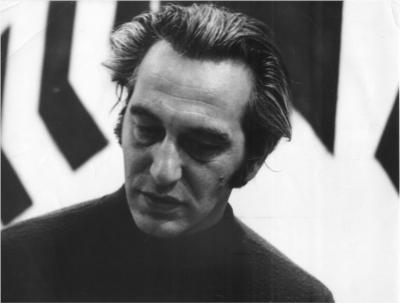
Where to see Allan D'Arcangelo
Collection holdings are reported here; current display varies. Check with each museum before visiting.
-
4 recorded works
National Gallery of Art
Washington D.C., United States
-
3 recorded works
Whitney Museum of American Art
New York City, United States


-
1 recorded work
Buffalo AKG Art Museum
Buffalo, United States
-
1 recorded work
Museum Ludwig
Cologne, Germany
-
1 recorded work
Museum of Fine Arts Boston
Boston, United States
-
1 recorded work
Wallraf–Richartz Museum
Cologne, Germany
-
1 recorded work
Museum of Modern Art
New York City, United States
-
1 recorded work
Virginia Museum of Fine Arts
Richmond, United States
-
1 recorded work
Metropolitan Museum of Art
New York City, United States
-
1 recorded work
Smithsonian American Art Museum
Washington D.C., United States


Own a piece of it
Allan D'Arcangelo prints
Hand-finished archival prints from Allan D'Arcangelo's body of work.
 Bridge Barrier - Allan D'Arcangelo
From £30.00
Bridge Barrier - Allan D'Arcangelo
From £30.00
 April - Allan D'Arcangelo
From £28.00
April - Allan D'Arcangelo
From £28.00
 Untitled (Highway Sign Study) - Allan D'Arcangelo
From £30.00
Untitled (Highway Sign Study) - Allan D'Arcangelo
From £30.00
 Untitled (PRO 75) - Allan D'Arcangelo
From £28.00
Untitled (PRO 75) - Allan D'Arcangelo
From £28.00
 Constellation - Allan D'Arcangelo
From £37.00
Constellation - Allan D'Arcangelo
From £37.00
 Mr. and Mrs. Moby Dick (Allan D'Arcangelo) - Allan D'Arcangelo
From £28.00
Mr. and Mrs. Moby Dick (Allan D'Arcangelo) - Allan D'Arcangelo
From £28.00
 Smoke Dream - Allan D'Arcangelo
From £37.00
Smoke Dream - Allan D'Arcangelo
From £37.00
 Landscape BB - Allan D'Arcangelo
From £37.00
Landscape BB - Allan D'Arcangelo
From £37.00
View all 11 museums
-
1 recorded work
Crystal Bridges Museum of American Art
Bentonville, United States

Can't travel? Bring Allan D'Arcangelo home.
See all Allan D'Arcangelo prints →Frequently Asked Questions
Where can I see Allan D'Arcangelo's work?
Allan D'Arcangelo's artworks can be viewed in several museums. In the United States, these include the Metropolitan Museum of Art (New York), the Museum of Modern Art (New York), the Los Angeles County Museum of Art, the Minneapolis Institute of Arts, the Virginia Museum of Fine Arts (Richmond), the Charles Hosmer Morse Museum of American[1] Art (Winter Park, Florida), and the Wolfsonian at Florida International University (Miami Beach). In Canada, D'Arcangelo's pieces are held at the Art Gallery of Ontario (Toronto), and the Mackenzie Art Gallery (Regina, Saskatchewan). In the United Kingdom, you can find his work at the Victoria & Albert Museum (London), the Brighton Museum & Art Gallery, the Geffrye Museum (London), the Manchester Art Gallery, and the National Museums of Scotland (Edinburgh).What should I know about Allan D'Arcangelo's prints?
Allan D'Arcangelo (1930[1]-1998[1]) was an American[1] Pop artist known for his screenprints. He studied at the Carnegie Institute of Technology and later apprenticed at a print shop. D'Arcangelo's prints often feature hard-edged geometric forms and flat planes of colour. These elements create a sense of depth and movement. His work frequently incorporates imagery drawn from American highways, advertising, and Op art. He was interested in how signs and symbols shape perception. His series "Proposition 1" (1963[1]) used the moiré effect, an optical illusion that creates a sense of movement. Other notable prints include his highway series, which depict road signs and landscapes seen from a moving car. These works examine the relationship between technology, perception, and the American landscape. His prints are held in the collections of the Museum of Modern Art, the Whitney Museum of American Art, and other major institutions.Why are Allan D'Arcangelo's works important today?
Allan D'Arcangelo (1930[1]-1998[1]) is remembered for his Pop art paintings and prints. He combined elements of hard-edge abstraction with imagery drawn from the American[1] roadside. D'Arcangelo's early work in the 1960s engaged with contemporary issues. For example, his series *Kennedy and King* (1964[1]) addressed political assassination. Other paintings, such as *Madonna and Child* (1963), appropriated religious iconography. His work often featured a flattened perspective. This was combined with simplified forms and bold colours. Later, D'Arcangelo moved away from overt social commentary. He explored themes of space and technology. His *Landscape Screens* series (1966-1968[1]) used highway imagery. These works evoke a sense of movement and speed. They also reflect the changing American environment. D'Arcangelo's distinctive style blends Pop art with elements of Minimalism. His prints and paintings offer a commentary on American culture during the Cold War era. His work is held in major museum collections. These include the Museum of Modern Art and the Whitney Museum of American Art in New York.What techniques or materials did Allan D'Arcangelo use?
Information on Allan D'Arcangelo's specific techniques is scarce; however, we can discuss painting techniques and materials common to the period. Artists often begin by preparing a canvas. This involves stretching the material, priming it with gesso (a white paint mixture), and sometimes sanding for a smooth surface. Oil paint is a common medium; it can be thinned with solvents or combined with mediums like wax and turpentine to alter its consistency and drying time. Various brush types exist, from rounds and flats to filberts, each offering different effects. Palette knives can also apply and manipulate paint, creating textures. Techniques include alla prima (direct painting, finishing in one sitting), impasto (thick application for texture), and scumbling (layering broken colour). Acrylic paint is another option, offering faster drying times. Ultimately, the choice of materials and techniques depends on the artist's desired outcome and personal preferences.Who did Allan D'Arcangelo influence?
It is difficult to identify specific artists who were directly influenced by Allan D'Arcangelo. The available texts do not discuss D'Arcangelo's direct influence on other artists. However, they do discuss the influence of some of his contemporaries and the artistic movements with which he was associated. For example, the painter David Smith influenced Anthony Caro. Caro, in turn, taught at Bennington College in Vermont from 1963[1] to 1965; during that time, Smith's Cubi XXIII of 1964-65 may have been influenced by Caro. Frank O'Hara valued William Carlos Williams's poetry. O'Hara, Leroi Jones (Amiri Baraka), James Schuyler, and Kenneth Koch all reference each other in their statements. Robert Rauschenberg combined Jackson Pollock's drip technique with the grid of Analytic Cubism.Who influenced Allan D'Arcangelo?
Allan D'Arcangelo (1930[1]-1998[1]) was an American[1] Pop artist whose work engaged with themes of technology, progress, and contemporary American life. Several artists and movements affected his artistic development. Early in his career, D'Arcangelo was influenced by Abstract Expressionism. He then moved towards a style that incorporated elements of hard-edge painting and Pop art. His mature works often combined flat planes of colour with simplified, silhouetted images, creating a distinctive and recognisable style. The artist himself cited influences such as billboards and road signs. These everyday objects informed his compositions and his interest in the visual language of modern America. The clean lines and bold colours of commercial design are apparent in his prints and paintings. D'Arcangelo’s work also shows an engagement with the art of the past. He admired early Italian Renaissance painters such as Paolo Uccello. The influence of these artists can be seen in D'Arcangelo’s use of perspective and geometric forms. His work offers a commentary on modern society, filtered through the lens of art history and popular culture.What is Allan D'Arcangelo's most famous work?
While it is difficult to identify a single "most famous" work, Allan D'Arcangelo is perhaps best known for his Pop art paintings that incorporate imagery from American[1] highways and advertising. His style often involved simplified, hard-edged forms and a limited colour palette, reflecting the visual language of road signs and billboards. D'Arcangelo's work frequently explores themes of consumer culture, technology, and the American experience. Examples of his notable pieces include his series of highway paintings, such as "Full Moon and Speed of Light" (1964[1]), which captures the stark, graphic quality of roadside views. He also created works that engage with contemporary political and social issues, such as "Life-Span No. 3 (Marilyn Monroe)" (1967), a variable painting using oil and enamel on a photograph and vinyl. D'Arcangelo's artwork often incorporates magnetic elements, allowing for variable configurations and viewer interaction. This approach reflects his interest in the changing nature of perception and the impact of mass media on contemporary life.What style or movement did Allan D'Arcangelo belong to?
Allan D'Arcangelo is associated with Pop Art[1], a movement that emerged in the 1950s in Britain and then in the United States during the early 1960s. Pop Art took inspiration and motifs from mass consumer society, industrial mass production, advertising, and the media. The art often incorporated images and techniques found in advertising, comic books, and other forms of popular culture. Pop Art reintroduced signs, symbols, metaphors, allusions, illusions, and figural imagery, contrasting with the abstract and reductive works of the post-war avant-garde. Artists like Andy Warhol and Roy Lichtenstein adopted everyday themes, from politics to gossip, transforming them into trivial clichés through simplification, enlargement, and repetition. British Pop Art, with figures such as Richard Hamilton, often adopted a more socially critical approach, caricaturing consumerism and fashion.
Sources
Where to See guide aggregates verified holdings of Allan D'Arcangelo's works across the following collections.
- [1] wikipedia Wikipedia: Allan D'Arcangelo Used for: biography.
- [2] book guggenheim-handboo00pegg Used for: biography.
- [3] book guggenheim-jimdinew00dine Used for: biography.
- [4] book guggenheim-moder00artg Used for: biography.
Editorial overseen by Solis Prints. Sources verified 2026-09-30. Click a source for details, or hover over [N] in the page above to preview.
Editorial standardsMethodologyCorrectionsAI disclosureAbout the editorial team