



About Eva Hesse
German-American · 1936–1970
- Post-Minimalism
- Contemporary
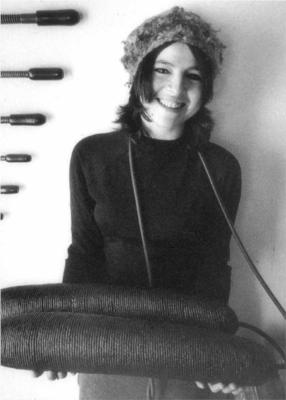
Eva Hesse challenged Minimalism with fragile sculptures made from unconventional materials before her early death in 1970.
Museums9
Countries5
Most worksMuseum of Modern Art, New York City · 24 works
Loading map…
Where to see Eva Hesse
Ranked by works you can see in person.
-
24 works
Museum of Modern Art
New York City, United States
-
5 works
Tate
London, United Kingdom


-
2 works
National Gallery of Art
Washington D.C., United States
-
2 works
Israel Museum
Jerusalem, Israel
-
1 works
Museum Ludwig
Cologne, Germany
-
1 works
Art Institute of Chicago
Chicago, United States
-
1 works
Seattle Art Museum
Seattle, United States
-
1 works
Detroit Institute of Arts
Detroit, United States
-
1 works
National Gallery of Victoria
Melbourne, Australia


Frequently Asked Questions
Where can I see Eva Hesse's work?
Eva Hesse's work can be viewed in person at several museums. These include the Solomon R. Guggenheim Museum and the Metropolitan Museum of Art in New York. Also in the United States, her pieces are held at the Art Institute of Chicago, the Cincinnati Art Museum, the Cleveland Museum of Art, the Busch-Reisinger Museum (Harvard University, Cambridge), and the Museum of Art (Carnegie Institute, Pittsburgh). In Europe, Hesse's art can be found at the Aarhus Kunstmuseum in Denmark, the Sonja Henies og Niels Onstads Stiftelser in Norway, and the Kunstmuseums in Bern and Luzern. Her work is also held at the Musée National d'Art Moderne, Centre Georges Pompidou, in Paris. Hesse's 'Expanded Expansion' (1969) is in the collection of the Guggenheim. This piece is made of fibreglass and rubberised cheesecloth, in three units.What should I know about Eva Hesse's prints?
Eva Hesse (born Hamburg, 1936; died New York City, 1970) was part of the post-Minimalist or Process Art movement. This tendency moved away from both Abstract Expressionism and the rigid geometry of Minimalism. Instead, artists explored the human body, chance occurrences, and improvisation. They also experimented with non-traditional materials like industrial felt, molten lead, wax, and rubber. Hesse's abstract sculptures contributed to this shift. Though best known for her sculpture, Hesse also made drawings and prints. In 1961, she participated in a watercolour exhibition at The Brooklyn Museum, as well as a drawing show called 'Drawings: Three Young Americans' at the John Heller Gallery in New York. Her first solo show of drawings occurred at the Allan Stone Gallery in 1963. Hesse taught at the School of Visual Arts in New York from 1968 to 1970 and participated in several exhibitions of Minimal and Post-Minimal sculpture.Why are Eva Hesse's works important today?
Eva Hesse (1936-1970) is important for her contribution to Post-Minimalism and Process Art. Her brief but significant career saw her challenge artistic conventions through abstract, sensual sculptures. Born in Hamburg, Hesse fled Nazi persecution with her family, arriving in New York in 1939. She studied at the Pratt Institute, the Art Students League, and Yale, initially painting in an Abstract Expressionist style. By the mid-1960s, she began creating sculpture, using industrial materials like latex and fibreglass. Hesse's work often incorporated organic forms, contrasting with the machine-made aesthetic of Minimalism. She embraced imperfection and the creative process itself, insisting that the act of creation was as important as the finished piece. Her sculptures explored contradictions: order versus chaos, stringy versus mass, huge versus small. A work such as Sequel (1967) uses latex spheres to mediate between the artwork and the space it occupies. Hesse’s sculptures evoke frailty, wear, and decay. She questioned standard attributes of sculpture, such as volume and verticality, favouring eccentric forms.What techniques or materials did Eva Hesse use?
Eva Hesse, born in Hamburg in 1936, began her artistic career painting in an Abstract Expressionist style. She studied at the Pratt Institute, the Art Students League, Cooper Union, and Yale University's School of Art and Architecture. In 1966, Hesse shifted from painting to sculpture. She experimented with industrial and found materials, such as rope, string, wire, and paper, often sourced from a disused factory that she and her husband used as a studio. She aimed to create what she termed "non-art", pushing the boundaries of possibility and logic. Hesse explored contrasts and contradictions in her work. She incorporated oppositions such as order versus chaos, stringy versus mass, and huge versus small. Hesse also used latex and fibreglass in her sculptures, beginning in 1967 and 1968 respectively. An example is *Expanded Expansion* (1969), constructed from cheesecloth, rubber, fibreglass poles, and resin. Hesse often repeated processes to an almost obsessive degree, and she is now classified as a Post-Minimalist artist. She died in New York in 1970.Who did Eva Hesse influence?
Eva Hesse's work influenced a subsequent generation of women artists. One such artist, Mona Hatoum, stated that Hesse was a model figure for her generation. Hatoum felt that Hesse's art, with its organic forms and connection to the body, offered an alternative to Minimalism. Hatoum's 1995 work, *Van Gogh's Back*, also shows Hesse's influence. Hesse came to maturity as an artist in the mid-1960s, a time of change in the art world. Artists began to question the geometric rigidity of Minimalism. They found inspiration in the human body, chance occurrences, improvisation, and non-traditional materials such as industrial felt, molten lead, wax, and rubber. Hesse contributed to this radical undermining of artistic convention with her abstract, sensual sculptural works. She rejected the standard attributes of monumental sculpture: volume, mass, and verticality. Instead, she favoured eccentric forms. Hesse's brief career lasted only a decade, ending with her death at age 34.Who influenced Eva Hesse?
Eva Hesse found inspiration and friendly competition within the New York art community. She felt close to David Smith and Hans Hofmann, and they "nourished each other as colleagues". Hofmann felt a "friendly competition" with her work. Hesse stated that such relationships are valuable, as "art is such a lonely business anyway". Hesse's influences included Analytic Cubism, particularly the work of Braque and Picasso. She also studied early Kandinsky and Miró, alongside Matisse and Mondrian. She analysed the structure of their paintings, citing Matisse's *Blue Window* (1913), Miró's *Person Throwing a Stone at a Bird* (1926), Cézanne's *Card Players* (1890-92), and Mondrian's grid paintings as important examples. She also looked at Léger, Renaissance and Quattrocento artists, Old Masters, American masters, and African art. Later, she appreciated Matisse, but was more affected by Analytic Cubist drawing. By 1950-51, Pollock, de Kooning, Rothko, and the entire New York School had become her mentors. She saw Gorky's *Agony* (1947) and *The Liver Is the Cock's Comb* (1944) in his 1951 show at the Whitney. She also saw many of Pollock's 1940s works.What is Eva Hesse's most famous work?
Eva Hesse (1936-1970) was a German-born American Post-Minimalist sculptor. Her family fled Nazi Germany in 1939, and she later studied at the Pratt Institute, the Art Students League, Cooper Union, and Yale University. Hesse's career was brief; she died of a brain tumour at age 34. Hesse worked with unusual materials, such as latex, fibre-glass, rubberised cheesecloth, rope, string, wire, and synthetic resins. She explored contradictions, such as order versus chaos, and stringy versus mass. One of her well-known pieces is Untitled (1968), which uses fibre-glass and latex. Its geometric form implies boxes, but the uneven surfaces transform the fibre-glass into an organic substance. Another major work, Expanded Expansion (1969), consists of modular elements made from cheesecloth, rubber, and fibre-glass poles. It was displayed in a memorial exhibition at the Guggenheim Museum in 1972.What style or movement did Eva Hesse belong to?
Eva Hesse's artistic trajectory moved through several styles. Initially, she painted in an Abstract Expressionist style, employing thick impasto paint to create fluid shapes intended to convey emotion. Around 1966, Hesse shifted her focus from painting to sculpture. She began experimenting with industrial and found materials in the disused factory she and her husband used as a studio. Her work with these materials aimed to push the boundaries of possibility. She sought to achieve a kind of "non-art" through contrasts and oppositions. Hesse is often classified as a Post-Minimalist. This term describes a range of styles connected to Minimalism, but with different concerns. Post-Minimalism questions the geometric rigidity of Minimalism. It finds inspiration in the human body, random occurrences, improvisation, and non-traditional materials such as industrial felt, molten lead, wax, and rubber. Hesse contributed to this with her abstract sculptural works. She rejected volume, mass, and verticality, favouring eccentric forms.
Sources
Where to See guide aggregates verified holdings of Eva Hesse's works across the following collections.
- [1] book guggenheim-guhe00solo Used for: biography.
- [2] book guggenheim-museum00solo Used for: biography.
- [3] book Hodge, Susie, 1960- author, The short story of women artists : a pocket guide to movements, works, breakthroughs, & themes Used for: biography.
Editorial overseen by Solis Prints. Sources verified 2026-09-24. Click a source for details, or hover over [N] in the page above to preview.
Editorial standardsMethodologyCorrectionsAI disclosureAbout the editorial team