



Allan D'Arcangelo
Allan D'Arcangelo spent much of the 1960s painting roads. His signature images, a divided highway seen through a car windscreen, flat sign lettering against a pale sky, the dotted centre line receding to nothing, were almost entirely absent from the New York art world when he began making them in 1963[1]. He used this imagery to say things about American[1] mythology, environmental degradation, and mass culture that his Pop contemporaries were saying through soup cans and celebrities.
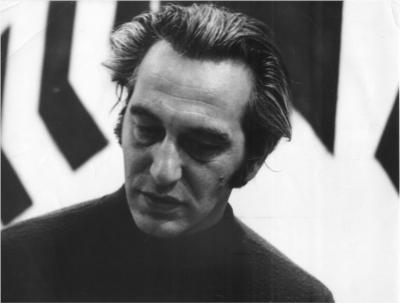
Biography
Born in Buffalo in 1930[1], D'Arcangelo studied history at the University at Buffalo before learning to paint in Mexico City on the GI Bill. Back in New York by the early 1960s, his first solo show came at the Thibaud Gallery in 1963[1], the same year he launched the US 1 series. The work sits at a crossroads of hard-edge abstraction, Precisionism, and Pop, but the subject matter was distinctly topical: the American[1] highway as icon.
His reputation spread quickly. In 1965[1] he appeared in the 11 Pop Artists portfolio alongside Warhol and Rosenquist, and work entered the collections of MoMA, the Guggenheim, the Whitney, and Tate. A 1971 Department of the Interior commission saw him paint the Grand Coulee Dam. In the 1970s he moved towards a more abstract register with his Barriers and Constellation series.
D'Arcangelo also paid a professional price for his convictions. In 1975[1] he resigned from the Marlborough Gallery in protest at its handling of the Rothko estate, a public act of solidarity when the gallery's dominance gave it significant leverage over its artists. He taught at the School of Visual Arts and Brooklyn College for two decades, and continued painting until his death in New York in December 1998[1].
Timeline
- 1930Born in Buffalo, New York
- 1960Studied painting in Mexico City on the GI Bill
- 1963First solo show at the Thibaud Gallery in New York
- 1963Launched the US 1 series
- 1965Appeared in the 11 Pop Artists portfolio
- 1971Commissioned to paint the Grand Coulee Dam
- 1975Resigned from the Marlborough Gallery in protest
- 1998Died in New York
Notable Works
Tap to view larger.
Next stop
Pop Art →
Explore the artists and ideas of Pop Art.
Allan D'Arcangelo prints
Hand-finished archival prints from Allan D'Arcangelo's body of work.
 Bridge Barrier - Allan D'Arcangelo
From £30.00
Bridge Barrier - Allan D'Arcangelo
From £30.00
 April - Allan D'Arcangelo
From £28.00
April - Allan D'Arcangelo
From £28.00
 Untitled (Highway Sign Study) - Allan D'Arcangelo
From £30.00
Untitled (Highway Sign Study) - Allan D'Arcangelo
From £30.00
 Untitled (PRO 75) - Allan D'Arcangelo
From £28.00
Untitled (PRO 75) - Allan D'Arcangelo
From £28.00
 Constellation - Allan D'Arcangelo
From £37.00
Constellation - Allan D'Arcangelo
From £37.00
 Mr. and Mrs. Moby Dick (Allan D'Arcangelo) - Allan D'Arcangelo
From £28.00
Mr. and Mrs. Moby Dick (Allan D'Arcangelo) - Allan D'Arcangelo
From £28.00
Related Artists

_%E2%80%93_LOC.jpg)


Take Allan D'Arcangelo home.
See all Allan D'Arcangelo prints →Frequently Asked Questions
What is Allan D'Arcangelo known for?
Allan D'Arcangelo is known for his paintings of roads, particularly divided highways seen through a car windscreen. His signature images featured flat sign lettering against a pale sky and the dotted centre line receding into the distance. He used this imagery to make statements about American[1] mythology, environmental degradation, and mass culture.What is Allan D'Arcangelo's most famous work?
While it is difficult to identify a single "most famous" work, Allan D'Arcangelo is perhaps best known for his Pop art paintings that incorporate imagery from American[1] highways and advertising. His style often involved simplified, hard-edged forms and a limited colour palette, reflecting the visual language of road signs and billboards. D'Arcangelo's work frequently explores themes of consumer culture, technology, and the American experience. Examples of his notable pieces include his series of highway paintings, such as "Full Moon and Speed of Light" (1964[1]), which captures the stark, graphic quality of roadside views. He also created works that engage with contemporary political and social issues, such as "Life-Span No. 3 (Marilyn Monroe)" (1967), a variable painting using oil and enamel on a photograph and vinyl. D'Arcangelo's artwork often incorporates magnetic elements, allowing for variable configurations and viewer interaction. This approach reflects his interest in the changing nature of perception and the impact of mass media on contemporary life.What should I know about Allan D'Arcangelo's prints?
Allan D'Arcangelo (1930[1]-1998[1]) was an American[1] Pop artist known for his screenprints. He studied at the Carnegie Institute of Technology and later apprenticed at a print shop. D'Arcangelo's prints often feature hard-edged geometric forms and flat planes of colour. These elements create a sense of depth and movement. His work frequently incorporates imagery drawn from American highways, advertising, and Op art. He was interested in how signs and symbols shape perception. His series "Proposition 1" (1963[1]) used the moiré effect, an optical illusion that creates a sense of movement. Other notable prints include his highway series, which depict road signs and landscapes seen from a moving car. These works examine the relationship between technology, perception, and the American landscape. His prints are held in the collections of the Museum of Modern Art, the Whitney Museum of American Art, and other major institutions.What style or movement did Allan D'Arcangelo belong to?
Allan D'Arcangelo is associated with Pop Art[1], a movement that emerged in the 1950s in Britain and then in the United States during the early 1960s. Pop Art took inspiration and motifs from mass consumer society, industrial mass production, advertising, and the media. The art often incorporated images and techniques found in advertising, comic books, and other forms of popular culture. Pop Art reintroduced signs, symbols, metaphors, allusions, illusions, and figural imagery, contrasting with the abstract and reductive works of the post-war avant-garde. Artists like Andy Warhol and Roy Lichtenstein adopted everyday themes, from politics to gossip, transforming them into trivial clichés through simplification, enlargement, and repetition. British Pop Art, with figures such as Richard Hamilton, often adopted a more socially critical approach, caricaturing consumerism and fashion.What techniques or materials did Allan D'Arcangelo use?
Information on Allan D'Arcangelo's specific techniques is scarce; however, we can discuss painting techniques and materials common to the period. Artists often begin by preparing a canvas. This involves stretching the material, priming it with gesso (a white paint mixture), and sometimes sanding for a smooth surface. Oil paint is a common medium; it can be thinned with solvents or combined with mediums like wax and turpentine to alter its consistency and drying time. Various brush types exist, from rounds and flats to filberts, each offering different effects. Palette knives can also apply and manipulate paint, creating textures. Techniques include alla prima (direct painting, finishing in one sitting), impasto (thick application for texture), and scumbling (layering broken colour). Acrylic paint is another option, offering faster drying times. Ultimately, the choice of materials and techniques depends on the artist's desired outcome and personal preferences.What was Allan D'Arcangelo known for?
Allan D'Arcangelo (1930[1]-1998[1]) was an American[1] Pop artist known for his hard-edged paintings. He appropriated imagery from advertising, road signs, and other sources. His work often explored themes of modern life, technology, and the American landscape. D'Arcangelo studied at the Art Academy of Chicago before moving to New York in the late 1950s. There, he encountered the burgeoning Pop Art[1] movement. Early pieces incorporated comic-book elements and references to mass media. In the 1960s, he developed his signature style, characterised by simplified forms, bold colours, and flat planes. His work frequently featured highway signs and symbols, such as those in *Full Moon and Green Light* (1965[1]), reflecting the increasing dominance of car culture. He also drew inspiration from Op Art and geometric abstraction. Later in his career, D'Arcangelo created a series of paintings based on the novels of Thomas Hardy. These works retained his hard-edged style, but explored literary and historical themes. He continued to exhibit his work throughout his life and is regarded as an important figure in the Pop Art movement.When did Allan D'Arcangelo live and work?
Allan D'Arcangelo was born in Buffalo, New York, in 1930[1]. He is associated with the Pop Art[1] movement. D'Arcangelo studied at the School of the Art Institute of Chicago, where he was until 1958[1]. In 1960, D'Arcangelo moved to New York City. He became part of a circle of artists who were reacting against Abstract Expressionism. His work often incorporated imagery from American[1] highways, signs, and popular culture. D'Arcangelo's paintings and prints gained recognition during the 1960s and 1970s. He exhibited widely in the United States and Europe. His work is included in the collections of major museums, including the Museum of Modern Art and the Whitney Museum of American Art in New York. Allan D'Arcangelo died in 1998[1].Where can I see Allan D'Arcangelo's work?
Allan D'Arcangelo's artworks can be viewed in several museums. In the United States, these include the Metropolitan Museum of Art (New York), the Museum of Modern Art (New York), the Los Angeles County Museum of Art, the Minneapolis Institute of Arts, the Virginia Museum of Fine Arts (Richmond), the Charles Hosmer Morse Museum of American[1] Art (Winter Park, Florida), and the Wolfsonian at Florida International University (Miami Beach). In Canada, D'Arcangelo's pieces are held at the Art Gallery of Ontario (Toronto), and the Mackenzie Art Gallery (Regina, Saskatchewan). In the United Kingdom, you can find his work at the Victoria & Albert Museum (London), the Brighton Museum & Art Gallery, the Geffrye Museum (London), the Manchester Art Gallery, and the National Museums of Scotland (Edinburgh).Who did Allan D'Arcangelo influence?
It is difficult to identify specific artists who were directly influenced by Allan D'Arcangelo. The available texts do not discuss D'Arcangelo's direct influence on other artists. However, they do discuss the influence of some of his contemporaries and the artistic movements with which he was associated. For example, the painter David Smith influenced Anthony Caro. Caro, in turn, taught at Bennington College in Vermont from 1963[1] to 1965; during that time, Smith's Cubi XXIII of 1964-65 may have been influenced by Caro. Frank O'Hara valued William Carlos Williams's poetry. O'Hara, Leroi Jones (Amiri Baraka), James Schuyler, and Kenneth Koch all reference each other in their statements. Robert Rauschenberg combined Jackson Pollock's drip technique with the grid of Analytic Cubism.Who influenced Allan D'Arcangelo?
Allan D'Arcangelo (1930[1]-1998[1]) was an American[1] Pop artist whose work engaged with themes of technology, progress, and contemporary American life. Several artists and movements affected his artistic development. Early in his career, D'Arcangelo was influenced by Abstract Expressionism. He then moved towards a style that incorporated elements of hard-edge painting and Pop art. His mature works often combined flat planes of colour with simplified, silhouetted images, creating a distinctive and recognisable style. The artist himself cited influences such as billboards and road signs. These everyday objects informed his compositions and his interest in the visual language of modern America. The clean lines and bold colours of commercial design are apparent in his prints and paintings. D'Arcangelo’s work also shows an engagement with the art of the past. He admired early Italian Renaissance painters such as Paolo Uccello. The influence of these artists can be seen in D'Arcangelo’s use of perspective and geometric forms. His work offers a commentary on modern society, filtered through the lens of art history and popular culture.Who was Allan D'Arcangelo?
Allan D'Arcangelo (1930[1]-1998[1]) was an American[1] Pop artist. He is best known for his screenprints and paintings. His work often combined hard-edged abstraction with elements of American iconography. Born in Buffalo, New York, D'Arcangelo studied at the Art Academy of Chicago. He then travelled extensively in Europe. Early influences included Italian Renaissance art, especially the work of Piero della Francesca. D'Arcangelo's mature style emerged in the early 1960s. He began incorporating highway signs and roadside imagery into his compositions. These works often featured simplified forms and flat areas of colour. Examples include his series of "Highway U.S. 1" paintings. These works explored themes of movement, distance, and the American landscape. Throughout his career, D'Arcangelo experimented with different media. He produced prints, paintings, and sculpture. He had solo exhibitions at the Fischbach Gallery, New York, and at other galleries internationally. His work is held in the collections of the Museum of Modern Art, the Whitney Museum of American Art, and other major institutions.Why are Allan D'Arcangelo's works important today?
Allan D'Arcangelo (1930[1]-1998[1]) is remembered for his Pop art paintings and prints. He combined elements of hard-edge abstraction with imagery drawn from the American[1] roadside. D'Arcangelo's early work in the 1960s engaged with contemporary issues. For example, his series *Kennedy and King* (1964[1]) addressed political assassination. Other paintings, such as *Madonna and Child* (1963), appropriated religious iconography. His work often featured a flattened perspective. This was combined with simplified forms and bold colours. Later, D'Arcangelo moved away from overt social commentary. He explored themes of space and technology. His *Landscape Screens* series (1966-1968[1]) used highway imagery. These works evoke a sense of movement and speed. They also reflect the changing American environment. D'Arcangelo's distinctive style blends Pop art with elements of Minimalism. His prints and paintings offer a commentary on American culture during the Cold War era. His work is held in major museum collections. These include the Museum of Modern Art and the Whitney Museum of American Art in New York.
Sources
Editorial draws on the following primary and tertiary references for Allan D'Arcangelo.
- [1] wikipedia Wikipedia: Allan D'Arcangelo Used for: biography, birth dates, death dates, identifiers, movement attribution, nationality.
- [2] book guggenheim-handboo00pegg Used for: biography.
- [3] book guggenheim-jimdinew00dine Used for: biography.
- [4] book guggenheim-moder00artg Used for: biography.
Editorial overseen by Solis Prints. Sources verified 2026-09-30. Click a source for details, or hover over [N] in the page above to preview.
Editorial standardsMethodologyCorrectionsAI disclosureAbout the editorial team