



Bartolomeo Veneto
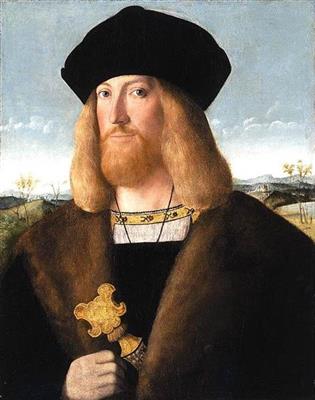
- portrait
On his earliest known work, a Madonna and Child of 1502[1], Bartolomeo Veneto described himself as "mezo venizian e mezo cremonexe": half Venetian, half Cremonese. It is one of the few autobiographical statements in the documentary record of his career, and only partly satisfying, since scholars have never fully resolved where he was born, where he trained, or, with certainty, when he died.
Biography
The training question has one solid pointer. A manuscript inventory records an inscription on a 1509[1] panel in which the artist names "Ze... Be..." as his master, generally identified as Gentile Bellini. The influence of the belliniani runs clearly through his early religious works, and his use of the trompe l'oeil cartellino, the illusionistic slip of paper bearing a signature, descends directly from Mantegna and the Bellini circle. By 1505, when he signed a Madonna now in Bergamo's Accademia Carrara, he was probably already away from Venice.
His portraits are where his reputation rests. Documented in Ferrara in 1505[1]-08 and possibly in Padua around 1510-12, he was active in or near Milan by the 1520s, where Leonardesque influence enters his work sharply. The Girl with a Lute of 1520 (Brera, Milan) is the clearest expression of that influence and was widely copied in its own time. His male portraits show elegantly dressed young men against bold colour contrasts, typically vivid red against sky blue, with meticulous attention to surface detail and a strong directional light.
The last firmly dated work is the Portrait of Ludovico Martinengo (National Gallery, London), inscribed 1530[1]. He is generally thought to have died in Turin in 1531.
Timeline
- 1480Born; birthplace uncertain, possibly Venice or Cremona.
- 1502Created a "Madonna and Child", describing himself as "mezo venizian e mezo cremonexe".
- 1505Signed a Madonna, now in Bergamo's Accademia Carrara; he was likely away from Venice by this time.
- 1505Documented in Ferrara; his presence there lasted until 1508.
- 1509A panel inscription names 'Ze... Be...' as his master, generally identified as Gentile Bellini.
- 1520Painted "Girl with a Lute" (Brera, Milan), showing Leonardesque influence.
- 1530Painted "Portrait of Ludovico Martinengo" (National Gallery, London).
- 1530Died, possibly in Turin, at approximately 50 years old.
Notable Works
Tap to view larger.
Next stop
Browse the movements →
Every movement in the collection, from the Renaissance to Pop art.
Related Artists
Frequently Asked Questions
What is Bartolomeo Veneto known for?
Bartolomeo Veneto is known for his portraits. He was documented in Ferrara from 1505[1]-08, possibly in Padua around 1510-12, and active near Milan by the 1520s.What is Bartolomeo Veneto's most famous work?
It is difficult to name Bartolomeo Veneto's single most famous work, as his body of work is not extensive and lacks firm attribution. He is best known for his portraits of fashionable women, often identified by art historians through inscriptions and symbolic details. Examples of works attributed to him include *Portrait of a Lady* in the National Gallery, London; *Flora* in the Städel Museum, Frankfurt; and *Portrait of a Lady as Saint Catherine* in the Indianapolis Museum of Art. These paintings display his skill in rendering textures and surfaces, particularly the luxurious fabrics and jewels worn by his sitters. He also produced religious paintings, such as *Virgin and Child*, but these are less well known. His style blends influences from Venetian and Lombard painting, reflecting the artistic currents of his time.What should I know about Bartolomeo Veneto's prints?
Bartolomeo Veneto is known for his paintings, but information about his prints is scarce. He was active during the early 16th century. He may have been born in Cremona and trained in Venice; his signature on a Madonna and Child (1502[1]) describes him as "mezo venizian e mezo cremonexe". His early religious works resemble those of Giovanni Bellini. Later, he painted portraits of fashionable men and allegorical portraits of women. These paintings use dramatic light and colour, objective detail, and focus on the subjects' presence. Scholars suggest that Bartolomeo may have worked in Milan around 1520, due to Leonardesque elements in his paintings. Some believe he was in Ferrara between 1505 and 1508, and that he died in Turin in 1531, but these identifications are not universally accepted. His portrait[1] style shows a northern European influence, possibly from contact between Dürer and Venetian painters like Jacopo de’ Barbari.What style or movement did Bartolomeo Veneto belong to?
Bartolomeo Veneto's artistic affiliations are complex, with elements of Venetian, North European, and Lombard styles. His early works, such as the 1502[1] *Madonna and Child*, show the influence of Giovanni Bellini, suggesting he trained in Venice. Some scholars believe he may have been a pupil of Gentile Bellini. The presence of the surname "Venetus" in his 1505 signature suggests he may have left Venice around that time. Later, Leonardesque elements appear in his portraits, leading scholars to believe he worked in or near Milan, possibly from around 1520. These portraits display an intense use of light, objective clarity in detail, and a focus on the subject's presence. The style shows a general affinity with that of Northern Europe, possibly through the influence of Dürer and Jacopo de’ Barbari. Some scholars suggest influences from Padua, Mantua, and Ferrara, during the early 16th century. He is not mentioned by Vasari or Ridolfi.What techniques or materials did Bartolomeo Veneto use?
Bartolomeo Veneto was an Italian painter who worked during the early 16th century. Technical analysis of his paintings has revealed information about his methods. Veneto primed his panels with a layer of gesso, a common practice at the time. He then applied an imprimatura, a thin tinted layer, on top of the gesso. This toned ground would have provided a smooth and slightly coloured surface on which to paint. Infrared reflectography has revealed underdrawing in some of his works, suggesting a careful planning stage. He employed oil paints, applying them in thin layers to build up colour and form. Veneto was skilled at creating realistic textures and details, particularly in fabrics and jewellery. He often used glazes, transparent layers of paint, to add depth and luminosity to his colours. His attention to detail and careful application of paint resulted in highly polished and refined surfaces. Some scholars suggest he may have been a pupil of Gentile Bellini, which could explain the influence of the Venetian style in his work.What was Bartolomeo Veneto known for?
Bartolomeo Veneto was a painter active in Venice and the Veneto region of northern Italy during the first three decades of the 16th century. He is best known for his portraits, particularly those of women. Veneto's style is characterised by its attention to detail and realistic representation of his subjects. He often depicted his sitters in elaborate clothing and jewellery, demonstrating his skill in rendering textures and surfaces. His work shows the influence of several artists, including Giovanni Bellini, Leonardo da Vinci, and Albrecht Dürer. This makes Veneto an interesting example of the artistic exchange that occurred in the Veneto. Despite his artistic talent, little is known about Veneto's life. His biography has been reconstructed primarily from his signed and dated works, as well as from a few documentary sources. These sources suggest he travelled and worked in various cities, including Venice, Ferrara, and Milan. He is not mentioned in Giorgio Vasari's *Lives of the Artists*. He is, however, discussed in Marcantonio Michiel's *Notizia d'opere di disegno*, a collection of notes on artworks in private collections.When did Bartolomeo Veneto live and work?
Bartolomeo Veneto was an Italian painter who was active in the first half of the 16th century. Documentation places him in Venice around 1502[1]-06, and then active in Ferrara by 1508. His career is divided into two stylistic phases. The first phase, to about 1512, shows the influence of Giovanni Bellini, Giorgione, and especially Albrecht Dürer. He is known for portraits of aristocratic women, often identified by name in inscriptions. Examples include the Portrait of a Lady as Flora in the Städel Museum, Frankfurt, and the Portrait of a Lady in the Galleria Nazionale, Rome. These early works often feature half-length figures set against dark backgrounds. After a period of roughly ten years, his documented activity resumes around 1520. His style changes, incorporating influences from Lorenzo Lotto and other Lombard painters. This later work is characterised by softer modelling and a more decorative approach. He continued to produce portraits, as well as some religious paintings. His whereabouts after the late 1530s are not known.Where can I see Bartolomeo Veneto's work?
Bartolomeo Veneto's paintings are held in several European and North American public collections. In Italy, examples of his work can be found at the Accademia Carrara (Bergamo), the Pinacoteca di Brera (Milan), the Uffizi Gallery (Florence), and the Galleria Borghese (Rome). Other European museums with works by Bartolomeo Veneto include the Louvre (Paris), the Bayerische Staatsgemäldesammlungen (Munich), the Städel Museum (Frankfurt), and the National Gallery (London). In the United States, you can view his paintings at the Metropolitan Museum of Art (New York), the Philadelphia Museum of Art, and the National Gallery of Art (Washington, D.C.). These collections offer opportunities to study Bartolomeo Veneto's portraits and allegorical subjects. His relatively small output means that seeing these works in person provides valuable insight into his artistic style and technique.Where was Bartolomeo Veneto from?
Bartolomeo Veneto's origins are somewhat unclear. Details of his early life and training remain uncertain. He was active in Venice and other parts of northern Italy during the first three decades of the 16th century. Some scholars suggest he may have been born in Venice itself, while others propose that he came from the Veneto region, the mainland territory controlled by Venice. This would account for his adopted name and artistic style. There is also speculation that he might have been related to another artist from the Veneto, perhaps a father or uncle, which could explain his early exposure to painting techniques. Records show he worked in various cities, including Ferrara and Milan, indicating a career that involved travel and collaboration. His geographical mobility makes pinpointing a precise place of birth difficult. Documents from the period offer little conclusive evidence, so art historians continue to debate his exact origins, relying on stylistic analysis and circumstantial clues to piece together his biography.Who did Bartolomeo Veneto influence?
Bartolomeo Veneto's artistic impact is somewhat difficult to trace with certainty. While he was a skilled portraitist, his style appears to have been more of a synthesis of existing trends than a source of innovation. His influences included the work of Giovanni Bellini, Leonardo da Vinci, and Albrecht Dürer. Veneto seems to have absorbed elements from each of these masters, blending them into his own distinctive approach to portraiture. He borrowed Bellini's use of colour, Leonardo's sfumato technique (subtle gradations of light and shadow), and Dürer's attention to detail. It is difficult to identify specific artists who were directly influenced by Bartolomeo Veneto. His career was relatively short, and he did not establish a workshop or school of followers. Some scholars have suggested possible connections with later Lombard painters, but these connections remain speculative. Veneto's importance lies primarily in his own artistic output, rather than in his role as a teacher or trendsetter. His portraits offer a fascinating glimpse into the appearance and fashion of his time.Who was Bartolomeo Veneto?
Details of Bartolomeo Veneto's life are scarce. He was active as a painter during the early 16th century. The exact origins of Bartolomeo are not definitively known, but his painting style suggests he trained in Venice. Some scholars propose he may have been linked to the Venetian artistic circles around Giovanni Bellini. Others suggest a connection to the Ferrarese School, based on stylistic similarities in his works. His known output consists mainly of portraits, often of women. These paintings display a meticulous attention to detail, particularly in the rendering of costumes and jewellery. He had an ability to capture the textures of fabrics and the reflective qualities of precious stones. Bartolomeo’s artistic style blends Venetian and Northern Italian influences. He combined the colourism of Venetian painting with a certain linear precision seen in the works of artists from Ferrara and other northern regions. This fusion gives his portraits a distinctive character.Why are Bartolomeo Veneto's works important today?
Venetian painting underwent a transformation from the death of Giorgione in 1510[1] to that of Tintoretto in 1594. This change affected style, subject, and meaning, and it influenced every school of European art. Venetian Renaissance painters provided a base for the artists of Baroque Rome. Throughout the seventeenth century, Venetian art inspired Caravaggio, the Carracci family, and other artists in Rome. Painters outside of Italy, such as Rubens, Van Dyck, Rembrandt, and Velázquez, derived pictorial style and subject interpretation from Venetian paintings. These were considered high points in art history. Admiration for Venetian artists continued into the eighteenth century. French painters of mythological scenes and portraits, including Boucher, Watteau, and Fragonard, reflected Venetian influence. European artists travelled to Italy to study Venetian works, often knowing them through engravings and copies. Venetian form, technique, and colour entered nineteenth-century European painting, influencing Goya, Turner, and the Impressionists. By the sixteenth century, Venice had developed a distinct manner of painting. The next generation built on this, making the city's art important in Italy and Europe.
Sources
Editorial draws on the following primary and tertiary references for Bartolomeo Veneto.
- [1] wikipedia Wikipedia: Bartolomeo Veneto Used for: biography, birth dates, death dates, identifiers, movement attribution, nationality.
- [2] book Beard, Lee, 1973- author, Butler, Adam, author; Van Cleave, Claire, author; Fortenberry, Diane, author; Stirling, Susan, author, Beard, Lee, 1973- author, Butler, Adam, author; Van Cleave, Claire, author; Fortenberry, Diane, author; Stirling, Susan, author - The Art Book_ New Edition, Mini Format Used for: biography.
- [3] book Jennifer D. Milam, Historical Dictionary of Rococo Art Used for: stylistic analysis.
- [4] book Museum of Fine Arts, Houston, Italian paintings XIV-XVI centuries in the Museum of Fine Arts, Houston Used for: biography.
- [5] book Norma Broude, The Expanding Discourse Used for: biography.
- [6] book Cole, Bruce; , Titian and Venetian Painting, 1450-1590 Used for: biography, stylistic analysis.
- [7] book Cole, Bruce, Titian and Venetian painting _ 1450-1590 Used for: biography.
- [8] book Titian, Susanna Biadene, Mary Yakush, Italy) Palazzo Ducale (Venice, National Gallery of Art (U. S.), Terisio Pignatti, Titian, Prince of Painters _ [Palazzo Ducale, Venice, 2 June - 7 October 1990 ; National Gallery of Art, Washington, 28 Octo Used for: biography.
Editorial overseen by Solis Prints. Sources verified 2026-09-19. Click a source for details, or hover over [N] in the page above to preview.
Editorial standardsMethodologyCorrectionsAI disclosureAbout the editorial team