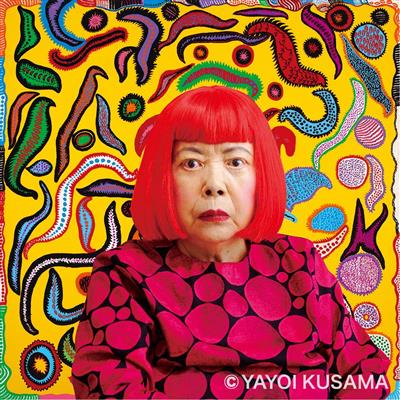
About Yayoi Kusama
Japanese · 1929–present · Contemporary, Minimalism, Pop Art
infinity rooms, polka dots and a voluntary psychiatric hospital for nearly five decades, while becoming one of the world's most visited living artists
Read full biography →Yayoi Kusama's works are held in 9 museums worldwide, including Museum Boijmans Van Beuningen, Los Angeles County Museum of Art, and National Gallery of Art.
🇫🇷 France
1 museum
- 1 works
Centre national des arts plastiques
Paris, France
🇳🇱 Netherlands
2 museums
- 2 works
Museum Boijmans Van Beuningen
Museum Boijmans Van Beuningen - Robbrecht & Daem wing, Netherlands
Main building closed for renovation until 2029; Depot open Tue–Sun 11:00–17:00Depot €20 adultsEendrachtsplein (Tram 7, 8)Confirm on museum website before visiting. - 1 works
Centraal Museum
Utrecht, Netherlands
Tue–Sun 11:00–17:00; closed Mon€15 adultsUtrecht Centraal (Bus 1, 2 (no metro))Confirm on museum website before visiting.
🇺🇸 United States
6 museums
- 2 works
Los Angeles County Museum of Art
Los Angeles, United States
- 2 works
National Gallery of Art
Washington, D.C., United States
Mon–Sat 10:00–17:00, Sun 11:00–18:00FreeArchives – Navy Memorial (Green & Yellow)Confirm on museum website before visiting. - 1 works
Princeton Art Museum
Princeton, United States
- 1 works
Museum of Modern Art
Midtown Manhattan, United States
Daily 10:30–17:30 (Sat until 19:00; first Fri of month until 20:00)Adults $30, students $17Fifth Av / 53 St (E, M)Confirm on museum website before visiting. - 1 works
Minneapolis Institute of Art
Minneapolis, United States
- 1 works
Art Institute of Chicago
Chicago, United States
Frequently Asked Questions
Where can I see Yayoi Kusama's work?
Yayoi Kusama's work can be viewed in many locations worldwide. In the United States, major museums holding her pieces include the Metropolitan Museum of Art, the Museum of Modern Art (MoMA), and the Solomon R. Guggenheim Museum, all in New York City. Other American museums include the Art Institute of Chicago, the National Gallery of Art in Washington DC, the Los Angeles County Museum of Art (LACMA), the Minneapolis Institute of Arts, the Pennsylvania Academy of the Fine Arts (Philadelphia), and the Carnegie Museum of Art (Pittsburgh). In Europe, Kusama's art can be seen at the Musée National d'Art Moderne, Centre Georges Pompidou (Paris), the Graphische Sammlung Albertina (Vienna), the Kunstmuseum (Bern and Lucerne), the Louisiana Museum of Modern Art (Humlebaek, Denmark), the Moderna Museet (Malmö and Stockholm), and the Museum am Ostwall (Dortmund). In the UK, visit the Museum of Modern Art (Oxford), the Tate Modern (London), the Victoria & Albert Museum (London), the Manchester Art Gallery, and the National Museums of Scotland (Edinburgh).Where did Yayoi Kusama live?
Yayoi Kusama moved to New York in 1958[2]. She returned to Japan in 1973 and has worked from the hospital and her nearby studio ever since.What should I know about Yayoi Kusama's prints?
Yayoi Kusama's prints, like those of many artists, exist as limited editions. The artist decides the size of the edition, and this is not dictated by technical limitations of the printmaking process itself. Each print in an edition does not have to be produced in a single session. Instead, the edition is defined by a written claim, typically in pencil, at the foot of the print. These claims follow informal conventions used by printmakers. Though not legally binding, these conventions are widely respected. Claims and descriptions are subject to the Trade Descriptions Act 1968[2] Section 2, which requires truthful descriptions of the artwork. A printmaker typically marks each print with a fraction (print number over edition number), the print's title in the centre, and their signature on the right. All edition descriptions are signed in pencil.Why are Yayoi Kusama's works important today?
Yayoi Kusama, born in Matsumoto, Japan, in 1929[2], is known for her installations and sculptures using dots and pumpkins. These motifs derive from hallucinations she has experienced since childhood; she calls the dots ‘infinity nets’. Kusama studied Nihonga painting before moving to New York in the late 1950s. There, she associated with artists such as Andy Warhol, Donald Judd, and Claes Oldenburg. She experimented with sculpture and installation, exploring her identity as a female Japanese[2] artist in a Western, male-dominated world. Kusama gained attention for happenings where naked people were painted with polka dots. After returning to Japan in 1973[2], Kusama continued working in various media, including film, fashion, and literature. Her work often expresses childhood memories and ideas about floating and enclosure, using mirrors and lights to evoke hallucinations. Kusama’s installations often encourage audience participation, allowing viewers to immerse themselves in her experiences. One such installation, *Peep Show/Endless Love Show* (1966), is a hexagonal mirrored room with coloured lights, creating a sense of infinite space. Kusama’s art explores themes of cosmic infinity and obsessive excess. In 2016, *Time* magazine named her one of the world’s 100 most influential people. That same year, she received the Order of Culture from the Japanese Imperial Family. The Yayoi Kusama Museum opened in Tokyo in 2017 to promote her art.Is Yayoi Kusama still making art?
Yayoi Kusama makes a lot of different types of art. Her spotted creations include paintings, sculptures, performances, and installations.How did Yayoi Kusama became famous?
Yayoi Kusama became part of the avant-garde in New York. She staged naked happenings, created infinity net paintings, and produced immersive mirrored environments.What techniques or materials did Yayoi Kusama use?
Yayoi Kusama's artistic practice involves diverse materials and techniques. In 1957[2], she created her first "achromes" using cloth soaked in kaolin and glue. By 1959, she was using sewing-machine seams for the "achromes". The next year, she experimented with cotton-wool and expanded polystyrene, as well as phosphorescent materials and cobalt chloride, which changed colour over time. In 1961, Kusama worked with straw and plastic, creating white paintings with balls made of cotton-wool or fur, and clouds of natural or artificial fibres. She also produced a sculpture using rabbit skin. In 1959, Kusama prepared "air bodies" (pneumatic sculptures), and in 1960, she realised a sculpture in space: a suspended sphere supported by an air jet. She also created bodies of pure light, spheroids held up by an air jet. Around the same time, she produced her first lines, eventually creating one measuring 7200 metres in 1960 in Herning, Denmark. Kusama also worked with unconventional materials, such as hard-boiled eggs, which she signed with her finger-prints at conventions in Copenhagen and Milan in 1960.Who did Yayoi Kusama influence?
Yayoi Kusama moved to the United States in the late 1950s, after writing to Georgia O'Keeffe. In New York, Kusama socialised with artists including Andy Warhol, Eva Hesse, Donald Judd, Joseph Cornell, and Claes Oldenburg. Kusama's work has been suggested as influencing artists such as Eliasson, Graham, Gursky, Riley, and Vasarely. Kusama was born in Matsumoto, Japan, in 1929[2]. As a child, she experienced hallucinations that she said inspired her signature use of polka dots. Kusama studied Nihonga painting in Kyoto. She began experimenting with sculpture and installation, exploring her identity as a female and Japanese[2] artist in a male-dominated Western art world. Kusama gained public attention for her 'happenings', in which naked people were painted with brightly coloured polka dots. Since the early 1970s, she has been a voluntary patient in a mental hospital in Japan. She continues to create art and write, and in 2017[2], she opened a museum of her work in Tokyo.
Sources
Where to See guide aggregates verified holdings of Yayoi Kusama's works across the following collections.
- [1] academic The Editors of Encyclopaedia Britannica, Grand Orgy to Awaken the Dead | art by Kusama Used for: notable works.
- [2] wikipedia Wikipedia: Yayoi Kusama Used for: biography.
- [3] academic The Editors of Encyclopaedia Britannica, Yayoi Kusama | Biography, Art, Infinity Mirrored Room, Pumpkin, & Facts Used for: biography.
- [4] academic Yayoi Kusama - Smarthistory Used for: biography.
- [5] book Susie Hodge, Artistic Circles Used for: biography, stylistic analysis.
- [6] book Dorling Kindersley, Artists: Inspiring Stories of the World's Most Creative Minds Used for: biography.
- [7] museum An Introduction to Yayoi Kusama Used for: biography.
- [8] museum Yayoi Kusama. Accumulation. 1962 Used for: museum holdings.
Editorial overseen by Solis Prints. Sources verified 2026-05-30. Click a source for details, or hover over [N] in the page above to preview.
Editorial standardsMethodologyCorrectionsAI disclosureAbout the editorial teamCitation ledger