



Yayoi Kusama
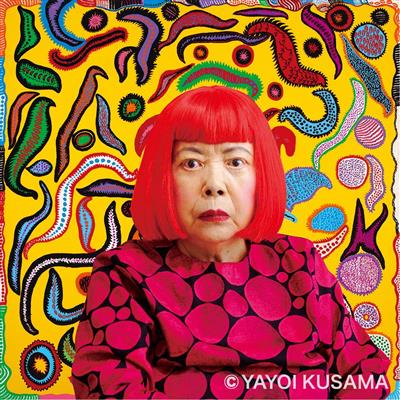
Yayoi Kusama used repetition to change how a surface or a space could be seen. Her Infinity Net paintings developed a field of small loops; her mirrored rooms extended repeated forms around the visitor. The pumpkins and polka dots belong to a career that also challenged the ordinary uses of objects and public space.
Biography
From Matsumoto to New York
Yayoi Kusama was born in Matsumoto, Japan, in 1929. Her early work included paintings on paper, before the large canvases associated with her New York years. She went to the United States in 1957 and settled in New York in 1958. The distinction matters: her move abroad and her arrival in the city were separate events.
In Waves, dated 1953 by the image source, white openings interrupt a red band and the blue field around it. The marks vary in size and direction. It offers an early way to see how repeated shapes could organise an entire surface. The pattern takes priority over a conventional view of a landscape. That concern continued as her work expanded in scale.
David Zwirner artist biography
Artwork images © Yayoi Kusama, via WikiArt
Infinity Nets and the spaces between the dots
An Infinity Net is built from repeated painted loops. The small spaces they enclose can read as dots, although the painter has worked around them. Victoria Miro describes the net as a lattice whose negative spaces form the dot pattern. This gives the viewer something precise to look for: the relationship between a painted line and the ground showing through it.
The close red tones of Infinity Net, dated 1998 by WikiArt, make the pattern less immediately obvious than the dots on a pumpkin. Some marks catch the light while others recede. Looking slowly reveals an uneven surface, rather than a mechanical grid. Repetition does not remove the differences between individual marks.
Kusama connected these recurring patterns with visual experiences she had described since childhood. Her account is part of the history of the work. The paintings also reward attention to what is physically there: closely packed loops extending towards the edges of the canvas.

Victoria Miro artist biography
Artwork images © Yayoi Kusama, via WikiArt
Accumulation: when repetition becomes sculpture
Accumulation No. 1, made in 1962 and held by MoMA, covers an armchair with hand-sewn, stuffed forms. Kusama painted the forms and called them phalluses. The chair remains recognisable, but its surface has become difficult to imagine using. An ordinary piece of furniture becomes a sculpture through the repeated addition of soft material.
MoMA records sewn stuffed fabric, paint and chair fringe as its materials. That account helps distinguish the work from a carved or cast object. Each protrusion had to be made and attached. The labour of repeating a form, already visible in the paintings, now occupied the space around a household object.
How the Infinity Mirror Rooms work
Infinity Mirror Room: Phalli’s Field first appeared in 1965. Mirrors multiplied the view of soft, spotted forms across the floor. The Hirshhorn explains how mirrors let Kusama extend the repetition of her Accumulation sculptures beyond the number of objects she could physically make. Reflection became a working method.
A room has a finite size, even when its reflections appear to continue without a visible end. The visitor’s body also enters that repeated image. Moving changes the relationship between the real objects and their reflections, which is why a photograph gives only one view of an installation.
Later rooms use different materials and lighting. The Broad’s Infinity Mirrored Room: The Souls of Millions of Light Years Away, dated 2013, includes LEDs, acrylic balls and water alongside mirrors. Its illuminated space should not be treated as the same work as the spotted field of 1965. The shared method produces distinct environments.
Hirshhorn: Infinity Mirror Rooms
The Broad: The Souls of Millions of Light Years Away
Historical Phalli’s Field photograph © Eiko Hosoe; artwork © Yayoi Kusama, via WikiArt
Why pumpkins recur in Kusama’s work
The pumpkin was a familiar plant from Kusama’s childhood surroundings. Victoria Miro connects the motif to her family’s cultivation of seeds and records her description of pumpkin images as a form of self-portraiture. The subject returned across paintings and sculptures, including installations made with mirrors.
In Yellow Pumpkin, dated 1992 by WikiArt, rows of dots follow the ridges of the yellow form. The varying size of those dots helps describe its rounded volume. Behind it, a dense net pattern covers the dark ground. Looking at both patterns shows how the same vocabulary can describe a solid object and a surrounding field.
The banner also includes Pumpkin, dated 1983 by the image source, as a view of a three-dimensional object. Its projecting stem and irregular surface provide a useful comparison with the frontal image of Yellow Pumpkin. The motif changes with the medium.

Victoria Miro artist biography
Artwork images © Yayoi Kusama, via WikiArt
Narcissus Garden and the reflected viewer
Kusama presented Narcissus Garden as an unofficial installation and performance at the Venice Biennale in 1966. MoMA PS1 describes silver spheres made from plastic arranged on the lawn outside the Italian Pavilion. Kusama offered individual spheres for sale. Her participation in this event was different from officially representing Japan at the Biennale, which she did in 1993.
Later versions use mirrored stainless steel spheres. The 2018 MoMA PS1 presentation placed 1,500 of them inside a former train garage at Fort Tilden. Each sphere reflected a small, distorted view of the building. The work uses reflections in the space around the viewer, instead of enclosing the viewer within a mirrored room.
David Zwirner artist biography
Flowers, mushrooms and later paintings
Kusama’s repeated patterns also surround recognisable plants and animals. Flowers, dated 1983 by WikiArt, places a green vase against a dark net-covered ground. In Dandelions, 1985, jagged leaves carry their own dot pattern. Butterfly, 1988, sets spotted wings against a red mesh. Each image gives the figure and the surrounding space a different pattern to carry.
Mushrooms, dated 1995 by the image source, makes that contrast particularly clear. The caps have several kinds of spots, while their stems carry smaller repeated marks. A pink net fills the background. Ready to Blossom in the Morning, 1989, uses dots behind the large flower heads; Waves on the Hudson River, 1988, instead arranges curling bands across the surface. These images show why the dots alone are an incomplete account of her painting.
Her later My Eternal Soul paintings, begun in 2009, developed recurring faces and eyes within densely patterned compositions. The smaller Every Day I Pray for Love paintings continued her investigation of line and form. She returned to Japan in 1973 and continued making art there. Her official studio announcement records that she painted until her final days, before her death in Tokyo on 14 August 2026, aged 97.
The existing sculpture image on this page is The Statue of Venus Obliterated by Infinity Nets, as identified by its photograph source. Dots cover a familiar classical figure and the rectangular surface behind it. The photograph is not an image of a stand-alone Infinity Net painting; its title has been corrected here. The photograph is credited to Mofei Wu under CC BY-SA 4.0, separately from the underlying artwork.

Victoria Miro artist biography
Official announcement, 27 August 2026
Artwork images © Yayoi Kusama, via WikiArt
Venus photograph by Mofei Wu, CC BY-SA 4.0; artwork © Yayoi Kusama
Photograph licence: CC BY-SA 4.0
Museum collections and planning a visit
MoMA in New York holds Accumulation No. 1. The Broad in Los Angeles holds The Souls of Millions of Light Years Away. The Hirshhorn in Washington, DC, documents the development of the mirror rooms and holds a later refabrication of Phalli’s Field. These collections offer different routes into Kusama’s work, from a single transformed chair to an environment visitors can enter.
The Yayoi Kusama Museum opened in Tokyo in 2017. Check the museum’s current exhibition and booking information before travelling. A collection holding does not guarantee that a particular work is on display, and a museum visit may require a separate reservation for a mirror room.
The Broad: The Souls of Millions of Light Years Away
Timeline
- 1929Born in Matsumoto, Japan
- 1957Moved to the United States; settled in New York in 1958
- 1965Created Infinity Mirror Room: Phalli’s Field
- 1966Presented Narcissus Garden as an unofficial Venice Biennale installation and performance
- 1973Returned to Japan
- 1993Officially represented Japan at the Venice Biennale
- 2017Yayoi Kusama Museum opened in Tokyo
- 2026Died in Tokyo on 14 August, aged 97
Notable Works
Tap to view larger.
Next stop
Contemporary →
Explore the artists and ideas of Contemporary.
Yayoi Kusama prints
Hand-finished archival prints from Yayoi Kusama's body of work.


Related Artists
_%E2%80%93_LOC.jpg)




Take Yayoi Kusama home.
See all Yayoi Kusama prints →Frequently Asked Questions
How do Kusama’s mirror rooms create infinity?
Mirrors repeat the appearance of a finite set of objects or lights. In Phalli’s Field, reflection multiplied the view of sewn, spotted forms. Later rooms use different materials and lighting to create distinct environments.Is Yayoi Kusama still alive?
No. Yayoi Kusama died in Tokyo on 14 August 2026, aged 97. Her official studio announced her death on 27 August 2026 and recorded that she continued painting until her final days.Was Kusama’s Narcissus Garden an official Venice Biennale entry?
Her 1966 Narcissus Garden was an unofficial installation and performance. Kusama later officially represented Japan at the Venice Biennale in 1993. These were different events.What are Kusama’s Infinity Nets?
Infinity Nets are paintings built from repeated loops. Small openings between the painted lines can appear as dots. Close looking reveals variations in the marks across the surface.What is Yayoi Kusama best known for?
Kusama is best known for Infinity Net paintings and mirrored installations. Her polka dots and pumpkins are recurring motifs across different media, rather than separate styles.Which US museums hold Yayoi Kusama’s work?
MoMA in New York holds Accumulation No. 1. The Broad in Los Angeles holds The Souls of Millions of Light Years Away. The Hirshhorn in Washington, DC, holds a refabrication of Phalli’s Field. Check current display and booking information before visiting.Why did Yayoi Kusama use pumpkins?
Pumpkins were familiar from her childhood surroundings. Victoria Miro connects the motif to her family’s cultivation of seeds and records Kusama’s description of pumpkin images as a form of self-portraiture.Where did Yayoi Kusama live and work?
Kusama was born in Matsumoto, Japan. She moved to the United States in 1957 and settled in New York in 1958, before returning to Japan in 1973. Her later studio practice was based in Tokyo.
Sources
Editorial draws on the following primary and tertiary references for Yayoi Kusama.
- [1] other Yayoi Kusama official biography Used for: biography, birth dates, nationality.
- [2] other Official announcement: death of Yayoi Kusama Used for: biography, death dates.
- [3] curated_kb Victoria Miro: Yayoi Kusama Used for: movement attribution, notable works, stylistic analysis, technique.
- [4] museum MoMA: Accumulation No. 1 Used for: museum holdings, notable works, technique.
- [5] museum Hirshhorn: Infinity Mirror Rooms Used for: notable works, technique.
- [6] museum MoMA PS1: Narcissus Garden Used for: exhibition history, notable works, technique.
- [7] museum The Broad: The Souls of Millions of Light Years Away Used for: museum holdings, notable works, technique.
- [8] curated_kb David Zwirner: Yayoi Kusama Used for: biography, exhibition history.
- [9] museum Smithsonian: Phalli’s Field collection record Used for: museum holdings, notable works.
- [10] curated_kb Getty ULAN: Kusama, Yayoi, 500122518 Used for: birth dates, death dates.
- [11] wikidata Wikidata: Yayoi Kusama, Q231121 Used for: birth dates, death dates.
Editorial overseen by Solis Prints. Sources verified 2026-10-11. Click a source for details, or hover over [N] in the page above to preview.
Editorial standardsMethodologyCorrectionsAI disclosureAbout the editorial team