

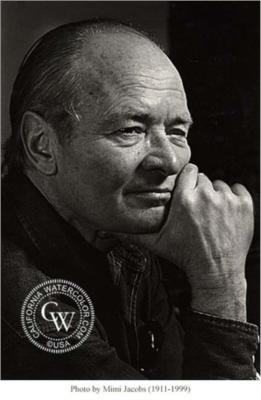
About Elmer Bischoff
A founder of the Bay Area Figurative Movement who left Abstract Expressionism[1] in the early 1950s in search of a more honest, perceptual language.
Where to see Elmer Bischoff
Collection holdings are reported here; current display varies. Check with each museum before visiting.
-
3 recorded works
Fine Arts Museums of San Francisco
San Francisco, United States
-
1 recorded work
Buffalo AKG Art Museum
Buffalo, United States


-
1 recorded work
National Gallery of Art
Washington D.C., United States
-
1 recorded work
Museum of Modern Art
New York City, United States
-
1 recorded work
Metropolitan Museum of Art
New York City, United States
-
1 recorded work
Smithsonian American Art Museum
Washington D.C., United States
-
1 recorded work
Museum of Fine Arts, Houston
Houston, United States
-
1 recorded work
Yale University Art Gallery
New Haven, United States


Frequently Asked Questions
Where can I see Elmer Bischoff's work?
Elmer Bischoff's paintings are held in several public collections in the United States. The Berkeley Art Museum and Pacific Film Archive at the University of California, Berkeley, holds a number of his works. The San Francisco Museum of Modern Art also has Bischoff's pieces in its collection. Further afield, the Smithsonian American[1] Art Museum in Washington, D.C., includes his art. The Hirshhorn Museum and Sculpture Garden, also in Washington, D.C., possesses examples of his output. Finally, the Walker Art Centre in Minneapolis, Minnesota, owns some of his paintings. These institutions offer opportunities to view Bischoff's artistic output, providing insight into his career and style. Checking the museum websites for current exhibitions is advisable.Why are Elmer Bischoff's works important today?
Elmer Bischoff (1916[1]-1991[1]) is known for his modern figurative paintings and association with the Bay Area Figurative group. He studied at the University of California, Berkeley, from 1934[1] to 1938. In 1946, Bischoff began teaching at the California School of Fine Arts, San Francisco, with Richard Diebenkorn, David Park, and Clyfford Still. He later taught at Yuba College, the San Francisco Art Institute, and the University of California, Berkeley, until 1985. Bischoff, along with Park and Diebenkorn, moved away from Abstract Expressionism[1], finding it too rule-bound. They sought a more approachable and humble form of expression. Bischoff aimed for something "more down to earth, more every day, more accessible" than the New York School abstractions. His early figurative works display a straightforward naturalism, concentrating on scenes of everyday life. Bischoff's still lifes, though few, depict common domestic objects. He chose subjects that evoked a personal response, things he felt "worth dealing with". By the mid-1950s, Bischoff and Park began incorporating aspects of gesture painting back into their work. Bischoff embodies the traditions of the California art scene.What techniques or materials did Elmer Bischoff use?
Elmer Bischoff is associated with the Bay Area Figurative Movement, a mid-20th century Californian style that maintained recognisable subjects. He is known for his use of colour and expressive brushwork. Bischoff worked primarily in painting, using oil paint on canvas. His early abstract expressionist works from the 1940s and 1950s involved layering paint and experimenting with colour relationships. By the mid-1950s, Bischoff reintroduced figures into his compositions. These paintings often featured loosely defined forms and gestural marks. He built up surfaces with thick applications of paint, creating texture and depth. Bischoff's approach involved both careful planning and spontaneous decisions, resulting in a dynamic interplay between representation and abstraction. He sometimes thinned the paint to create washes or glazes, adding luminosity to certain areas. Bischoff also made use of drawing in his practice, producing preparatory sketches and studies for larger paintings. These drawings helped him to refine his compositions and explore different arrangements of figures and space.Who did Elmer Bischoff influence?
Elmer Bischoff taught at the California School of Fine Arts (now the San Francisco Art Institute) in 1946[1], with Richard Diebenkorn, David Park, and Clyfford Still. He moved to Marysville in 1953, teaching at Yuba College. In 1956, he returned to Berkeley and taught at the San Francisco Art Institute in 1957. Bischoff was appointed tenured professor at the University of California, Berkeley, in 1963, where he taught until he retired in 1985. Bischoff, along with Park and Diebenkorn, was troubled by Still's pronouncements. Bischoff's influence is interesting because students were attracted to his attitude, not necessarily his work. Joan Brown's figurative work embodies the tradition in her person. Her figurative work is among the strongest and most intense figurative painting being done on the West Coast; the reason for its compelling qualities is that it is informed by the “attitude” of the Still tradition.Who influenced Elmer Bischoff?
Elmer Bischoff studied at the University of California, Berkeley, from 1934[1] to 1938. His instructors there included John Haley, Erle Loran, Margaret Peterson, and Worth Ryder. Later, Bischoff taught at the California School of Fine Arts (now the San Francisco Art Institute), beginning in 1946. He worked alongside Richard Diebenkorn, David Park, and Clyfford Still. Bischoff, Park, and Diebenkorn seemed particularly troubled by Still's pronouncements. Bischoff is associated with the Bay Area Figurative group. One writer has claimed that Bischoff embodies the tradition of Clyfford Still. This writer also suggests that some San Francisco artists assimilated Still’s teachings, pushing and twisting them. Some elements of Still's tradition were abandoned, while others were intensified or misinterpreted.What is Elmer Bischoff's most famous work?
It is difficult to name Elmer Bischoff's single most famous work. He is best known for his association with the Bay Area Figurative group of painters. Bischoff, born in Berkeley in 1916[1], studied at the University of California, Berkeley, from 1934[1] to 1938. He served in the U.S. Air Force during World War II, then began teaching at the California School of Fine Arts, San Francisco, in 1946. There, he worked alongside Richard Diebenkorn, David Park, and Clyfford Still. He taught at Yuba College in Marysville in 1953, then returned to the San Francisco Art Institute in 1957. Bischoff became a tenured professor at the University of California, Berkeley, in 1963, and taught there until 1985. The Bay Area Figuratives, including Bischoff, moved away from Abstract Expressionism[1] in favour of a more approachable, everyday style. Bischoff aimed for an expression that was "more humble, more down to earth, more every day, more accessible" than the New York School abstractions. His still lifes, though few, concentrate on direct depictions of everyday scenes. Pink Table (1954) and Untitled (Table with Baby Bottle) from about 1953-54 exemplify this focus.What style or movement did Elmer Bischoff belong to?
Elmer Bischoff is associated with Abstract Expressionism[1], a movement that gained momentum in New York after the Second World War. This broad category includes a range of artists and styles, but Bischoff is particularly linked to the Bay Area Figurative Movement, a regional variant of Abstract Expressionism that reintegrated the human figure into abstract compositions. Abstract Expressionism, in general, moved away from traditional representation. It embraced non-figurative forms as a means of expressing inner emotions and experiences. Action Painting, with artists such as Jackson Pollock, emphasised the physical act of painting, using techniques like dripping and splattering to create dynamic, energetic works. Color Field painting, exemplified by Mark Rothko, focused on large areas of colour to evoke a meditative response. Bischoff, along with other West Coast artists, synthesised abstraction with figuration. While retaining the expressive brushwork and non-representational elements of Abstract Expressionism, they reintroduced recognisable subjects, primarily the human figure, into their paintings.What was Elmer Bischoff known for?
Elmer Bischoff (1916[1]-1991[1]) was an American[1] artist, associated with the Bay Area Figurative Movement. This style, which emerged in the 1950s, combined abstract expressionism with a return to representational imagery. Bischoff began his career with abstract works. However, by the early 1950s, he, along with artists such as David Park and Richard Diebenkorn, began to reintroduce figures into their compositions. Bischoff's paintings from this period often feature loosely defined human forms within domestic or outdoor settings. His colour palette tended toward muted tones, and his brushwork was expressive. Later in his career, Bischoff moved away from figuration, returning to abstraction. These later works often incorporated geometric shapes and brighter colours. Bischoff taught at several institutions, including the California School of Fine Arts (now the San Francisco Art Institute) and the University of California, Berkeley. He is regarded as an important figure in post-war Californian art.
Sources
Where to See guide aggregates verified holdings of Elmer Bischoff's works across the following collections.
- [1] wikipedia Wikipedia: Elmer Bischoff Used for: biography.
- [2] book Jed Perl, Art in America 1945-1970 Used for: biography, stylistic analysis.
- [3] book Landauer, Susan, The not-so-still life : a century of California painting and sculpture Used for: biography, stylistic analysis.
Editorial overseen by Solis Prints. Sources verified 2026-10-14. Click a source for details, or hover over [N] in the page above to preview.
Editorial standardsMethodologyCorrectionsAI disclosureAbout the editorial team