



About David Alfaro Siqueiros
- graphics
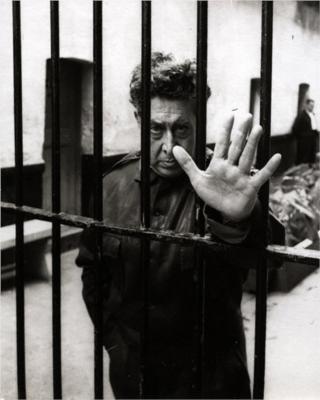
Mexican[1] muralist and political militant who co-founded Los Tres Grandes and pioneered industrial spray techniques in large-scale public painting.
Where to see David Alfaro Siqueiros
Collection holdings are reported here; current display varies. Check with each museum before visiting.
-
6 recorded works
Museum of Modern Art
New York City, United States
-
3 recorded works
Los Angeles County Museum of Art
Los Angeles, United States


-
2 recorded works
São Paulo Museum of Art
São Paulo, Brazil
-
2 recorded works
Museum of Fine Arts, Houston
Houston, United States
-
1 recorded work
Princeton Art Museum
Princeton, United States
-
1 recorded work
Arizona State University Art Museum
Tempe, United States
-
1 recorded work
The Nelson-Atkins Museum of Art
Kansas City, United States
-
1 recorded work
National Gallery of Art
Washington D.C., United States
-
1 recorded work
Art Institute of Chicago
Chicago, United States


View all 13 museums
-
1 recorded work
Indianapolis Museum of Art
Indianapolis, United States
-
1 recorded work
RISD Museum
Providence, United States
-
0 recorded works
Vanderbilt Museum of Art
Nashville, United States


Frequently Asked Questions
Where can I see David Alfaro Siqueiros's work?
David Alfaro Siqueiros (1896[1]-1974[1]) was a Mexican[1] muralist and political activist. He, Diego Rivera, and José Clemente Orozco are considered the founders of Mexican muralism after the Mexican Revolution of 1910[1]. Siqueiros's work can be viewed in several locations. The Museo de Arte Carrillo Gil in Mexico City holds his 1947 acrylic on panel painting, *Death and Funeral of Cain*. The Sala de Arte Publico David Alfaro Siqueiros, also in Mexico, holds his 1936 painting *Birth of Fascism (first version)*. In the USA, Siqueiros had an exhibition at the Stendhal Ambassador Galleries in Los Angeles in 1932. That same year, he organised the Block of Mural Painters, with whom he collaborated on the exterior mural, *The Workers' Meeting*. He also completed two more exterior murals, *Tropical America* and *Portrait of Present-Day Mexico*. In 1932-33, Diego Rivera painted murals for The Detroit Institute of Arts.What should I know about David Alfaro Siqueiros's prints?
David Alfaro Siqueiros (1896[1]-1974[1]) was a Mexican[1] painter known for his murals and political activism. He, Diego Rivera, and José Clemente Orozco founded the Mexican muralist school after the Revolution. Siqueiros's style is impassioned, dynamic, and often carries ideological meaning. Siqueiros was politically active; he was imprisoned and exiled numerous times. In 1932[1], he travelled to Los Angeles and organised a group of mural painters. That same year, he had an exhibition at the Stendhal Ambassador Galleries in Los Angeles, displaying work from his political exile in Taxco. In 1936, Siqueiros established an experimental workshop in New York. His prints often reflect his mural work, with bold compositions and striking use of colour. His art blends reality and fantasy, influenced by Surrealism and Mexican folk art. One notable work, "Death and Funeral of Cain" (1947), uses acrylic on panel to depict a crowd seemingly venerating a dead chicken, a commentary on the futility of their actions.Why are David Alfaro Siqueiros's works important today?
David Alfaro Siqueiros (1896[1]-1974[1]) was a Mexican[1] painter and muralist, with a political life as a Marxist activist. His artistic innovations, coupled with his political engagement, make his works relevant to contemporary discussions about art and social justice. Siqueiros experimented with new materials and techniques, such as using industrial paints and airbrushes. He also explored perspective and movement in his murals, aiming to create a more dynamic viewing experience. His focus on audience engagement, combined with his exploration of modern materials, separates him from other muralists of his time. Siqueiros's art often addressed themes of revolution, oppression, and the struggles of the working class. His murals frequently depict historical events and figures, as well as scenes of contemporary social unrest. By using art as a tool for political expression, Siqueiros sought to raise awareness about social issues and inspire action. His works continue to resonate with audiences interested in the relationship between art, politics, and social change.What techniques or materials did David Alfaro Siqueiros use?
David Alfaro Siqueiros was interested in innovative methods and materials. He moved away from traditional fresco techniques. Siqueiros explored industrial paints, such as Duco lacquer (a nitrocellulose paint manufactured by DuPont) and pyroxylin. These allowed for faster drying times and greater durability, suitable for exterior murals. He adopted spray guns to apply paint, which enabled him to achieve smoother gradations and textures. Siqueiros also experimented with new supports, including cement panels and asbestos cement sheets. These were more resistant to the elements than traditional plaster walls. In his workshop in Cuernavaca, Mexico, Siqueiros developed what he termed "accidental painting". This involved pouring and manipulating paints on a surface, then exploiting chance effects. His goal was to integrate art with architecture and technology. He wanted to create a dynamic, modern art that engaged with social and political issues. His innovative approach influenced muralists and artists internationally.Who did David Alfaro Siqueiros influence?
David Alfaro Siqueiros, a Mexican[1] social realist painter, influenced many artists through his mural work and political activism. His emphasis on modern industrial technology and dynamic composition had an impact on the art world. One notable example is Jackson Pollock. Siqueiros conducted an experimental workshop in New York City in 1936[1], which Pollock attended. Pollock was exposed to unconventional techniques, such as using spray guns and stencils. These methods contributed to Pollock's later development of his famous drip painting style. Siqueiros's political beliefs and artistic approach also resonated with other artists involved in social realism and muralism, both in Mexico and internationally. His large-scale public works aimed to convey political messages and engage with the public, inspiring similar projects by other artists who sought to use art as a tool for social change. His work had an effect on the Chicano art movement in the United States.Who influenced David Alfaro Siqueiros?
David Alfaro Siqueiros, a Mexican[1] social realist painter, was born in 1896[1]. He had a long career before his death in 1974[1] and absorbed many influences. Early on, Siqueiros was exposed to the theories of Dr Atl (Gerardo Murillo Coronado), who advocated for a uniquely Mexican art, distinct from European traditions. Atl's emphasis on the direct experience of nature and the use of indigenous motifs resonated with Siqueiros's developing artistic and political sensibilities. Italian futurism, with its emphasis on dynamism and technology, also interested Siqueiros. Although he rejected its pro-war stance, he adapted its aesthetic principles to his own revolutionary vision. His time in Europe exposed him to various avant-garde movements, which shaped his ideas about the role of art in society. The Russian Revolution further impacted Siqueiros. He saw art as a tool for social change, a means to educate and mobilise the working class. This conviction led him to experiment with new techniques and materials, seeking a monumental and accessible style that could convey his political message effectively.What style or movement did David Alfaro Siqueiros belong to?
David Alfaro Siqueiros (1896[1]-1974[1]) is best known as one of the leading figures in the Mexican[1] muralism movement. This artistic trend emerged after the Mexican Revolution of 1910[1]. Many Mexican artists, including Siqueiros, used their work to express the nation's political ideologies. Siqueiros, along with Diego Rivera and José Clemente Orozco, is considered a founder of this school of mural painting. He created a Muralist Manifesto and, like Orozco, painted his first mural at the National Preparatory School of Mexico City in 1922. Siqueiros's paintings often carried strong political and social messages. He was deeply involved in politics, leading to imprisonment and exile on several occasions. His style is characterised by its impassioned nature, power, vitality, and ideological meaning. One of his works, Death and Funeral of Cain (1947), shows his bold composition and use of colour, influenced by Surrealism and Mexican folk art. His painting Echo of a Scream is a protest against war.What was David Alfaro Siqueiros known for?
David Alfaro Siqueiros (1896[1]-1974[1]) was a Mexican[1] painter and muralist. Along with Diego Rivera and José Clemente Orozco, he established the Mexican muralism movement. He is best known for his large-scale public murals, often political in message. Siqueiros's artistic career began with his involvement in student activism. He studied at the Academy of San Carlos in Mexico City, where he participated in student strikes. In 1919[1], he travelled to Europe to study art and encounter new avant-garde movements. Returning to Mexico, Siqueiros became involved in the Syndicate of Revolutionary Mexican Painters, Sculptors and Engravers. His art and politics were intertwined; he was a member of the Mexican Communist Party and fought in the Spanish Civil War. His political activism led to periods of imprisonment and exile. Siqueiros experimented with new materials and techniques, such as using industrial paints and airbrushes. He also explored the use of dynamic perspective and incorporated sculptural elements into his murals. Notable works include "The Burial of a Worker" (1923) and "Echo of a Scream" (1937). His mural "Del Porfirismo a la Revolución" (1957-1966[1]), at the Museo Nacional de Historia in Mexico City, is among his most ambitious projects.
Sources
Where to See guide aggregates verified holdings of David Alfaro Siqueiros's works across the following collections.
- [1] wikipedia Wikipedia: David Alfaro Siqueiros Used for: biography.
- [2] book Beard, Lee, 1973- author, Butler, Adam, author; Van Cleave, Claire, author; Fortenberry, Diane, author; Stirling, Susan, author, Beard, Lee, 1973- author, Butler, Adam, author; Van Cleave, Claire, author; Fortenberry, Diane, author; Stirling, Susan, author - The Art Book_ New Edition, Mini Format Used for: biography, stylistic analysis.
- [3] book Jackson Pollock : new approaches Used for: biography, stylistic analysis.
- [4] book Beckett, Wendy, The story of painting Used for: biography, stylistic analysis.
- [5] book Christian Kravagna;, Transmodern Used for: biography.
Editorial overseen by Solis Prints. Sources verified 2026-09-30. Click a source for details, or hover over [N] in the page above to preview.
Editorial standardsMethodologyCorrectionsAI disclosureAbout the editorial team