



David Alfaro Siqueiros
- graphics
On the morning of 24 May 1940[1], approximately twenty men disguised as police officers stormed the Coyoacán home of Leon Trotsky and fired more than two hundred bullets into his bedroom. Trotsky and his wife survived by hiding under the bed. The operation was led by David Alfaro Siqueiros, one of Mexico's most celebrated muralists, who had recently returned from commanding Republican troops in the Spanish Civil War. That particular assassination attempt failed; Trotsky was killed by different means three months later.
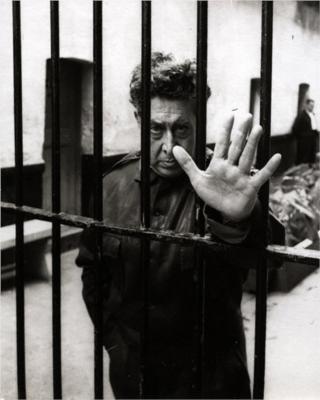
Biography
Born José de Jesús Alfaro Siqueiros on 29 December 1896[1] in Santa Rosalía de Camargo, Chihuahua, he fought in the Mexican[1] Revolution as a young soldier before travelling to Europe in the early 1920s on a government grant. With Diego Rivera and José Clemente Orozco, together known as Los Tres Grandes, he developed Mexican Muralism into the dominant artistic movement of the postwar Americas: large-scale public frescoes addressing history, labour, and political struggle. Where Rivera favoured allegory and Orozco expressionist anguish, Siqueiros brought an industrial energy to his surfaces. He pioneered the use of spray guns, airbrushes, and pyroxylin lacquer, embracing the materials of the factory floor rather than the studio.
In 1932[1], working in Los Angeles, he painted *Tropical America* on a public wall in Olvera Street. The mural, depicting an indigenous figure crucified under an American eagle, was whitewashed by city authorities shortly after completion. In 1936 he ran an experimental workshop in New York where he taught drip and pour painting techniques to a class that included a young Jackson Pollock. His *Portrait of the Bourgeoisie* (1939–40) for the Mexican[1] Electricians' Union in Mexico City remains one of the most forceful political murals of the 20th century.
Siqueiros was imprisoned in 1960[1] for publicly criticising the Mexican[1] president and was not pardoned until 1964. He spent his final years completing *The March of Humanity* (1957–71), a monumental mural cycle housed in the Polyforum Siqueiros in Mexico City, the largest mural complex he ever realised. He died in Cuernavaca in January 1974[1].
Timeline
- 1896Born José de Jesús Alfaro Siqueiros on 29 December in Santa Rosalía de Camargo, Chihuahua.
- 1920Travelled to Europe on a government grant after fighting in the Mexican Revolution as a young soldier.
- 1932Painted *Tropical America* on a public wall in Olvera Street, Los Angeles. It was whitewashed by city authorities shortly after completion.
- 1936Ran an experimental workshop in New York, teaching drip and pour painting techniques; Jackson Pollock was among his students.
- 1940Led an assault on Leon Trotsky's home in Coyoacán, though the assassination attempt failed.
- 1940Completed *Portrait of the Bourgeoisie* (1939–40) for the Mexican Electricians' Union in Mexico City.
- 1960Imprisoned for publicly criticising the Mexican president.
- 1964Pardoned after being imprisoned in 1960.
- 1971Completed *The March of Humanity* (1957–71), a mural cycle housed in the Polyforum Siqueiros in Mexico City.
- 1974Died in Cuernavaca in January, aged 77.
Notable Works
Tap to view larger.
Next stop
Browse the movements →
Every movement in the collection, from the Renaissance to Pop art.
Related Artists


Frequently Asked Questions
What is David Alfaro Siqueiros known for?
David Alfaro Siqueiros is known for developing Mexican[1] Muralism with Diego Rivera and José Clemente Orozco. Together, the three artists, known as Los Tres Grandes, created large-scale public frescoes addressing history, labour, and political struggle; Siqueiros brought an industrial energy to his murals and embraced materials from the factory floor.What should I know about David Alfaro Siqueiros's prints?
David Alfaro Siqueiros (1896[1]-1974[1]) was a Mexican[1] painter known for his murals and political activism. He, Diego Rivera, and José Clemente Orozco founded the Mexican muralist school after the Revolution. Siqueiros's style is impassioned, dynamic, and often carries ideological meaning. Siqueiros was politically active; he was imprisoned and exiled numerous times. In 1932[1], he travelled to Los Angeles and organised a group of mural painters. That same year, he had an exhibition at the Stendhal Ambassador Galleries in Los Angeles, displaying work from his political exile in Taxco. In 1936, Siqueiros established an experimental workshop in New York. His prints often reflect his mural work, with bold compositions and striking use of colour. His art blends reality and fantasy, influenced by Surrealism and Mexican folk art. One notable work, "Death and Funeral of Cain" (1947), uses acrylic on panel to depict a crowd seemingly venerating a dead chicken, a commentary on the futility of their actions.What style or movement did David Alfaro Siqueiros belong to?
David Alfaro Siqueiros (1896[1]-1974[1]) is best known as one of the leading figures in the Mexican[1] muralism movement. This artistic trend emerged after the Mexican Revolution of 1910[1]. Many Mexican artists, including Siqueiros, used their work to express the nation's political ideologies. Siqueiros, along with Diego Rivera and José Clemente Orozco, is considered a founder of this school of mural painting. He created a Muralist Manifesto and, like Orozco, painted his first mural at the National Preparatory School of Mexico City in 1922. Siqueiros's paintings often carried strong political and social messages. He was deeply involved in politics, leading to imprisonment and exile on several occasions. His style is characterised by its impassioned nature, power, vitality, and ideological meaning. One of his works, Death and Funeral of Cain (1947), shows his bold composition and use of colour, influenced by Surrealism and Mexican folk art. His painting Echo of a Scream is a protest against war.What techniques or materials did David Alfaro Siqueiros use?
David Alfaro Siqueiros was interested in innovative methods and materials. He moved away from traditional fresco techniques. Siqueiros explored industrial paints, such as Duco lacquer (a nitrocellulose paint manufactured by DuPont) and pyroxylin. These allowed for faster drying times and greater durability, suitable for exterior murals. He adopted spray guns to apply paint, which enabled him to achieve smoother gradations and textures. Siqueiros also experimented with new supports, including cement panels and asbestos cement sheets. These were more resistant to the elements than traditional plaster walls. In his workshop in Cuernavaca, Mexico, Siqueiros developed what he termed "accidental painting". This involved pouring and manipulating paints on a surface, then exploiting chance effects. His goal was to integrate art with architecture and technology. He wanted to create a dynamic, modern art that engaged with social and political issues. His innovative approach influenced muralists and artists internationally.What was David Alfaro Siqueiros known for?
David Alfaro Siqueiros (1896[1]-1974[1]) was a Mexican[1] painter and muralist. Along with Diego Rivera and José Clemente Orozco, he established the Mexican muralism movement. He is best known for his large-scale public murals, often political in message. Siqueiros's artistic career began with his involvement in student activism. He studied at the Academy of San Carlos in Mexico City, where he participated in student strikes. In 1919[1], he travelled to Europe to study art and encounter new avant-garde movements. Returning to Mexico, Siqueiros became involved in the Syndicate of Revolutionary Mexican Painters, Sculptors and Engravers. His art and politics were intertwined; he was a member of the Mexican Communist Party and fought in the Spanish Civil War. His political activism led to periods of imprisonment and exile. Siqueiros experimented with new materials and techniques, such as using industrial paints and airbrushes. He also explored the use of dynamic perspective and incorporated sculptural elements into his murals. Notable works include "The Burial of a Worker" (1923) and "Echo of a Scream" (1937). His mural "Del Porfirismo a la Revolución" (1957-1966[1]), at the Museo Nacional de Historia in Mexico City, is among his most ambitious projects.When did David Alfaro Siqueiros live and work?
David Alfaro Siqueiros (1896[1]-1974[1]) was a Mexican[1] painter and muralist. He was a major figure in twentieth-century Mexican art, known for his politically charged works and his exploration of new techniques. Born in Chihuahua, Mexico, Siqueiros became involved in radical politics early in his life. He fought in the Mexican Revolution and later became a member of the Mexican Communist Party. His political activism often intertwined with his artistic practice. Siqueiros spent much of his career creating large-scale murals in public spaces. These murals often depicted scenes from Mexican history and social struggles, promoting socialist ideals. Some of his most important murals include "The Burial of the Worker" (1923[1]) at the Colegio Chico, and the Polyforum Cultural Siqueiros (1971) in Mexico City. Beyond Mexico, Siqueiros also worked in the United States and South America. He experimented with industrial materials and techniques, such as using spray guns and new types of paint, to achieve dynamic effects. His innovative approach influenced other artists and contributed to the development of modern muralism. Siqueiros's life was marked by both artistic achievement and political controversy.Where can I see David Alfaro Siqueiros's work?
David Alfaro Siqueiros (1896[1]-1974[1]) was a Mexican[1] muralist and political activist. He, Diego Rivera, and José Clemente Orozco are considered the founders of Mexican muralism after the Mexican Revolution of 1910[1]. Siqueiros's work can be viewed in several locations. The Museo de Arte Carrillo Gil in Mexico City holds his 1947 acrylic on panel painting, *Death and Funeral of Cain*. The Sala de Arte Publico David Alfaro Siqueiros, also in Mexico, holds his 1936 painting *Birth of Fascism (first version)*. In the USA, Siqueiros had an exhibition at the Stendhal Ambassador Galleries in Los Angeles in 1932. That same year, he organised the Block of Mural Painters, with whom he collaborated on the exterior mural, *The Workers' Meeting*. He also completed two more exterior murals, *Tropical America* and *Portrait of Present-Day Mexico*. In 1932-33, Diego Rivera painted murals for The Detroit Institute of Arts.Where was David Alfaro Siqueiros from?
David Alfaro Siqueiros was born in Santa Rosalía, Mexico, in 1896[1]. He died in Cuernavaco in 1974[1]. Siqueiros, along with Diego Rivera and José Clemente Orozco, is recognised as one of the leading figures in the Mexican[1] muralist movement that developed after the Mexican Revolution of 1910[1]-1921[1]. This artistic movement coincided with a surge of nationalism that aimed to celebrate indigenous traditions and move away from European influences. These artists saw murals as a way to create public art that would be accessible to the masses. As socialists or communists, they used their art to express their political beliefs. Siqueiros, like Rivera, was also a political activist. His activism led to periods of imprisonment and exile throughout his life. His style is characterised by its energy, bold compositions, and the use of colour to mix reality and fantasy. His work often carried ideological meaning.Who did David Alfaro Siqueiros influence?
David Alfaro Siqueiros, a Mexican[1] social realist painter, influenced many artists through his mural work and political activism. His emphasis on modern industrial technology and dynamic composition had an impact on the art world. One notable example is Jackson Pollock. Siqueiros conducted an experimental workshop in New York City in 1936[1], which Pollock attended. Pollock was exposed to unconventional techniques, such as using spray guns and stencils. These methods contributed to Pollock's later development of his famous drip painting style. Siqueiros's political beliefs and artistic approach also resonated with other artists involved in social realism and muralism, both in Mexico and internationally. His large-scale public works aimed to convey political messages and engage with the public, inspiring similar projects by other artists who sought to use art as a tool for social change. His work had an effect on the Chicano art movement in the United States.Who influenced David Alfaro Siqueiros?
David Alfaro Siqueiros, a Mexican[1] social realist painter, was born in 1896[1]. He had a long career before his death in 1974[1] and absorbed many influences. Early on, Siqueiros was exposed to the theories of Dr Atl (Gerardo Murillo Coronado), who advocated for a uniquely Mexican art, distinct from European traditions. Atl's emphasis on the direct experience of nature and the use of indigenous motifs resonated with Siqueiros's developing artistic and political sensibilities. Italian futurism, with its emphasis on dynamism and technology, also interested Siqueiros. Although he rejected its pro-war stance, he adapted its aesthetic principles to his own revolutionary vision. His time in Europe exposed him to various avant-garde movements, which shaped his ideas about the role of art in society. The Russian Revolution further impacted Siqueiros. He saw art as a tool for social change, a means to educate and mobilise the working class. This conviction led him to experiment with new techniques and materials, seeking a monumental and accessible style that could convey his political message effectively.Who was David Alfaro Siqueiros?
David Alfaro Siqueiros (1896[1]-1974[1]) was a Mexican[1] social realist painter, known for his murals and his Marxist political activism. Along with Diego Rivera and José Clemente Orozco, he established the Mexican muralism movement. Siqueiros was born in Camargo, Mexico. He studied at the Academy of San Carlos in Mexico City. In 1911[1], he participated in a student strike against the school's teaching methods. His early work reflects his involvement in revolutionary politics; he fought in the Mexican Revolution. In the 1920s, Siqueiros travelled to Europe, where he studied fresco painting techniques. He was interested in using new materials and methods in his art. Back in Mexico, he became involved in labour organising and continued to create murals that depicted the struggles of the working class. His political activities led to periods of imprisonment and exile. In 1930, he was jailed and then exiled for his May Day speech. Siqueiros painted murals in various locations, including Mexico, the United States, and Cuba. Notable works include *The Burial of a Worker* (1923) at the Colegio Chico, *Collective Suicide* (1936) at the Mexican Center for Art in Los Angeles, and *The March of Humanity* (1971) at the Polyforum Cultural Siqueiros in Mexico City. He aimed to create a public art that would promote social change.Why are David Alfaro Siqueiros's works important today?
David Alfaro Siqueiros (1896[1]-1974[1]) was a Mexican[1] painter and muralist, with a political life as a Marxist activist. His artistic innovations, coupled with his political engagement, make his works relevant to contemporary discussions about art and social justice. Siqueiros experimented with new materials and techniques, such as using industrial paints and airbrushes. He also explored perspective and movement in his murals, aiming to create a more dynamic viewing experience. His focus on audience engagement, combined with his exploration of modern materials, separates him from other muralists of his time. Siqueiros's art often addressed themes of revolution, oppression, and the struggles of the working class. His murals frequently depict historical events and figures, as well as scenes of contemporary social unrest. By using art as a tool for political expression, Siqueiros sought to raise awareness about social issues and inspire action. His works continue to resonate with audiences interested in the relationship between art, politics, and social change.
Sources
Editorial draws on the following primary and tertiary references for David Alfaro Siqueiros.
- [1] wikipedia Wikipedia: David Alfaro Siqueiros Used for: biography, birth dates, death dates, identifiers, movement attribution, nationality.
- [2] book Beard, Lee, 1973- author, Butler, Adam, author; Van Cleave, Claire, author; Fortenberry, Diane, author; Stirling, Susan, author, Beard, Lee, 1973- author, Butler, Adam, author; Van Cleave, Claire, author; Fortenberry, Diane, author; Stirling, Susan, author - The Art Book_ New Edition, Mini Format Used for: biography, stylistic analysis.
- [3] book Jackson Pollock : new approaches Used for: biography, stylistic analysis.
- [4] book Beckett, Wendy, The story of painting Used for: biography, stylistic analysis.
- [5] book Christian Kravagna;, Transmodern Used for: biography.
Editorial overseen by Solis Prints. Sources verified 2026-10-07. Click a source for details, or hover over [N] in the page above to preview.
Editorial standardsMethodologyCorrectionsAI disclosureAbout the editorial team