



About Desmond Morris
British · 1928–present
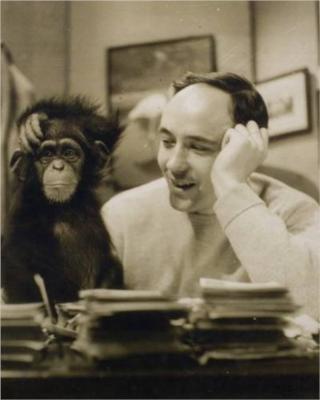
British[3] zoologist and last surviving Surrealist painter, who exhibited with Joan Miró in 1950 and completed over 2,500 biomorphic canvases alongside writing The Naked Ape.
Museums4
Countries2
Largest reported holdingArt Institute of Chicago, Chicago · 6 recorded works
Loading map…
Where to see Desmond Morris
Collection holdings are reported here; current display varies. Check with each museum before visiting.
-
 6 recorded works
Art Institute of Chicago
Chicago, United States
-
2 recorded works
Museum & Art Swindon
Swindon, United Kingdom
-
 2 recorded works
Harvard Art Museums
Cambridge, United States
-
1 recorded work
The Atkinson
Southport, United Kingdom
Frequently Asked Questions
Where can I see Desmond Morris's work?
While a comprehensive list of Desmond Morris's exhibition locations is unavailable, several museums hold collections that may include his work. In the UK, these include the Victoria & Albert Museum in London; the National Museums of Scotland, Royal Museum, in Edinburgh; the Manchester Art Gallery; and the Brighton Museum & Art Gallery. Other possibilities are the Ashmolean Museum at the University of Oxford and the British[3] Museum in London. In the United States, museums with relevant collections are the Metropolitan Museum of Art in New York; the Los Angeles County Museum of Art (LACMA); the Minneapolis Institute of Arts; the Museum of Modern Art in New York; the Virginia Museum of Fine Arts in Richmond; the Wolfsonian at Florida International University; and the Charles Hosmer Morse Museum of American Art in Winter Park, Florida. The Royal Ontario Museum in Toronto also has relevant holdings. Always check museum websites for current exhibition details.What should I know about Desmond Morris's prints?
When buying a Desmond Morris print, it is useful to understand some basic principles of printmaking and editioning. A print is considered original when the artist conceives it as a print and executes it as a print. Each print in the edition is an original, made from a plate, stone, screen, block or other matrix created for that purpose. Each print is individually inked and pulled; it is a multi-original medium. The artist decides the number of prints in the edition. Numbering provides an accounting; each print has a specific number, such as 12/25 (print 12 from an edition of 25). The edition claim is written as a pair of numbers on the left bottom margin of the print. The title of the print is written in the middle of the bottom margin, and the signature is on the right. The decision to limit an edition is the artist's choice, not a technical limitation. There is no inherent need to make limited editions, though most printmakers do. Every copy does not have to be produced at a single printing. An edition is limited by a claim, written in pencil at the foot of each print. These claims are subject to the Trade Descriptions Act 1968, requiring truthful descriptions.Why are Desmond Morris's works important today?
Desmond Morris's works are important due to his exploration of human and animal behaviour through a semiotic lens. Semiotics studies signs and symbols; it considers how meaning is created not just through language but also through images, tone, and colour. Morris applies this approach to the visual arts. His art can be analysed using iconology, which gained traction after the Second World War. Iconology provides a systematic classification of pictorial objects and subjects in visual arts. Morris's paintings and drawings often depict biomorphic forms and surrealist imagery, inviting viewers to decode their symbolic content. Morris's background as a zoologist informs his artistic practice, leading him to examine the underlying patterns and structures that govern both human and animal actions. This interdisciplinary approach, combining art with scientific observation, offers insights into the relationship between culture and biology. His art encourages a consideration of how we interpret visual information and the meanings we ascribe to it.What techniques or materials did Desmond Morris use?
Desmond Morris is known for his surrealist paintings and drawings, often featuring biomorphic forms and abstract compositions. While specific details about his techniques are not widely published, some general observations can be made based on art historical context and analysis of similar artists' methods. Morris likely employed a range of materials common to painting and drawing, such as oils, acrylics, watercolours, inks, pencils, and pastels. The choice of support would vary depending on the medium, including canvas, paper, and board. Technically, Morris may have used layering, blending, and glazing to achieve particular effects in his paintings. His drawings could involve hatching, cross-hatching, stippling, or other mark-making techniques to create tone and texture. As with many artists, Morris's approach probably evolved over time, with experimentation playing a significant role in his artistic development. The balance between conscious intention and accidental effects would also have been a factor in his creative process.Who did Desmond Morris influence?
Desmond Morris's influence is complex, extending across art and science. As a zoologist, his books, such as *The Naked Ape* (1967), influenced popular understanding of human behaviour through an evolutionary lens. This approach affected fields like sociology and anthropology, though sometimes controversially, due to its broad generalisations. In the art world, Morris's surrealist paintings and theories about animal art impacted artists interested in automatism and the subconscious. His studies of chimpanzee art, for instance, provided a novel perspective on the creative process, suggesting artistic expression is not exclusive to humans. Some artists explored similar themes of instinct and primal expression in their own work. However, it is difficult to trace direct lines of influence to specific artists. Morris's interdisciplinary approach made his impact diffuse. He affected general intellectual trends more than individual artistic styles. His popular writings also brought zoological concepts to a wider audience, indirectly shaping cultural attitudes towards science and art.Who influenced Desmond Morris?
Desmond Morris's artistic development was shaped by a combination of formal training and personal connections. He studied under দুটোs like Lucian Freud at the Central School of Art, an experience that exposed him to a particular approach to figurative art. Morris's interest in surrealism also played a role. He met Joan Miró and became familiar with the work of René Magritte; these encounters broadened his artistic horizons. Morris's paintings and drawings often incorporate surreal elements, a possible effect of his exposure to surrealist ideas. His academic background in zoology also affected his art. Morris studied animal behaviour, and this scientific perspective informs his artistic representations of both humans and animals. He does not depict his subjects naturalistically; instead, he uses his knowledge of biology to explore themes of instinct, behaviour, and the human condition through his art.What is Desmond Morris's most famous work?
Desmond Morris is best known for his 1967 book, *The Naked Ape*. In it, he presents a zoological study of humans, comparing human behaviour to that of other animals. Morris analyses aspects of human life, such as eating, sleeping, fighting, sex, and childrearing, from a biological perspective. He argues that, despite cultural and technological advancements, humans remain fundamentally driven by their biological instincts. *The Naked Ape* achieved considerable popularity; it was translated into numerous languages and sold millions of copies worldwide. The book sparked debate, with some praising Morris for his accessible and engaging writing style, while others criticised him for oversimplifying complex human behaviours and for his potentially reductionist approach. Despite the criticisms, *The Naked Ape* made an impact on popular science writing and contributed to discussions about human nature and behaviour.What style or movement did Desmond Morris belong to?
Desmond Morris is associated with Surrealism[3], a movement that gained formal recognition with André Breton's 1924 manifesto. Surrealism aimed to express the true functioning of thought, without the control of reason or moral and aesthetic considerations. It explored the unconscious mind, dreams, and the juxtaposition of unrelated objects to unlock imagination and create a new reality. Breton defined Surrealism as 'pure psychic automatism', and advocated for dreamlike images and stream-of-consciousness techniques. Surrealist artists sought to create the 'marvellous' by using chance, poetry, and mystery. Surrealism's roots can be traced to literature, but visual artists like Max Ernst, Man Ray, and Picasso were also associated with the movement. Morris himself stated that he draws inspiration from nature, using it only as a starting point for his imagination, combined with abstraction, geometry, and design.
Sources
Where to See guide aggregates verified holdings of Desmond Morris's works across the following collections.
- [1] museum Harvard Art Museums Used for: museum holdings.
- [2] museum Art Institute of Chicago Used for: museum holdings.
- [3] wikipedia Wikipedia: Desmond Morris Used for: biography.
- [4] book E. H. Gombrich; Partha Mitter; María Angélica Martínez; Juan Luis Lorda (editors), Gombrich _ a theory of art Used for: stylistic analysis.
- [5] book Lorda, Joaquin;Gombrich, E. H. ;Mitter, Partha;, Gombrich: A Theory of Art Used for: stylistic analysis.
- [6] book guggenheim-britishartnowame00wald Used for: biography.
- [7] book guggenheim-robertm00morr Used for: biography.
- [8] book Gombrich, E. H. (Ernst Hans), 1909-2001, Symbolic images : studies in the art of the Renaissance Used for: stylistic analysis.
- [9] book Beckett, Wendy, The story of painting Used for: biography.
Editorial overseen by Solis Prints. Sources verified 2026-09-30. Click a source for details, or hover over [N] in the page above to preview.
Editorial standardsMethodologyCorrectionsAI disclosureAbout the editorial team