



About Filipp Malyavin
1869–1940
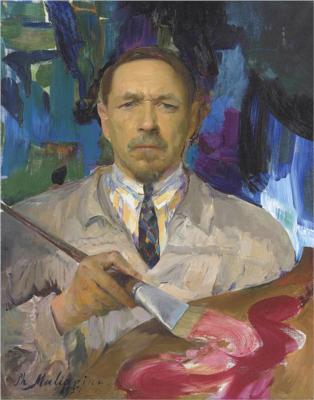
Russian painter celebrated for monumental canvases of peasant women in swirling red, who trained under Repin and won a Paris gold medal in 1900[1].
Museums4
Countries3
Largest reported holdingNational Gallery of Armenia, Yerevan · 55 recorded works
Loading map…
Where to see Filipp Malyavin
Collection holdings are reported here; current display varies. Check with each museum before visiting.
-
55 recorded works
National Gallery of Armenia
Yerevan, Armenia
Also here (6)
-
2 recorded works
Musée d'Orsay
Paris, France


-
1 recorded work
Tretyakov Gallery
Moscow, Russia
-
1 recorded work
Russian Museum
Saint Petersburg, Russia


Frequently Asked Questions
Where can I see Filipp Malyavin's work?
Filipp Malyavin's works can be viewed in several museums. In Russia, the State Tretyakov Gallery in Moscow and the State Russian Museum in St Petersburg hold pieces. Regional museums, such as the A. V. Grigoryev Art and Historical Museum in Kozmodemyansk, the Yaroslavl Art Museum, and the Samara Regional Art Museum also possess collections that include his paintings. Some works are held in the Museum Ludwig in Cologne, Germany. These museums acquired pieces through purchases, gifts, or transfers from central collections like the Museum Bureau. This bureau distributed art to regional museums, aiming to establish Museums of Artistic Culture across Russia. Avant-garde works were allocated to various museums between 1922[1] and 1929, benefiting museums in areas such as Chechnya, Baku, Dagestan, and Belorussia. These distributions helped spread artistic culture and establish collections in diverse locations.What should I know about Filipp Malyavin's prints?
Filipp Malyavin (1869[1]-1940[1]) was a Russian painter known for his depictions of peasant life. He studied art at an icon-painting studio before working with Ilya Repin. Malyavin's prints, like his paintings, often feature Russian peasant women. When assessing a Malyavin print, consider the edition number. Printmakers often limit editions, and each print is marked with a fraction on the bottom left indicating its number within the total edition. The title is typically in the centre, and the artist's signature on the right, all in pencil. The Trade Descriptions Act of 1968 requires commercial vendors to accurately describe their products; edition claims add value if truthful. The artist decides the edition size, as the medium itself does not impose a technical limit. A print may involve several blocks, and proofing is a critical stage for artistic choices.What techniques or materials did Filipp Malyavin use?
Details regarding Filipp Malyavin's specific techniques are scarce. However, some general information about oil-painting methods may be helpful. Oil painters often apply paint with brushes, achieving varied effects depending on brush selection and technique. Methods include applying thick, opaque paint to create texture; thinning paint with solvent for transparent layers; and drybrushing, which involves dragging a loaded brush lightly over the surface for irregular effects. Blending uses a clean brush to soften colours; glazing applies thin, transparent layers over dry paint. Pulling and dragging creates texture; scumbling lightly brushes semi-opaque colour over dry paint. Sponging creates mottled textures; wiping removes paint for highlights. Spattering applies specks of colour, scraping removes paint to reveal underlying layers, and stippling applies dots of paint to build colour. Artists often use artist-quality paints to ensure colour saturation, permanence, and stability. Brushes with hog hair are favoured for their springiness and broader application of paint. Surfaces include gessoed MDF, primed canvas on MDF, and primed canvas, all of artist quality.Who did Filipp Malyavin influence?
While it is hard to pinpoint direct artistic descendants, Filipp Malyavin's work did resonate with certain later artists and movements. Pavel Filonov, a contemporary, developed his analytical-art principles around 1912[1], the same year that Mikhail Larionov originated Rayism. Filonov stated that Cubo-Futurism and Picasso had not influenced his theories. However, he allowed that anything done in art influenced him, positively or negatively. German art exhibitions in Russia during the mid-1920s also affected Soviet artists. Despite critics' condemnation of Expressionism, some artists found inspiration in the German works. Even within the Association of Artists of Revolutionary Russia (AKhRR), some artists responded to the exhibitions with greater expressiveness. Ultimately, it is difficult to trace a clear line of influence from Malyavin to specific artists. However, his work contributed to the broader artistic environment in Russia during a time of significant change and experimentation.Who influenced Filipp Malyavin?
Filipp Malyavin (1869[1]-1940[1]) was a Russian painter known for his depictions of peasant life. He initially studied icon painting before training under Ilya Repin. Malyavin's early artistic path involved the study of traditional forms, which later informed his unique style. Malyavin's work focused on capturing the essence of rural Russia. He often used local peasant girls as models, portraying them with dark complexions and distinctive gazes. His subjects, such as Verka, possess an icon-like quality, reflecting Malyavin's early training. While aiming to represent a national type, Malyavin retained portrait-like features in his paintings. These features were sometimes subsumed by the sweeping brushstrokes in his later work, which prioritised a general impression of Russian peasant women.What style or movement did Filipp Malyavin belong to?
Filipp Malyavin is primarily associated with the Russian realist tradition, although his work also shows some connections to impressionism and early modernist trends. Initially, Malyavin studied at an icon-painting workshop before joining Ilya Repin's studio. This background informed his early work, which often depicted peasant life in Russia. He is known for his portrayals of Russian peasant women, aiming to capture a national type in his art. While Malyavin's early works retained traditional portrait features, his later paintings developed a more impetuous style, characterised by sweeping brushstrokes. This shift suggests an engagement with contemporary movements in painting, moving away from strict realism. Although he did not fully embrace futurism or cubo-futurism, the evolution of his technique indicates an awareness of the changing artistic environment in Russia during the early 20th century.What was Filipp Malyavin known for?
Filipp Malyavin (1869[1]-1940[1]) was a Russian painter known for his expressive, colourful depictions of peasant life. He is associated with the Russian Itinerants (Peredvizhniki), a realist movement that aimed to portray the realities of Russian society. Malyavin studied at the St Petersburg Academy of Arts under Ilya Repin. Early works show the influence of academic training, but he soon developed a distinctive style. His paintings often feature groups of peasant women in bright clothing, set against rural backgrounds. These works are characterised by bold brushwork and a focus on colour. Malyavin's paintings achieved recognition both in Russia and internationally. He participated in exhibitions such as the Paris World Fair in 1900[1], where he received a gold medal. After the Russian Revolution, Malyavin emigrated, living in France for much of his later life. Although he continued to paint, his earlier works remain his most recognised. They offer insight into Russian peasant life at the turn of the century.What was Filipp Malyavin's art style?
Malyavin's style evolved towards loose, almost expressionistic brushwork. His later paintings featured hotter palettes and larger figures, with peasant women depicted as forces of nature.
Sources
Where to See guide aggregates verified holdings of Filipp Malyavin's works across the following collections.
- [1] wikipedia Wikipedia: Filipp Malyavin Used for: biography.
- [2] book Yevgenia Petrova (editor), Origins of the Russian avant-garde_ celebrating the 300th anniversary of St. Petersburg_ the Walters Art Museum, Baltimore (13 February-25 May 2003), Fine Arts Museums of San Francisco (29 June-21 September 2003) Used for: biography.
- [3] book Russian art of the avant-garde : theory and criticism, 1902-1934, with 105 illustrations Used for: biography.
- [4] book Peter. Leek, Russian Painting Used for: biography.
Editorial overseen by Solis Prints. Sources verified 2026-09-30. Click a source for details, or hover over [N] in the page above to preview.
Editorial standardsMethodologyCorrectionsAI disclosureAbout the editorial team