

About Alexander Liberman
- abstract art
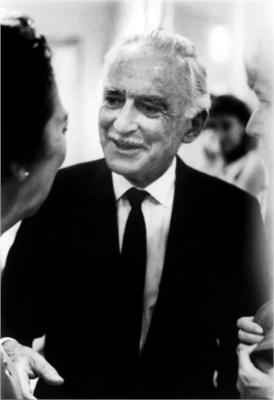
Russian[1]-born sculptor and Condé Nast editorial director whose welded steel installations appear at Storm King Art Center and the Metropolitan Museum.
Where to see Alexander Liberman
Collection holdings are reported here; current display varies. Check with each museum before visiting.
-
4 recorded works
Smithsonian American Art Museum
Washington D.C., United States
-
3 recorded works
Whitney Museum of American Art
New York City, United States


-
3 recorded works
Museum of Modern Art
New York City, United States
-
3 recorded works
Metropolitan Museum of Art
New York City, United States
-
2 recorded works
Buffalo AKG Art Museum
Buffalo, United States
-
1 recorded work
Princeton Art Museum
Princeton, United States
-
1 recorded work
National Gallery of Art
Washington D.C., United States
-
1 recorded work
Tate
London, United Kingdom
-
1 recorded work
Museum of Fine Arts, Houston
Houston, United States


Frequently Asked Questions
Where can I see Alexander Liberman's work?
Alexander Liberman's works can be found in numerous public collections. In the United States, these include the Albright-Knox Art Gallery (Buffalo, New York), the Allen Memorial Art Museum (Oberlin, Ohio), the Dallas Museum of Art, and the Los Angeles County Museum of Art. Several New York institutions also hold his work, such as the Solomon R. Guggenheim Museum and the Metropolitan Museum of Art. Other locations are the Minneapolis Institute of Arts and the Virginia Museum of Fine Arts (Richmond). Outside the United States, you can see Liberman's art at the Royal Ontario Museum in Toronto, the Galleria internazionale d'arte moderna (Ca' Pesaro, Venice), and the Wilhelm Hack Museum (Ludwigshafen). His works are also held in Moscow at the All-Russian[1] Museum of Decorative and Folk Art, and at the Central State Archive for Literature and Art.What should I know about Alexander Liberman's prints?
Alexander Liberman (1912[1]-1994[1]) was a Russian[1]-American artist and sculptor, best known for his large-scale, abstract metal sculptures. While he is most noted for his work in painting and sculpture, he also produced prints. Prints, unlike unique works, are produced in multiples; this allows them to reach a wider audience at a lower cost. As a medium, printmaking dates back centuries, with early examples found in ancient Egypt and China. In Europe, printmaking flourished after paper became readily available in the late fourteenth century. Artists began to sign their prints in the later part of the nineteenth century. This helped to distinguish original graphics from reproductions, and to confirm the print's authenticity. The practice of limiting the size of editions and numbering them also emerged around this time, giving the artist more control over the market. Some artists use prints to explore concepts established in other media. Josef Albers, for example, used silkscreen to study colour interactions, while Jean Dubuffet used lithography to further his texturology experiments. Alexander Liberman's prints are an extension of his broader artistic practice, reflecting his interest in form, colour, and geometric abstraction.Why are Alexander Liberman's works important today?
Alexander Liberman (1912[1]-1999[1]) was an American abstract expressionist painter, sculptor, and magazine editor. His paintings from the 1950s are important as early examples of a tendency towards 'systemic painting'. This approach combined economy of form and neatness of surface with fullness of colour. His symmetrical layouts, along with those of Sol LeWitt and Agnes Martin, stressed the holistic properties of shapes. Liberman's works are also significant because of their move towards impersonality. His paintings of this period were designed by him but executed by workmen; this anticipated later practices that stressed the conceptual act of the artist over their physical engagement with a medium. A symmetrical painting by Liberman was exhibited at the Guggenheim Museum in 1951[1]. Its total absence of touch was remarked upon at the time. By 1960, his circles had become tighter, and the dyed colour became disembodied, without hints of modelling or textural variation.What techniques or materials did Alexander Liberman use?
Alexander Liberman worked across painting, sculpture, and photography, using varied techniques and materials. In the early 20th century, Alexander Archipenko combined different materials and painted surfaces in his "Sculpto-Peintures". He also invented "Archipentura", kinetic paintings, during the mid-1920s. Later, in the 1940s and 1950s, Archipenko created electrically lit plastic sculptures. Archipenko's early constructions used reflective surfaces, such as polished metals, mirrors and glass. Later, he limited his means to painted wood and metal. Archipenko also said that non-plastic material inevitably has a geometric character. He utilised flat boards, sheets of metal, glass, or mirrors, cutting them into patterns and layering them in ways that would lead to a new aesthetic.Who did Alexander Liberman influence?
Alexander Liberman's work influenced several artists through his exploration of colour, form, and surface. His early symmetrical paintings, such as *Diptych. One Way* (1950[1]), explored completeness of symmetry. His immaculate finish, associated with international geometric art, was taken up to a physical scale comparable to the earlier American modernists. Some of Liberman's paintings from this period were designed by him but executed by workmen; this anticipated later practices that focused on the artist's conceptual act rather than their physical engagement with a medium. His systemic approach, combining economy of form with fullness of colour, impacted artists working in non-expressionist tendencies. These tendencies were complimented as Timeless Form's latest embodiment, such as Jules Langsner's West Coast group of Abstract Classicists. Some artists used the flat, surface-oriented figurative work to bypass abstract expressionism.Who influenced Alexander Liberman?
During the 1950s, Alexander Liberman found inspiration from the New York School artists. He saw work by Pollock, de Kooning, and Rothko, who became his mentors. He also saw work by Still, Newman, and others at Betty Parsons's gallery. He visited the homes and studios of Gottlieb, Stamos, Reinhardt, and Baziotes. Liberman's paintings from this period were designed and executed by workmen, which anticipates later practice. This connects him to Malevich, whose Suprematist compositions were rendered by pencil drawings in his book *The Non-Objective World*. Reinhardt began his symmetrical, one-colour paintings in 1953[1], which progressively darkened through the 1950s, culminating in 1960 with black squares. Newman's 1958 exhibition at Bennington College, repeated in New York the following year, also had a large impact. In 1960, Noland's circles became tighter, and the dyed colour became disembodied. By 1963, a conceptual approach to painting was becoming more widespread.What is Alexander Liberman's most famous work?
Alexander Liberman, born in Kiev, Russia, in 1912[1], was a versatile artist known for his work as a painter, sculptor, photographer, and magazine art director. In 1921[1], his family moved from Russia, and by 1924, he was in Paris, studying art. By the late 1920s, Liberman had met artists such as Marc Chagall and Fernand Léger. He became the art director of *Vu* magazine from 1932 to 1936, after which he focused on painting, writing, and filmmaking. Forced to flee France during World War II, Liberman arrived in New York in 1941 and began working at *Vogue* magazine. After the war, he resumed painting and, in 1959, learned to weld, creating his first welded sculpture. His initial one-man show occurred in 1960 at the Betty Parsons Gallery in New York. While it is difficult to name one single 'most famous work', *Sixteen Ways* (1951), with its exploration of the circle, is often mentioned. The Jewish Museum, New York, held a solo show of his sculpture in 1966, and a retrospective took place at the Corcoran Gallery of Art, Washington, D.C., in 1970.What style or movement did Alexander Liberman belong to?
Alexander Liberman is associated with several abstract movements, including Abstract Expressionism and Hard-Edge painting. In the 1940s, the term Abstract Expressionism gained traction to describe the work of New York painters. Harold Rosenberg later introduced "action painting" to highlight the painting process itself, viewing the canvas as an arena for self-creation through spontaneous action. Liberman's work from the 1950s demonstrates an immaculate finish and large scale, aligning with international geometric art. By 1950[1], his paintings displayed symmetry, and by 1953, he was creating activated fields devoid of gestural marks. One of his symmetrical paintings was exhibited at the Guggenheim Museum in 1951. The term "Hard Edge" was used to describe a development combining economy of form, neat surfaces, and fullness of colour, without evoking earlier geometric art. It emphasised the holistic properties of asymmetrical shapes, as seen in the works of Smith and Kelly, as well as the symmetrical layouts in the works of Liberman and Martin.
Sources
Where to See guide aggregates verified holdings of Alexander Liberman's works across the following collections.
- [1] wikipedia Wikipedia: Alexander Liberman Used for: biography.
- [2] book guggenheim-guhe00solo Used for: biography.
- [3] book guggenheim-onehundredpainti00thom Used for: biography.
- [4] book guggenheim-youngeramericanp00swee Used for: biography.
Editorial overseen by Solis Prints. Sources verified 2026-09-30. Click a source for details, or hover over [N] in the page above to preview.
Editorial standardsMethodologyCorrectionsAI disclosureAbout the editorial team