

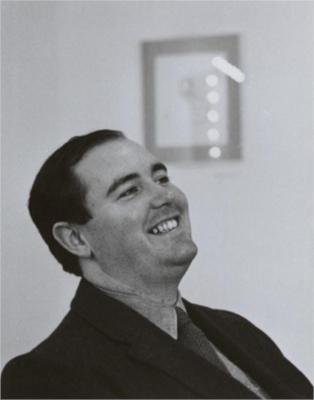
Dan Flavin
- Minimalism
- Light Art
Dan Flavin, the American artist recognised for his minimalist light installations, initially trained for the priesthood. His path then shifted to art history, studying at the New School for Social Research and Columbia University in the late 1950s. While working as a guard at the American Museum of Natural History, he began creating art. This early period saw him experiment with drawings and collages.
Biography
By 1961, Flavin had started incorporating electric lights into his work, creating a series he called "icons." These pieces combined painted box-like structures with attached incandescent bulbs. However, it was in 1963 that he made his decisive move, abandoning painting entirely. He instead used commercially available fluorescent light tubes as his sole medium. His first such piece, "diagonal of May 25, 1963 (to Constantin Brancusi)," was a single gold fluorescent lamp mounted diagonally on a wall.
Flavin's practice involved arranging standard fluorescent tubes in various configurations, exploring the spatial and atmospheric effects of coloured light. He did not alter the tubes themselves, relying on the industrial purity of the factory-made objects. His later works often took the form of site-specific installations, transforming architectural spaces with washes of light. Notable examples include his "corners" and "barriers," which redefined gallery environments.
He dedicated his entire career to these light constructions. Flavin's art invited viewers to experience light as both a physical presence and an environmental phenomenon. He used light to define and alter perception of space. His precise arrangements of light challenged traditional notions of sculpture and painting.
Timeline
- 1933Born in the United States.
- 1950Trained for the priesthood.
- 1950Studied art history at the New School for Social Research.
- 1950Studied art history at Columbia University.
- 1961Began incorporating electric lights into his art.
- 1963Abandoned painting, used fluorescent lights as sole medium.
- 1963Created 'diagonal of May 25, 1963 (to Constantin Brancusi)'.
- 1996Died.
Notable Works
Tap to view larger.
Next stop
Minimalism →
Explore the artists and ideas of Minimalism.
Related Artists

.jpg!Portrait.jpg)

Frequently Asked Questions
What is Dan Flavin known for?
Daniel Nicholas Flavin is recognised for his minimalist light installations using commercially available fluorescent light tubes. He arranged these tubes in various configurations to explore the spatial and atmospheric effects of coloured light.What is Dan Flavin's most famous work?
Dan Flavin, born in Queens, New York, in 1933, is best known for his installations using commercially produced fluorescent lights. Although he initially worked with traditional media like watercolour, by the mid-1960s he was transforming spaces with coloured fluorescent light in what he called "situations". While it is difficult to name one single "most famous" work, several pieces mark important moments in his development. In 1963, he created *the diagonal of personal ecstasy (the diagonal of May 25, 1963)*, attaching a single yellow fluorescent tube to his studio wall at a 45-degree angle. He considered this piece significant as both light and material object. His work developed into room-sized environments, such as the ultraviolet light installation at 4. Documenta in Kassel, Germany, in 1968. Also from 1968 is *an artificial barrier of blue, red and blue fluorescent light (to Flavin Starbuck Judd)*, a barrier piece using blue and red lights to create a violet effect. Flavin's work often involved dedicating pieces or series to individuals, such as his extensive series dedicated to Russian Constructivist artist Vladimir Tatlin. He continued creating site-specific installations until his death in 1996, including a 1997 installation in Chiesa Rossa, Milan, completed posthumously.What should I know about Dan Flavin's prints?
Dan Flavin (born in Jamaica, New York, in 1933) is best known for his sculptures and installations using commercially available fluorescent lights. Although he worked primarily with light, drawings, diagrams, and prints also formed a part of his practice. His first solo exhibition of constructions and watercolours was at the Judson Gallery, New York, in 1961. By 1963, he worked solely with fluorescent bulbs; his work took various forms, including "corner pieces", "barriers", and "corridors". Many of his pieces were dedicated to individuals or groups; one of the best known was dedicated to Russian Constructivist artist Vladimir Tatlin, begun in 1964. Several exhibitions have presented his drawings and prints alongside his light-based work. These include shows at the Staatliche Kunsthalle, Baden-Baden, in 1989 and at The Saint Louis Art Museum, Missouri, in 1973. These prints often relate directly to his light installations, acting as plans or diagrams. Flavin died in November 1996.What style or movement did Dan Flavin belong to?
Dan Flavin (1933-1996) is associated with the Minimalist movement. His artistic instruction was largely self-imposed. Flavin's initial public exhibition occurred in 1957 at a group show at the U.S. Air Force station in Roslyn, New York. A 1961 solo exhibition at the Judson Gallery in New York featured his assemblages and watercolours, preceding his use of light. By 1963, Flavin worked solely with commercially produced fluorescent bulbs, completing *the diagonal of personal ecstasy (the diagonal of May 25, 1963)*. His work took various forms, including 'corner pieces', 'barriers', and 'corridors'. Many pieces were dedicated to specific individuals or groups; a well-known series begun in 1964 was dedicated to Russian Constructivist Vladimir Tatlin. Flavin's work was included in early Minimal art exhibitions, such as *Primary Structures* at the Jewish Museum, New York, in 1966, and *Minimal Art* at the Gemeentemuseum, The Hague, in 1968. His use of light, space, and identical geometric objects connects him to Minimalism.What techniques or materials did Dan Flavin use?
Dan Flavin is known for his use of commercially available fluorescent light tubes to create art installations. He did not always work with this medium; early works from the late 1950s included drawings using pencil and watercolour. He also made small constructions from found objects covered in thick paint. By late 1961, Flavin began attaching electric light fixtures to small, square wooden constructions, which he called "icons". He liked the combination of paint and light, contemplating the mix of reflected light from the painted surface and the direct light from the bulbs. In 1963, he created *the diagonal of personal ecstasy (the diagonal of May 25, 1963)*, made from a single eight-foot fluorescent fixture with a yellow tube attached to his studio wall at a 45-degree angle. He recognised the potential of fluorescent light as both light and material object. His installations often used standard lengths (two, four, six, and eight feet) and a limited range of colours (blue, green, pink, red, yellow, and four shades of white). Flavin referred to his installations as "situations", not sculpture. He used these light "situations" to transform spaces, creating perceptual changes.What was Dan Flavin known for?
Dan Flavin (born 1933 in Queens, New York; died 1996) is known for his work with commercially produced fluorescent light tubes. He used these tubes, available in standard lengths, to create sculptures and installations, sometimes dedicating entire series to specific individuals. Flavin's early artistic interests included drawing, and he also experimented with assemblages and watercolours. His initial public exhibition was in 1957, and by 1961 he began to incorporate electric light into his art, creating his first "icon". By 1963, he worked solely with fluorescent bulbs, completing *the diagonal of personal ecstasy (the diagonal of May 25, 1963)*. His work took various forms, including corner pieces, barriers, and corridors. Flavin's pieces were often part of Minimal art exhibitions, such as *Primary Structures* (1966) and *Minimal Art* (1968). A major installation of his work with blue and green fluorescents is permanently installed at the Hamburger Bahnhof in Berlin. In 1997, designs for an installation of coloured light in Chiesa Rossa, Milan, were realised after his death.When did Dan Flavin live and work?
Daniel Nicholas Flavin (1933-1996) was born in Jamaica, Queens, New York. He expressed an early interest in art, especially drawing. Flavin's art education was mainly informal and self-directed. He served in Korea in 1954 and 1955 as a U.S. Air Weather Service Observer. After returning to New York, he studied art history at the New School for Social Research and Columbia University. He also attended the Hans Hofmann School of Fine Arts for four sessions. He briefly worked at the Museum of Modern Art, the American Museum of Natural History, and the Guggenheim. Flavin's first public art exhibition was in 1957 at a group show at the U.S. Air Force station in Roslyn, New York. He gained wider recognition in 1961 with a solo exhibition of his assemblages and watercolours at the Judson Gallery, New York. By the mid-1960s, he began creating installations using coloured fluorescent light. In 1983, Flavin started renovating a former firehouse and church in Bridgehampton, New York; it became the Dan Flavin Institute, maintained by Dia.Where can I see Dan Flavin's work?
Dan Flavin's work has been displayed in many locations. His first solo exhibition was at the Judson Gallery, New York, in 1961. A decade later, his work was part of Minimal art exhibitions at the Jewish Museum, New York, in 1966 and at the Gemeentemuseum, The Hague, in 1968. In 1967, his show *Alternating Pink and Gold* was at Chicago's Museum of Contemporary Art. The National Gallery of Canada, Ottawa, organised an exhibition in 1969. The Saint Louis Art Museum, Missouri, held concurrent exhibitions of his works on paper and fluorescent sculptures in 1973. Later exhibitions include a 1989 exhibition at the Staatliche Kunsthalle, Baden-Baden; a 1993 exhibition at the Stadtische Galerie im Stadel, Frankfurt; and shows at the Guggenheim Museum SoHo and Dia Center for the Arts, New York, during 1995-96. The Dia Art Foundation maintains the Dan Flavin Art Institute in a renovated firehouse and church in Bridgehampton, New York. A permanent installation, dated 1996, illuminates two stairwells of Dia's building in West Twenty-Second Street, New York. Another permanent installation using blue and green fluorescents is at the Hamburger Bahnhof, part of the Neue Nationalgalerie, Staatliche Museen zu Berlin.Where was Dan Flavin from?
Dan Flavin was born in Jamaica, Queens, New York, on 1 April 1933. His artistic education was largely informal, although he did take art history classes at the New School for Social Research and Columbia University. He also attended the Hans Hofmann School of Fine Arts for a time. Flavin's early artistic explorations included drawings, assemblages, and watercolours. In 1954-55, Flavin served in Korea as a U.S. Air Weather Service Observer. Later, he briefly held positions at the Museum of Modern Art, the American Museum of Natural History, and the Guggenheim Museum in New York. His first public art exhibition was in 1957, at the U.S. Air Force station in Roslyn, New York. By the mid-1960s, Flavin began to focus on transforming interiors using coloured fluorescent lights. Before his death in 1996, he was living and working in Garrison-on-Hudson and Bridgehampton, New York.Who did Dan Flavin influence?
Dan Flavin's work, characterised by its use of commercially available fluorescent light tubes, had a significant impact on the development of Minimalism and Conceptual art. His exploration of space, light, and colour influenced artists who sought to move beyond traditional sculptural forms. Flavin's emphasis on the readymade, his rejection of conventional artistic materials, and his focus on the experiential qualities of light resonated with artists interested in challenging established artistic norms. His installations, often site-specific, transformed spaces through the diffusion of coloured light, altering perceptions of volume and architecture. This approach influenced artists who explored the relationship between art, architecture, and the viewer's experience. Figures such as Robert Irwin, Bruce Nauman, Richard Serra, and Christo, while not direct students, engaged with similar concerns regarding space and the viewer's perception. Flavin's work also contributed to discussions around "site-specific" art, influencing artists who created works that responded directly to their architectural surroundings. His work encouraged a shift away from art as a discrete object and towards art as an environmental intervention.Who influenced Dan Flavin?
Dan Flavin (born in Jamaica, Queens, New York, in 1933) expressed an early interest in art, especially drawing. His initial art instruction came from a family friend, marking the beginning of his artistic journey. Flavin's wider education included art history studies at the New School for Social Research and Columbia University. He also attended the Hans Hofmann School of Fine Arts. His early paintings show Abstract Expressionism's influence. By the summer of 1961, while employed at the American Museum of Natural History, Flavin began sketching sculptures incorporating electric lights. Later that year, he created his first light sculptures, which he termed "icons". Many of Flavin's pieces were dedicated to specific people or groups; several of these inspired entire series. One well-known example, begun in 1964, was dedicated to Russian Constructivist artist Vladimir Tatlin.Who was Dan Flavin?
Daniel Nicholas Flavin (1933-1996) was an American artist known for his minimalist installations using commercially available fluorescent lights. Born in Jamaica, Queens, New York, he initially considered the priesthood before serving in the U.S. Air Force in Korea. Upon his return, he studied art history at the New School for Social Research and Columbia University. Flavin also attended the Hans Hofmann School of Fine Arts. Flavin's early artistic explorations involved drawings and watercolours. By 1961, he began experimenting with electric light in his sculptures, which he termed 'icons'. In 1963, he transitioned to using solely fluorescent tubes, creating works like *the diagonal of personal ecstasy (the diagonal of May 25, 1963)*. His installations often took the form of corner pieces, barriers, and corridors, and were frequently dedicated to specific individuals or groups; one extensive series, begun in 1964, honoured Russian Constructivist Vladimir Tatlin. Flavin's work was featured in significant exhibitions such as *Primary Structures* (1966) and the Guggenheim International (1971). Before his death, he designed a light installation for Chiesa Rossa, Milan, realised in 1997.
Sources
Editorial draws on the following primary and tertiary references for Dan Flavin.
- [1] wikidata Wikidata: Q504395 Used for: identifiers.
- [2] book guggenheim-danfla00flav Used for: biography.
- [3] book guggenheim-guggenheimintern1971solo Used for: biography.
- [4] book guggenheim-guhe00solo Used for: biography.
Editorial overseen by Solis Prints. Sources verified 2026-09-22. Click a source for details, or hover over [N] in the page above to preview.
Editorial standardsMethodologyCorrectionsAI disclosureAbout the editorial team