



Bill Bollinger
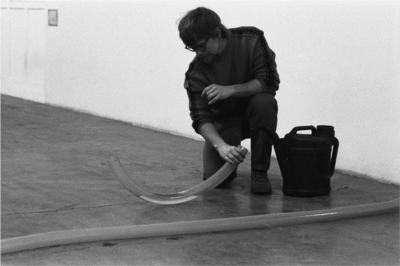
Bill Bollinger studied aeronautical engineering at Brown University before he ever touched a piece of aluminium as an artist. That technical background turned out to matter: when he shifted to sculpture in the early 1960s, he began working with extruded industrial profiles and raw materials in ways that placed him alongside Bruce Nauman, Eva Hesse, and Richard Serra as a leading figure of American[1] Post-Minimalism[1].
Biography
Born in Brooklyn in 1939[1], Bollinger studied briefly at the Art Students League after leaving engineering. His breakthrough came through a series of Channel Pieces (1965[1]-1968[1]): extruded aluminium profiles arranged directly on gallery floors without bases or additional fabrication. He followed these with Pipe Pieces, Rope Pieces, and works in wire mesh, then in 1969-1970 began laying down graphite dust in geometric configurations, removing the sculptural object almost entirely.
His inclusion in "When Attitudes Become Form" at the Kunsthalle Bern in 1969[1] placed him at the centre of the most consequential survey of his generation. He was also awarded a National Council on the Arts grant that year. Yet Bollinger largely disappeared from the critical conversation through the 1970s and 1980s, teaching at the School of Visual Arts and the University of Rhode Island while his contemporaries gained institutional prominence.
He died in 1988[1], aged 48. A 2012 retrospective at SculptureCenter in New York prompted a reassessment of his work, establishing him as one of the more overlooked sculptors of the postwar American[1] avant-garde.
Timeline
- 1939Born in Brooklyn.
- 1960Studied aeronautical engineering at Brown University.
- 1965Began creating "Channel Pieces", extruded aluminium profiles arranged on gallery floors.
- 1969Included in "When Attitudes Become Form" at the Kunsthalle Bern.
- 1969Awarded a National Council on the Arts grant.
- 1969Began laying down graphite dust in geometric configurations.
- 1970Continued laying down graphite dust in geometric configurations.
- 1988Died at 48.
Notable Works
Tap to view larger.
Next stop
Minimalism →
Explore the artists and ideas of Minimalism.
Related Artists



Frequently Asked Questions
What is Bill Bollinger's most famous work?
It is difficult to name a single work as Bill Bollinger's most famous, but certain pieces appear repeatedly in discussions of his practice. Bollinger is known for his sculptural arrangements using industrial materials, often presented in a Minimalist style. One recurring form is his use of rope and cable arrangements, often suspended in ways that explore tension, gravity, and line. These works sometimes incorporate found objects, such as buoys or piping, adding an element of the readymade to his constructions. Bollinger also worked with metal, creating pieces that investigate material properties and spatial relationships. His work often has a temporary, site-specific quality, reacting to the architectural space in which it is installed. Although he produced a varied body of work during his career, his rope and cable sculptures are among his most recognisable and discussed pieces.What should I know about Bill Bollinger's prints?
When considering Bill Bollinger's prints, it is useful to understand some basics of fine-art printmaking. Original prints, such as woodcuts, linocuts, etchings, or serigraphs, are produced by hand; the artist creates the artwork directly on the plate, block, stone, or screen. Each print is considered an original. These are sold through specialist print galleries, frame shops, and fine-art galleries. Offset reproductions, also known as posters, are created via photochemical means. The number of prints can be unlimited, though publishers may limit quantities to increase value. Giclée prints are made using inkjet technology, and canvas transfers involve transferring the image onto canvas for a painting-like effect. Limited editions involve a set number of prints, each numbered (e.g., 35/100, where 100 is the total). Artists may reserve a percentage as artist's proofs, marked "AP". Prints are typically signed and numbered in pencil. The print number and edition number are written on the left bottom margin, the title in the middle, and the signature on the right.What techniques or materials did Bill Bollinger use?
Information on Bill Bollinger's techniques and materials is scarce. However, one can discuss materials and methods used by other artists. Some artists prime cotton duck canvas with two coats of turps-thinned Flake White, then sand the surface when dry. When applying colour to the canvas, standard artist's oil colour (paint) can be mixed with a medium of wax and turpentine. The medium is kept warm (liquid) on a hot plate by the palette, and small amounts are mixed in with the paint by brush just prior to applying colour to the canvas. The mixture is then applied to the canvas with a brush and worked over so the medium and paint are thoroughly mixed and evenly cover the shape. The paint is then worked with a large painting spatula and a small painting knife until it arrives at a satisfactory state. Other materials include Fredrix Red Label medium-textured canvas, hardboard panels primed with acrylic gesso, and canvas-textured paper pads. Mediums and thinners are two separate categories of liquids used to adjust the handling qualities of the paint. Thinners like turpentine or mineral spirits that have been mixed with tube paints evaporate quickly without altering the chemical composition of the paint. Mediums, on the other hand, do alter chemical composition because they add oils or varnishes to the paint.What was Bill Bollinger known for?
Bill Bollinger (1939[1]-1988[1]) was an American[1] sculptor associated with Minimalism[1] and Post-Minimalism. He is best known for his use of everyday industrial materials in simple, elegant arrangements. Born in Brooklyn, New York, Bollinger studied mathematics and engineering before becoming an artist. This background informed his sculptural work, which often employed mathematical or geometric principles. Bollinger's sculptures frequently incorporated materials such as rope, wood, metal pipes, and wire mesh. He arranged these items in ways that emphasised their physical properties and spatial relationships. Examples include suspended rope constructions, arrangements of aluminium pipes, and wire mesh screens. These works often explored balance, tension, and the interplay of positive and negative space. His work shares some features with that of other Post-Minimalist artists, such as Richard Serra and Eva Hesse, but Bollinger's constructions often possess a delicate, almost ephemeral quality. Bollinger's career was relatively short; he died at the age of 49. Despite this, he produced a significant body of work that continues to be exhibited and studied.Where can I see Bill Bollinger's work?
Bill Bollinger's sculptures and drawings are held in numerous public collections. These include museums in the United States and Europe. In New York, his work can be seen at the Museum of Modern Art, the Whitney Museum of American[1] Art, and the Guggenheim Museum. Other American museums holding his pieces are the Hirshhorn Museum and Sculpture Garden in Washington, D.C.; the Walker Art Centre in Minneapolis; and the Carnegie Museum of Art in Pittsburgh. European museums with works by Bollinger include the Kunstmuseum Liechtenstein in Vaduz; the Serralves Museum in Porto, Portugal; and the Tate in London. His art has also been exhibited at the Musée d’Art Moderne Grand-Duc Jean (Mudam) in Luxembourg. Bollinger's sculptures are often constructed from industrial materials. These include rope, metal, and wood. His drawings frequently explore similar forms and spatial relationships. Viewing his work in person provides an opportunity to appreciate the scale and materiality of his constructions.Who did Bill Bollinger influence?
It is difficult to identify specific artists directly influenced by Bill Bollinger. Art history sources often discuss influence in a complex way. Some argue that influence is a construct of art historians and critics, rather than a reflection of direct artistic connection. While Bollinger's work might share characteristics with other artists, establishing a definitive line of influence requires careful consideration. The minimalist Robert Irwin, for example, taught Ed Ruscha, but Ruscha's work also references Pop Art. Similarly, Vija Celmins engaged with household objects, a theme linked to Pop Art, but she was also inspired by Giorgio Morandi. The "game of influence baiting," as one critic termed it, involves identifying artistic connections, but this can be subjective. Art dealers and critics sometimes promote artists as "influencers" to boost their market value. Lucy Lippard suggested that American[1] art has its own roots, separate from European Dada, even though critics often cite Marcel Duchamp as a precedent.Why are Bill Bollinger's works important today?
Bill Bollinger (1939[1]-1988[1]) was an American[1] artist known for his sculptures using industrial materials. He often employed simple, readily available items such as rope, piping, and metal bars. His work explores the relationship between form, space, and gravity. Bollinger's approach is important because it challenges traditional notions of sculpture. Rather than carving or modelling, he assembled pre-existing components. This aligns with minimalist and conceptual art movements, which question the artist's hand and emphasise the idea behind the work. His sculptures frequently interact with their surroundings, creating a dialogue between the artwork and the space it occupies. This site-responsive quality is a continuing concern for many contemporary artists. His use of everyday materials also resonates today. In an era of increasing environmental awareness, Bollinger's resourcefulness offers a model for sustainable artistic practice. By finding beauty and potential in the mundane, he encourages viewers to reconsider their relationship with the built environment.What was Bill Bollinger's art style?
Bill Bollinger's art style is considered Post-Minimalism[1]. He worked with industrial materials like extruded aluminium, pipes, rope, and wire mesh, and he also experimented with graphite dust in geometric configurations.How did Bill Bollinger die?
Bill Bollinger died in 1988[1] at the age of 49.
Sources
Editorial draws on the following primary and tertiary references for Bill Bollinger.
- [1] wikipedia Wikipedia: Bill Bollinger Used for: biography, birth dates, death dates, identifiers, movement attribution, nationality.
- [2] book Hopper, Edward, 1882-1967, Edward Hopper : the art and the artist Used for: stylistic analysis.
- [3] book guggenheim-19artistsemergen00solo Used for: biography.
- [4] book guggenheim-guggenheimintern1964allo Used for: biography.
- [5] book guggenheim-refigur00kren Used for: biography.
- [6] book Beckett, Wendy, The story of painting Used for: biography, stylistic analysis.
Editorial overseen by Solis Prints. Sources verified 2026-09-30. Click a source for details, or hover over [N] in the page above to preview.
Editorial standardsMethodologyCorrectionsAI disclosureAbout the editorial team