



Sol LeWitt
LeWitt wrote a letter to the sculptor Eva Hesse in 1965 when she was paralysed by self-doubt. He told her to try to do some bad work. The worst you can think of and see what happens but mainly relax and let everything go to hell. Two days after Hesse's death in 1970, he created Wall Drawing 46 in her memory, using non-straight lines for the first time. The aesthetic shift was credited to her influence.
Biography
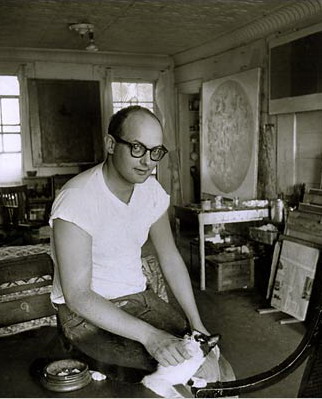
He was born in Hartford, Connecticut, in 1928, to Russian Jewish immigrant parents. His father died when he was six. He drew on wrapping paper from his aunt's shop and took art classes at the Wadsworth Atheneum. He served in the Korean War, then settled in New York.
From 1968, he created over a thousand numbered wall drawings. He conceived them as musical scores that anyone could execute: a set of written instructions, carried out by other people, with the physical drawing destroyed after each exhibition. The idea, he argued, was the machine that makes the art. The execution was secondary. He championed and financially supported women artists who were being sidelined by the male-dominated art world. He refused to participate in celebrity culture and remained deliberately private. He died in 2007.
Timeline
- 1928Born on 9 September in Hartford, Connecticut, to a family of Jewish immigrants from Russia. His father died when he was six.
- 1949At 21, earned a BFA from Syracuse University in New York and travelled to Europe, where he encountered Old Master paintings that would inform his understanding of structure.
- 1955At 27, worked briefly as a draughtsman at I.M. Pei's architectural firm in New York, where exposure to structural design deepened his interest in form and systems.
- 1960At 32, took a night job at the Museum of Modern Art in New York, where he befriended fellow artists Robert Ryman and Dan Flavin.
- 1968At 40, created his first wall drawings in New York, executing works directly on gallery walls from written instructions, a method that redefined authorship in contemporary art.
- 1976At 48, co-founded Printed Matter, Inc. in Tribeca, New York, a non-profit dedicated to artists' books and publications.
- 1986At 58, awarded the Golden Lion at the Venice Biennale. By this time he and his wife Carol Androgio had relocated to Spoleto, Italy.
- 2007Died aged 78 on 8 April in New York City from cancer complications. He left behind over 1,270 wall drawings and hundreds of modular structures.
Notable Works
Tap to view larger.
Where to See Sol LeWitt
6 museums worldwide.
-
 337 works
National Gallery of Art
Washington D.C., United States
Mon–Sat 10:00–17:00, Sun 11:00–18:00 · Free
-
 5 works
Museum of Modern Art
New York City, United States
Daily 10:30–17:30 (Sat until 19:00; first Fri of month until 20:00) · Adults $30, students $17
-
4 works
Stedelijk Museum voor Actuele Kunst
Ghent, Belgium
Tue–Fri 9:30–17:30, Sat–Sun 10:00–18:00, closed Mondays (open until 22:00 on the first Thursday of the month) · €17 adults
- 2 works
Society for the Museum of Contemporary Art
Ghent, Belgium
-
1 works
Toledo Museum of Art
Toledo, United States
-
1 works
Virginia Museum of Fine Arts
Richmond, United States
Mon–Tue 10:00–17:00, Wed–Fri 10:00–21:00, Sat–Sun 10:00–17:00 · Free


Next stop
Minimalism →
Explore the artists and ideas of Minimalism.
Sol LeWitt prints
Hand-finished archival prints from Sol LeWitt's body of work.
 Untitled (from 4x4x4) - Sol LeWitt
From £37.00
Untitled (from 4x4x4) - Sol LeWitt
From £37.00
 Arcs From Sides or Corners, Grids & Circles - Sol LeWitt
From £37.00
Arcs From Sides or Corners, Grids & Circles - Sol LeWitt
From £37.00
 Irregular Vertical and Horizontal Bands of Color Superimposed - Sol LeWitt
From £37.00
Irregular Vertical and Horizontal Bands of Color Superimposed - Sol LeWitt
From £37.00
 Squiggles - Sol LeWitt
From £37.00
Squiggles - Sol LeWitt
From £37.00
 Horizontal Bands with Colors Superimposed - Sol LeWitt
From £37.00
Horizontal Bands with Colors Superimposed - Sol LeWitt
From £37.00
 Not Straight Brushstrokes in All Directions - Sol LeWitt
From £37.00
Not Straight Brushstrokes in All Directions - Sol LeWitt
From £37.00
Related Artists


.jpg!Portrait.jpg)
Take Sol LeWitt home.
See all Sol LeWitt prints →Frequently Asked Questions
How did sol lewitt die?
Sol LeWitt died in 2007 at the age of 79.Is sol lewitt still alive?
No, Sol LeWitt died in 2007.What is sol lewitt known for?
Sol LeWitt is known as one of the foremost exponents of Minimalist Art of the 1960s. He is also an extremely important precursor of Conceptualism.Where did sol lewitt live?
He settled in New York after serving in the Korean War.Who is sol lewitt?
Sol LeWitt is one of the foremost exponents of Minimalist Art of the 1960s. He is also an extremely important precursor of Conceptualism.Who was sol lewitt?
Sol LeWitt is one of the foremost exponents of Minimalist Art of the 1960s. He is also an extremely important precursor of Conceptualism.Sol lewitt facts?
Sol LeWitt created Wall Drawing 46 in memory of Eva Hesse, using non-straight lines for the first time. He also created over a thousand numbered wall drawings from 1968.When was sol lewitt born?
Sol LeWitt was born in 1928 in United States. Sol LeWitt died in 2007, aged 79.Sol lewitt instructions?
From 1968, LeWitt created over a thousand numbered wall drawings. He conceived them as musical scores that anyone could execute: a set of written instructions, carried out by other people, with the physical drawing destroyed after each exhibition.Sol lewitt is associated with which art movement?
Sol LeWitt is associated with Minimalist Art of the 1960s. He is also an important precursor of Conceptualism.What materials did sol lewitt use?
Sol LeWitt worked on wall drawings, drawings on paper, and drawings on three-dimensional pieces. One of his works, Fifteen Part Drawing using four colours and all variations (1970), used graphite on a wall surface.Where is sol lewitt from?
Sol LeWitt was United States, born in 1928 and died in 2007.
Sources
Editorial draws on the following primary and tertiary references for Sol LeWitt.
- [1] museum Toledo Museum of Art Used for: museum holdings.
- [2] museum National Galleries Scotland Used for: museum holdings.
- [3] museum Sprengel Museum Used for: museum holdings.
- [4] museum Museum Boijmans Van Beuningen Used for: museum holdings.
- [5] museum Museum of Grenoble Used for: museum holdings.
- [6] museum Museum of Fine Arts Boston Used for: museum holdings.
- [7] book Beard, Lee, 1973- author, Butler, Adam, author; Van Cleave, Claire, author; Fortenberry, Diane, author; Stirling, Susan, author, Beard, Lee, 1973- author, Butler, Adam, author; Van Cleave, Claire, author; Fortenberry, Diane, author; Stirling, Susan, author - The Art Book_ New Edition, Mini Format Used for: biography, stylistic analysis.
- [8] book guggenheim-guggenheimintern1971solo Used for: biography, museum holdings.
- [9] book Alexander Alberro; Patricia Norvell (editors), Recording Conceptual Art _ Early Interviews with Barry, Huebler, Kaltenbach, LeWitt, Morris, Oppenheim, Siegelaub, Smithson, and Weiner by Patricia Norvell Used for: biography, museum holdings, stylistic analysis.
- [10] book Anfam, David A;Callen, Anthea. Techniques of the impressionists, Techniques of the great masters of art Used for: biography, museum holdings, stylistic analysis.
Editorial overseen by Solis Prints. Sources verified 2026-09-13. Click a source for details, or hover over [N] in the page above to preview.
Editorial standardsMethodologyCorrectionsAI disclosureAbout the editorial team