

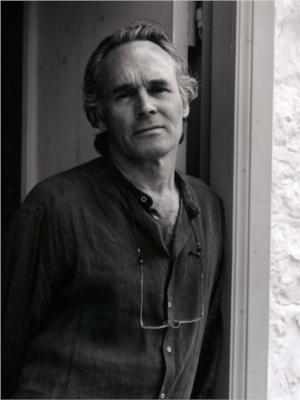
Brice Marden
Brice Marden grew up in Bronxville, New York and studied at Boston University before completing his MFA at Yale in 1963[1]. That autumn he took a job as a guard at the Jewish Museum, where the Jasper Johns retrospective confirmed the direction his painting would take: structurally unified fields of colour that are at once formally austere and quietly charged with feeling. He was drawn specifically to Johns's structural unity between canvas shape and image, and to the intense painterliness of the surface, not to the symbols, irony, or three-dimensional objects.
Biography
His technique distinguishes him from both the Abstract Expressionists and the strict Minimalists. He mixes oil paint with a medium of melted beeswax and turpentine, one part wax to four parts spirits, applied in layers and then worked with a large spatula and painting knife. The wax produces the matte, dense surface he wanted; pure oil was too reflective to read properly. "You simply could not see the picture," he said. Earlier paintings in this medium tend to softer luminescence; later canvases appear harder and less porous.
From the outset he left the lower edges of his canvases unpainted, exposing the built-up layers beneath as a process record. *Paris Painting* (1968[1]), two joined panels, the right lighter than the grey beside it, typifies his multi-panel strategy for combining colours without fragmenting the indivisible unity of each canvas. He calibrated canvas dimensions to the heights of specific people, proposing an analogy with the body. "As a painter I believe in the indisputability of The Plane," he wrote in 1974.
From the mid-1980s, engagement with Chinese and Japanese calligraphy introduced serpentine linear forms. *Event* (2004[1]–07), oil on linen, each panel 180 by 120 cm, shows the later mode: lines moving across the surface, each occupying a defined plane within shallow pictorial space, without intertwining.
Timeline
- 1938Born in Bronxville, New York.
- 1963Completed his MFA at Yale University.
- 1963Began working as a guard at the Jewish Museum.
- 1968Created "Paris Painting", which features two joined panels.
- 1974Wrote about his belief in 'the indisputability of The Plane'.
- 1985Began incorporating serpentine linear forms, influenced by Chinese and Japanese calligraphy.
- 2007Completed "Event", an oil on linen work with lines moving across the surface.
Notable Works
Tap to view larger.
Next stop
Minimalism →
Explore the artists and ideas of Minimalism.
Related Artists


.jpg!Portrait.jpg)
Frequently Asked Questions
What is Brice Marden known for?
Brice Marden is known for his minimalist monochromes from the 1960s. Later in his career, he became known for serpentine linear forms, influenced by Chinese and Japanese calligraphy.What is Brice Marden's most famous work?
Brice Marden is best known for his minimalist paintings from the 1960s onwards. In 1964[1], after a trip to Paris, he began painting single monochrome canvases. He expanded this approach in 1968, creating two- and three-panel works such as *Paris Painting*. Marden's early paintings consist of rectangular monochrome panels with muted colours. These works often feature thick skins of oil paint mixed with wax. The lower edge and sides reveal the layering of paint, suggesting a laborious process. The surfaces recall frescoed walls and the legacy of postwar European painters. Marden's subdued canvases of the 1960s are considered Minimalist. However, he maintained a handmade approach, rather than the industrial methods favoured by other Minimalists. In his 1963 M.F.A. thesis at Yale, he stated his goal was to give the viewer something to which he would react subjectively. Marden often gives his paintings allusive titles taken from places and seasons. The titles and coloration recall nature; *Paris Painting* evokes a cold, grey day in the French capital.What should I know about Brice Marden's prints?
Brice Marden is known for abstract paintings, drawings, and prints characterised by subtle colour and minimalist forms. While information on Marden's printmaking is limited, examining the broader context of 20th-century printmaking can provide some insight. Printmaking during this period saw artists exploring various techniques, such as lithography, etching, and serigraphy (silkscreen). S. W. Hayter, a significant figure, promoted experimentation and automatism in printmaking, influencing many artists. Key printmakers include Josef Albers, noted for his serigraphs exploring colour interaction; Georges Braque, who produced Cubist etchings; and Jasper Johns, Roy Lichtenstein and Ellsworth Kelly, all of whom had prints included in the portfolio "For Meyer Schapiro" (1974[1]). These artists, like Marden, used printmaking to explore themes and ideas present in their other work, often collaborating with master printers to achieve specific effects. The publications of the time, such as Riva Castleman's "Prints of the Twentieth Century: A History", document the rise of printmaking as a major artistic medium. Examining Marden's prints through this lens reveals his place within the wider history of 20th-century graphic arts.What style or movement did Brice Marden belong to?
Brice Marden is associated with both Minimalism[1] and Abstract Expressionism. His initial rise to prominence occurred in the 1960s, a period when his monochrome paintings aligned with Minimalist principles. These paintings often feature serial rectangles and suppressed brushstrokes. Marden's work displays a measured response to the gestural techniques associated with second-generation Abstract Expressionism. However, he never fully embraced the industrial or anonymous approaches favoured by some Minimalists. He maintained a "handmade production" with what some critics saw as evocative associations. His artistic education included an intense study of the figure, and his master's thesis articulated goals of creating paintings in a subjective state, but within Spartan limitations. Marden's paintings invite contemplation of colour variations, surface inflections, and the tensions between separate surfaces. By the mid-1980s, Marden began introducing linear motifs, drawing inspiration from Chinese and Japanese calligraphy.What techniques or materials did Brice Marden use?
Brice Marden is known for his exploration of colour, surface, and form, often employing techniques that highlight the physicality of his materials. In his early monochrome paintings, Marden mixed beeswax with oil paint to create a matte, opaque surface, a departure from the reflective quality of oil paint alone. This innovation came about after a suggestion from painter Harvey Quaytman. Marden applied the wax and oil mixture in layers, reworking each layer with a brush, spatula, and knife until he achieved the desired effect. This process resulted in subtle imperfections and gestures on the surface, further emphasising the material's inherent qualities. The artist primed his cotton duck canvases with two coats of turps-thinned Flake White, sanding the surface when dry. He kept his wax medium warm on a hot plate, adding it to the paint just before application. Later, in the mid-1980s, Marden introduced linear motifs into his work, drawing inspiration from Chinese and Japanese calligraphy. Using a long brush, he painted from a distance, imposing compositional and formal rules on each series of works, creating subtle variations on a theme.What was Brice Marden known for?
Brice Marden (1938[1]-2023[1]) was an American[1] artist, primarily a painter and printmaker. He is best known for his subtle, abstract works that explore colour, surface, and form. Early in his career, Marden created monochrome panels using wax and oil paint, often arranged in series or grids. These works emphasised the materiality of paint and the effects of light on the surface. His interest in colour theory led him to develop a personal palette of muted, earthy tones. In the 1980s, Marden's style shifted towards more calligraphic and linear compositions. Inspired by Asian art and calligraphy, he began incorporating looping lines and gestural marks into his paintings and drawings. These later works retained his focus on colour relationships, but with a greater sense of movement and energy. Marden's prints are closely related to his paintings, often exploring similar themes and compositions. He used various printmaking techniques, including etching, lithography, and screenprinting, to create works that are both visually complex and conceptually rigorous. Throughout his career, Marden's art has been characterised by a careful balance between formal structure and expressive gesture.When did Brice Marden live and work?
Brice Marden was born in Bronxville, New York, in 1938[1]. He is known for his work in abstract painting and printmaking. Marden received a BFA from Boston University in 1961[1]. Afterwards, in 1963, he earned an MFA from Yale University. While at Yale, he encountered artists like Alex Katz, who was a visiting critic. Early in his career, Marden worked as a guard at the Jewish Museum in New York. This position allowed him to study the work of Jasper Johns at close range. Johns's use of encaustic particularly influenced Marden's early paintings. These pieces often featured muted colours and smooth, waxy surfaces. Throughout the 1970s, Marden's work evolved. He began creating diptychs and triptychs, exploring colour relationships and surface textures. He moved away from single-panel paintings. Marden continues to work and exhibit internationally. His art can be found in major museum collections. He currently lives and works in New York City and Tivoli, New York.Where can I see Brice Marden's work?
Brice Marden's paintings and drawings are held in many public collections. In New York City, his work can be viewed at the Museum of Modern Art, the Whitney Museum of American[1] Art, and the Metropolitan Museum of Art. Other major US museums holding works by Marden include the Art Institute of Chicago, the Philadelphia Museum of Art, and the San Francisco Museum of Modern Art. In Europe, Marden's art is represented in the collection of the Tate Modern, London. His work is also held at the Kunstmuseum Basel, Switzerland, and the Stedelijk Museum, Amsterdam. Various other museums and galleries throughout Europe and North America have exhibited his art in both solo and group shows. Check museum websites for current exhibition schedules. Major retrospectives of Marden's career have occurred periodically, often travelling to multiple venues. These provide the most comprehensive view of his artistic development.Where was Brice Marden from?
Brice Marden's early artistic career is associated with New York City. His work was shown at the Wilcox Gallery, Swarthmore College, Pennsylvania, in late 1963[1] and early 1964. Marden had a series of one-man exhibitions and reviews at the Bykert Gallery, New York, starting in November 1966. Carl Andre reviewed Marden's work in the 57th Street Review that same month. Throughout the late 1960s and early 1970s, Marden's art was frequently exhibited in New York galleries, including the Bykert Gallery and Leo Castelli Gallery. His drawings were displayed at Ithaca College Museum of Art, New York, in 1967. By the 1970s, Marden's work began to be shown internationally, including at the Galerie Yvon Lambert, Paris, in 1969, and Konrad Fischer, Dusseldorf, in 1971.Who did Brice Marden influence?
Brice Marden's impact is most visible among younger artists working in abstract painting and drawing. His use of colour, surface texture, and calligraphic line has been particularly influential. Although direct lineages are difficult to trace, Marden's work has affected artists interested in process-based abstraction. His early monochrome panels, with their wax surfaces, encouraged a generation to explore the material qualities of paint. The Cold Mountain series (1988[1]-1991[1]), with its loose, gestural lines, provided a model for combining spontaneity and control. Marden's drawings, often made in series and exploring similar motifs to his paintings, have also been influential. Their emphasis on repetition, variation, and the expressive potential of simple marks resonates with artists interested in minimalist aesthetics. His impact can be seen in the work of painters such as Christopher Wool, who uses silkscreen techniques to create layered, abstract compositions. Other artists, like Jacqueline Humphries, have explored similar territory, using complex layering and unconventional materials.Who influenced Brice Marden?
Brice Marden's artistic development involved several influences. He studied at Boston University, and later at Yale University School of Art, receiving a BFA in 1961[1] and an MFA in 1963. Marden's early work shows an interest in painters such as Jasper Johns, and the sculptor, Constantin Brâncuși. The influence of Johns is apparent in Marden's use of encaustic, a wax-based paint, which gives his surfaces a textured quality. Brâncuși's impact can be seen in Marden's concern with form and simplified shapes. Later, Marden's travels to places such as Greece had an impact on his work; the light and architecture of the Mediterranean became important inspirations. His use of colour and line evolved, influenced by the natural world and classical forms. He also drew inspiration from calligraphy, particularly Chinese calligraphy, which led to more gestural and linear elements in his paintings and drawings.Who was Brice Marden?
Brice Marden (1938[1]-2023[1]) was an American[1] artist, primarily known for his abstract paintings and prints. He was born in Bronxville, New York. Marden received a BFA from Boston University in 1961[1], and a MFA from Yale University in 1963. Early in his career, Marden explored monochromatic painting, often using encaustic (wax) to create surfaces with depth. He worked as a guard at the Jewish Museum in New York, where he encountered the work of Jasper Johns; Johns's use of encaustic influenced Marden's early style. Throughout the 1970s, Marden's palette expanded, and he began creating multi-panel works exploring colour relationships. His work often involved layering colours to create subtle variations and atmospheric effects. In the 1980s, a trip to Asia influenced his work, leading to calligraphic elements and a looser, more gestural style. Marden's prints are closely related to his paintings, often revisiting similar themes and compositions. He experimented with various printmaking techniques, including etching, lithography, and screenprinting. His work can be found in major museum collections, including the Museum of Modern Art, the Tate, and the Centre Pompidou.
Sources
Editorial draws on the following primary and tertiary references for Brice Marden.
- [1] wikipedia Wikipedia: Brice Marden Used for: biography, birth dates, death dates, identifiers, movement attribution, nationality.
- [2] book Beard, Lee, 1973- author, Butler, Adam, author; Van Cleave, Claire, author; Fortenberry, Diane, author; Stirling, Susan, author, Beard, Lee, 1973- author, Butler, Adam, author; Van Cleave, Claire, author; Fortenberry, Diane, author; Stirling, Susan, author - The Art Book_ New Edition, Mini Format Used for: biography, stylistic analysis.
- [3] book guggenheim-bricemardencatal00mard Used for: biography, stylistic analysis.
- [4] book guggenheim-museum00solo Used for: biography, stylistic analysis.
Editorial overseen by Solis Prints. Sources verified 2026-08-29. Click a source for details, or hover over [N] in the page above to preview.
Editorial standardsMethodologyCorrectionsAI disclosureAbout the editorial team