



About Edward Hicks
- naïve art
Quaker minister who painted 62 versions of The Peaceable Kingdom, using Biblical imagery to argue his way through the fractures of early American[1] Quakerism.
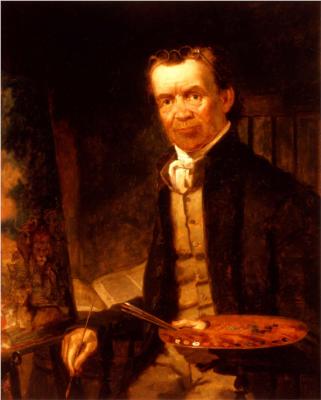
Where to see Edward Hicks
Collection holdings are reported here; current display varies. Check with each museum before visiting.
-
6 recorded works
National Gallery of Art
Washington D.C., United States
-
4 recorded works
Yale University Art Gallery
New Haven, United States


-
2 recorded works
Carnegie Museum of Art
Pittsburgh, United States
-
2 recorded works
The Nelson-Atkins Museum of Art
Kansas City, United States
-
2 recorded works
Metropolitan Museum of Art
New York City, United States
-
2 recorded works
Museum of Fine Arts, Houston
Houston, United States
-
1 recorded work
Buffalo AKG Art Museum
Buffalo, United States
-
1 recorded work
Pennsylvania Academy of the Fine Arts
Philadelphia, United States
-
1 recorded work
Worcester Art Museum
Worcester, United States
-
1 recorded work
Gilcrease Museum
Tulsa, United States


View all 11 museums
-
1 recorded work
Fine Arts Museums of San Francisco
San Francisco, United States

Frequently Asked Questions
Where can I see Edward Hicks's work?
Edward Hicks's work can be viewed in several locations. In New York City, examples are held at the Metropolitan Museum of Art, the Museum of Modern Art, and the Whitney Museum of American[1] Art. You can also find his pieces at the Yale University Art Gallery in New Haven, Connecticut. Further works are on display at the Philadelphia Museum of Art, and at the Pennsylvania Academy of the Fine Arts, also in Philadelphia. The Carnegie Museum of Art in Pittsburgh has examples, too. In Washington, DC, Hicks's art can be seen at the National Gallery of Art and the National Museum of American Art. Other locations include the Los Angeles County Museum of Art (LACMA), the Minneapolis Institute of Arts, the Virginia Museum of Fine Arts in Richmond, and the Worcester Art Museum. These institutions provide opportunities to see Hicks's artistic output.What should I know about Edward Hicks's prints?
When assessing Edward Hicks's prints, bear in mind some basic information about printmaking. Printmakers often limit the number of copies of an image they produce, although there is no technical requirement to do so. The artist's decision to limit an edition is recorded in pencil at the bottom margin of each print, following standard conventions. These conventions include a print number and an edition number, the print's title in the centre, and the artist's signature on the right. These descriptions are subject to the Trade Descriptions Act of 1968, so any claims must be truthful when describing the print. Original prints are conceived and executed solely as prints, usually in numbered editions signed by the artist. Each print in the edition is an original, printed individually from a matrix created for that purpose. Reproductions, on the other hand, are copies of artworks initially conceived in another medium, such as painting or watercolour, and made by photomechanical means. Numbering and signing a reproduction does not change its status as a copy rather than an original print.Why are Edward Hicks's works important today?
Edward Hicks (1780[1]-1849[1]) was an American[1] folk painter and Quaker minister. Hicks is best known for his series of paintings titled "Peaceable Kingdom". These works, produced in many versions, depict a scene inspired by Isaiah 11:6-9, showing a collection of animals, including a lion, lamb, bear, and wolf, coexisting peacefully. Hicks's art provides insight into 19th-century American religious and social values. As a devout Quaker, his paintings often conveyed his spiritual beliefs and pacifist ideals. The "Peaceable Kingdom" paintings, in particular, reflect the Quaker vision of harmony and reconciliation. His work is significant for its contribution to American folk art. Hicks's style is characterised by its simplicity, directness, and lack of formal training. These qualities give his paintings a unique charm and authenticity that appeals to modern audiences. His paintings offer a window into a specific time and place in American history. They document the values, beliefs, and artistic sensibilities of a particular community.What techniques or materials did Edward Hicks use?
Edward Hicks (1780[1]-1849[1]) was an American[1] folk painter, best known for his series of paintings titled "Peaceable Kingdom". Hicks was largely self-taught, and his artistic techniques were somewhat unconventional. Initially apprenticed to coach makers, Hicks learned decorative painting, which influenced his later work. He often used house paint, rather than traditional artists' pigments, which contributed to the distinctive look of his paintings. His brushwork is characterised by its directness and lack of blending. Hicks's painting process typically involved sketching the composition directly onto the canvas, then applying thin layers of paint. He sometimes added glazes to create depth and luminosity. His colour palette was relatively limited, consisting primarily of earth tones, blues, and reds. While not formally trained, Hicks developed a unique style that suited his artistic vision and the demands of his subject matter. His paintings have a distinctive, somewhat primitive quality that is part of their charm and appeal.Who influenced Edward Hicks?
Edward Hicks began his career painting decorative panels for coaches and tavern signs. His style is considered typical of early American[1] painting. Hicks was an active Quaker preacher, and his Christian values influenced his subjects. He reflected these values in his compositions, and he sold paintings to finance his travels as a missionary. His most frequent subject was "The Peaceable Kingdom", which he painted repeatedly with slight variations. This subject relates to the eleventh chapter of the Book of Isaiah, which concerns peace between people and animals. Benjamin West, another American artist who spent time in London, was an extremely influential figure in the development of American art. West had enormous flair and versatility, achieving great popularity. His London studio became a training location for important American artists, but it is not clear whether Hicks was directly influenced by West, or if they simply shared a similar background.What is Edward Hicks's most famous work?
It is difficult to identify one single work as Edward Hicks's most famous. He is best known for a series of paintings on one theme, rather than a single canvas. Hicks repeatedly returned to the subject of "The Peaceable Kingdom". He created numerous versions of this composition throughout his career. These paintings draw inspiration from the Book of Isaiah, specifically the passage describing a time when wild animals and humans will live together in harmony. These works typically depict a pastoral scene with a group of animals, including lions, bears, wolves, and lambs, coexisting peacefully. In the background, one often sees William Penn negotiating a treaty with the Native Americans. This reflects Hicks's Quaker beliefs and his hope for reconciliation and harmony between different groups of people. The paintings combine religious, historical, and utopian themes.What style or movement did Edward Hicks belong to?
Edward Hicks (born in Bucks County, Pennsylvania, in 1780[1]; died in Langhorne, Pennsylvania, in 1849[1]) is associated with early American[1] painting, often described as naive. Hicks's style is characterised by its directness and simplicity, reflecting the values he preached as an active Quaker. Hicks began his career as an apprentice to a coachmaker, where he painted decorative panels. He later painted tavern signs, and his art often promoted Christian values. His paintings, such as "The Peaceable Kingdom" (circa 1833[1]/4), illustrate this with depictions of animals and children in an idealised setting. These paintings also include William Penn concluding a treaty with the Indians, further communicating goodwill and harmony. Hicks created many versions of "The Peaceable Kingdom", each with slight alterations. The basic colour scheme and naive style of Hicks's work reinforce its simple message. His landscapes reflected his Christian beliefs, and he sold them to fund his missionary travels.What was Edward Hicks known for?
Edward Hicks (1780[1]-1849[1]) was an American[1] primitive painter and Quaker preacher. Hicks began his career apprenticed to a coachmaker, painting decorative panels. He also painted tavern signs. He is known for his paintings reflecting Christian values, which he sold to fund his missionary travels. His style is considered naive. Many critics compare him to Rousseau. Hicks is best known for his series *The Peaceable Kingdom*, representing the eleventh chapter of the Book of Isaiah. These paintings depict animals and children together in an idealised scene. Often, they include William Penn, the founder of Pennsylvania, concluding a treaty with Native Americans. Hicks produced numerous versions of *The Peaceable Kingdom*, each with slight variations.
Sources
Where to See guide aggregates verified holdings of Edward Hicks's works across the following collections.
- [1] wikipedia Wikipedia: Edward Hicks Used for: biography.
- [2] book Laurie Adams, 9780077551957.pdf Used for: biography.
- [3] book Jesse Bryant Wilder, Art History For Dummies Used for: biography.
- [4] book Jed Perl, Art in America 1945-1970 Used for: biography.
- [5] book Beard, Lee, 1973- author, Butler, Adam, author; Van Cleave, Claire, author; Fortenberry, Diane, author; Stirling, Susan, author, Beard, Lee, 1973- author, Butler, Adam, author; Van Cleave, Claire, author; Fortenberry, Diane, author; Stirling, Susan, author - The Art Book_ New Edition, Mini Format Used for: biography.
- [6] book Masterpieces of western art : a history of art in 900 individual studies from the Gothic to the present day Used for: biography.
Editorial overseen by Solis Prints. Sources verified 2026-10-06. Click a source for details, or hover over [N] in the page above to preview.
Editorial standardsMethodologyCorrectionsAI disclosureAbout the editorial team