



About Arthur Beecher Carles
- American modernism
Philadelphia colourist who studied with Matisse's circle in Paris and showed at Stieglitz's 291, later cited as a forerunner of colour abstraction.
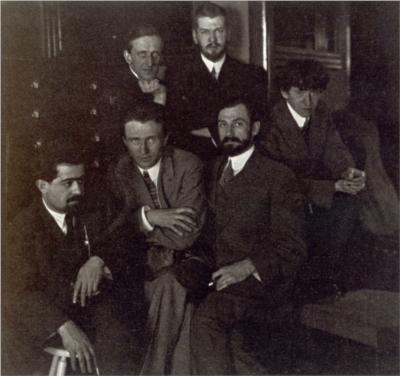
Where to see Arthur Beecher Carles
Collection holdings are reported here; current display varies. Check with each museum before visiting.
-
12 recorded works
Pennsylvania Academy of the Fine Arts
Philadelphia, United States
-
3 recorded works
Metropolitan Museum of Art
New York City, United States


-
2 recorded works
Art Institute of Chicago
Chicago, United States
-
1 recorded work
Buffalo AKG Art Museum
Buffalo, United States
-
1 recorded work
New Britain Museum of American Art
New Britain, United States
-
1 recorded work
Carnegie Museum of Art
Pittsburgh, United States
-
1 recorded work
National Gallery of Art
Washington D.C., United States
-
1 recorded work
Museum of Modern Art
New York City, United States
-
1 recorded work
RISD Museum
Providence, United States
-
1 recorded work
Crystal Bridges Museum of American Art
Bentonville, United States


Frequently Asked Questions
Where can I see Arthur Beecher Carles's work?
To view work by Arthur Beecher Carles, consider the collections of several prominent museums. In the United States, these include the Metropolitan Museum of Art in New York, the Museum of Modern Art (also in New York), the Los Angeles County Museum of Art (LACMA), the Minneapolis Institute of Arts, the Charles Hosmer Morse Museum of American[1] Art in Winter Park, Florida, and the Virginia Museum of Fine Arts in Richmond. Outside the United States, the Royal Ontario Museum in Toronto may hold relevant works. These institutions also feature art deco objects; a related field. Please check each museum's website for current holdings and exhibition schedules before planning a visit, as artworks on display can change.What should I know about Arthur Beecher Carles's prints?
When considering Arthur Beecher Carles's prints, it is helpful to understand some basic principles of printmaking. An original print is conceived as a print, executed solely as a print, and usually produced in a numbered edition, signed by the artist. Each print in the edition is an original, printed from a plate, stone, screen, block, or other matrix created for that purpose. There is no single original print from which copies are made. Each print is inked and pulled individually; it is a multi-original medium. The number of prints in the edition is decided by the artist, and the sequential numbering provides an accounting for the number of prints in the edition. Each print has a specific number; for example, 12/25 means it is print number 12 from an edition of 25. Early prints were not always numbered or signed; in some cases, the artist might have signed the plate or stone itself, with no pencilled signature on each print. The edition claim is written as a pair of numbers on the left bottom margin of the print itself: it consists of a print number and an edition number written as a group with a short separating line between them. The print number is written above or to the left, the edition size is written below or to the right. The title of the print is written in the middle of the bottom margin of the print. The signature (and/or chop mark) is on the right of the bottom margin of the print. Edition descriptions are always signed in pencil.Why are Arthur Beecher Carles's works important today?
Arthur Beecher Carles's works are important because they represent a pursuit of a new mode of creativity that would meet the needs of modern men and women. Carles lived during a period when artists and designers felt that the established rules of the academies were no longer adequate. A new way of doing things was needed. The Art Nouveau movement, to which Carles is connected, was based on a shared belief in the necessity for innovation. Artists looked to various sources for guidance, including the natural sciences, pagan antiquity, and emerging ideas about the unconscious. This resulted in a staggering variety of work, marked by the primacy given to subjective experience. Carles's art reflects a desire to dissolve boundaries between different art forms and to bring beauty into everyday life. This breaking down of hierarchies, which separated the fine arts from the mechanical arts, was central to the Art Nouveau movement. Alternative cultural models, such as ancient Greece or Japan, were seen as evidence that it was possible to transcend these categories and invest all areas of life with aesthetic and spiritual value.What techniques or materials did Arthur Beecher Carles use?
Arthur Beecher Carles employed a range of techniques and materials in his art. Some sources mention the use of wax as a painting medium, citing its durability and resistance to yellowing, in contrast to oils and varnishes. Recipes from the early 20th century describe mixtures of white wax with substances like carbon tetrachloride, turpentine, benzene, spike oil of lavender, and gum elemi. For works on paper, a manual from 1934[1] suggests mounting enlargements on beaver board, three-ply board, or linen canvas. Preparatory layers might include solutions of acetic acid, gelatin, and glue, or a casein mixture with borax, alcohol, glycerin, and carbolic acid. These prepared surfaces could then be painted with oils, watercolours, or tempera colours combined with the casein mixture. The use of photography also influenced painting techniques. A 1936 manual recommends painting oil portraits over carbon prints on canvas, using a starch and mucilage priming. The "Russian method" of colouring involved rubbing transparent oils onto the surface with cotton.Who did Arthur Beecher Carles influence?
The available references do not directly address Arthur Beecher Carles's influence on other artists. However, they do provide some context regarding artistic influence and movements in the late 19th and early 20th centuries, particularly concerning Impressionism and still-life painting. Monet's Impressionistic style influenced many American[1] artists, such as Childe Hassam, who adapted these approaches to American subjects. Monet's later waterlily paintings had an impact on American Abstract Expressionists in the 1950s, after André Masson wrote about them and the Museum of Modern Art acquired one. Still-life painting was also a significant genre, with figures like Samuel Marsden Brookes in San Francisco. Emil Carlsen, who taught at the California School of Design, brought renewed appreciation for Chardin. The husband-and-wife team of William and Alberta McCloskey were also painters of still lifes. Anne Bremer, from San Francisco, shifted towards Modernism after seeing works by Cézanne and Matisse.What is Arthur Beecher Carles's most famous work?
It is difficult to name Arthur Beecher Carles's single most famous work, as opinions vary. He produced a diverse body of work throughout his career. Carles was active during the early 20th century, a period of significant change in the art world. He is associated with the American[1] modernism movement, and his style evolved over time, incorporating elements of Impressionism, Post-Impressionism, and Cubism. This stylistic variation makes it difficult to identify one piece as definitively his most well-known. His body of work includes still lifes, portraits, and abstract compositions. These paintings demonstrate his exploration of colour and form. Without specific data indicating one work's superior notability, it is more accurate to appreciate his contribution as a whole, rather than focusing on a single piece.What style or movement did Arthur Beecher Carles belong to?
Arthur Beecher Carles (1882[1]-1952[1]) was an American[1] modernist painter, whose work engaged with several contemporary European movements. Initially, Carles adopted a style influenced by Fauvism and Post-Impressionism, characterised by its bold use of colour. Later, he experimented with Cubism, incorporating its geometric forms and fragmented perspectives into his compositions. Some critics have noted an affinity between Carles's approach and Synchromism, an early abstract movement that explored colour relationships. Carles's move towards abstraction was gradual, but by the 1920s, he was producing non-objective works. Throughout his career, he synthesised various modernist idioms, rather than adhering strictly to any single one. His paintings often feature dynamic compositions and a strong emphasis on the expressive potential of colour.What was Arthur Beecher Carles known for?
Arthur Beecher Carles (1882[1]-1952[1]) was an American[1] modernist painter, known for his explorations of colour and form. He experimented with various styles, including Impressionism, Cubism, and Fauvism, synthesising them into a personal approach. Carles studied at the Pennsylvania Academy of the Fine Arts, and later travelled to Europe, where he encountered the work of Matisse and other modernists. Carles was interested in abstracting the essence of his subjects, rather than depicting them realistically. He often used bold, non-naturalistic colour to convey emotion and create visual impact. His work includes still lifes, portraits, and abstract compositions. Carles also taught at the Pennsylvania Academy, influencing a generation of artists. Despite facing personal struggles and a decline in his later years, Carles is recognised for his contribution to the development of modernism in American art.
Sources
Where to See guide aggregates verified holdings of Arthur Beecher Carles's works across the following collections.
- [1] wikipedia Wikipedia: Arthur Beecher Carles Used for: biography.
- [2] book Hopper, Edward, 1882-1967;Levin, Gail, 1948-;Whitney Museum of American Art;Philip Morris Incorporated;National Endowment for the Arts;Hayward Gallery, Edward Hopper : the art and the artist Used for: biography.
- [3] book Hopper, Edward, 1882-1967, Edward Hopper : the art and the artist Used for: biography.
- [4] book Landauer, Susan, The not-so-still life : a century of California painting and sculpture Used for: biography, stylistic analysis.
Editorial overseen by Solis Prints. Sources verified 2026-09-30. Click a source for details, or hover over [N] in the page above to preview.
Editorial standardsMethodologyCorrectionsAI disclosureAbout the editorial team