



Arthur Beecher Carles
- American modernism
Arthur Beecher Carles has a better claim than almost any American[1] of his generation to the title of pure colourist. The Philadelphia painter spent years in Paris absorbing Matisse at first hand through the Stein circle, then brought that chromatic intelligence back to Pennsylvania, where he produced paintings and taught with an intensity that outran his era's capacity to appreciate him.
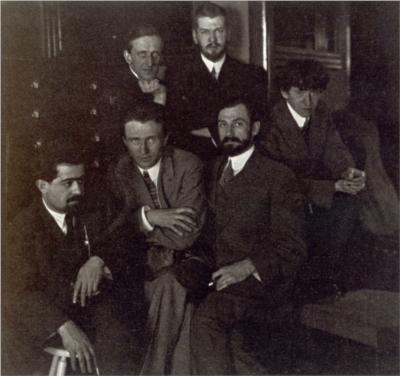
Biography
Born in Philadelphia on 9 March 1882[1], Carles studied at the Pennsylvania Academy of the Fine Arts from 1900[1] to 1907 under Hugh Breckenridge, Henry McCarter, Cecilia Beaux, and William Merritt Chase. He won the Cresson Travelling Scholarship in both 1905 and 1906, funding extended time in Paris, where his encounter with the Matisse circle proved decisive. His first solo exhibition, held in January 1912 at Alfred Stieglitz's legendary 291 gallery in New York, placed him in the most progressive company in American[1] art.
Carles taught at PAFA from 1917[1] to 1925, then continued to instruct students privately, among them the painter Jane Piper. His work moved through tonalism and Impressionism toward an increasingly abstract use of colour that anticipated Abstract Expressionism by two decades. His mother's death in 1927 sent him into a depression compounded by alcoholism and requiring hospitalisation. A stroke in 1941 left him partially paralysed, ending his active career.
He died, on his seventieth birthday, on 9 March 1952[1]. Posthumous exhibitions at the Whitney Museum, the Corcoran Gallery, and the Hirshhorn confirmed a reputation that his lifetime had not properly rewarded.
Timeline
- 1882Born in Philadelphia on 9 March.
- 1900Began studying at the Pennsylvania Academy of the Fine Arts (PAFA).
- 1905Awarded the Cresson Travelling Scholarship, funding time in Paris.
- 1906Awarded the Cresson Travelling Scholarship for a second time, funding further time in Paris.
- 1912Held his first solo exhibition at Alfred Stieglitz's 291 gallery in New York.
- 1917Began teaching at the Pennsylvania Academy of the Fine Arts.
- 1925Stopped teaching at PAFA, continuing to instruct students privately.
- 1927Experienced depression and alcoholism after his mother's death, requiring hospitalisation.
- 1941Suffered a stroke that left him partially paralysed, ending his career.
- 1952Died on his 70th birthday, 9 March.
Notable Works
Tap to view larger.
Next stop
Browse the movements →
Every movement in the collection, from the Renaissance to Pop art.
Related Artists


Frequently Asked Questions
What is Arthur Beecher Carles known for?
Arthur Beecher Carles is known as a pure colourist. His first solo exhibition was held in January 1912[1] at Alfred Stieglitz's 291 gallery in New York.What is Arthur Beecher Carles's most famous work?
It is difficult to name Arthur Beecher Carles's single most famous work, as opinions vary. He produced a diverse body of work throughout his career. Carles was active during the early 20th century, a period of significant change in the art world. He is associated with the American[1] modernism movement, and his style evolved over time, incorporating elements of Impressionism, Post-Impressionism, and Cubism. This stylistic variation makes it difficult to identify one piece as definitively his most well-known. His body of work includes still lifes, portraits, and abstract compositions. These paintings demonstrate his exploration of colour and form. Without specific data indicating one work's superior notability, it is more accurate to appreciate his contribution as a whole, rather than focusing on a single piece.What should I know about Arthur Beecher Carles's prints?
When considering Arthur Beecher Carles's prints, it is helpful to understand some basic principles of printmaking. An original print is conceived as a print, executed solely as a print, and usually produced in a numbered edition, signed by the artist. Each print in the edition is an original, printed from a plate, stone, screen, block, or other matrix created for that purpose. There is no single original print from which copies are made. Each print is inked and pulled individually; it is a multi-original medium. The number of prints in the edition is decided by the artist, and the sequential numbering provides an accounting for the number of prints in the edition. Each print has a specific number; for example, 12/25 means it is print number 12 from an edition of 25. Early prints were not always numbered or signed; in some cases, the artist might have signed the plate or stone itself, with no pencilled signature on each print. The edition claim is written as a pair of numbers on the left bottom margin of the print itself: it consists of a print number and an edition number written as a group with a short separating line between them. The print number is written above or to the left, the edition size is written below or to the right. The title of the print is written in the middle of the bottom margin of the print. The signature (and/or chop mark) is on the right of the bottom margin of the print. Edition descriptions are always signed in pencil.What style or movement did Arthur Beecher Carles belong to?
Arthur Beecher Carles (1882[1]-1952[1]) was an American[1] modernist painter, whose work engaged with several contemporary European movements. Initially, Carles adopted a style influenced by Fauvism and Post-Impressionism, characterised by its bold use of colour. Later, he experimented with Cubism, incorporating its geometric forms and fragmented perspectives into his compositions. Some critics have noted an affinity between Carles's approach and Synchromism, an early abstract movement that explored colour relationships. Carles's move towards abstraction was gradual, but by the 1920s, he was producing non-objective works. Throughout his career, he synthesised various modernist idioms, rather than adhering strictly to any single one. His paintings often feature dynamic compositions and a strong emphasis on the expressive potential of colour.What techniques or materials did Arthur Beecher Carles use?
Arthur Beecher Carles employed a range of techniques and materials in his art. Some sources mention the use of wax as a painting medium, citing its durability and resistance to yellowing, in contrast to oils and varnishes. Recipes from the early 20th century describe mixtures of white wax with substances like carbon tetrachloride, turpentine, benzene, spike oil of lavender, and gum elemi. For works on paper, a manual from 1934[1] suggests mounting enlargements on beaver board, three-ply board, or linen canvas. Preparatory layers might include solutions of acetic acid, gelatin, and glue, or a casein mixture with borax, alcohol, glycerin, and carbolic acid. These prepared surfaces could then be painted with oils, watercolours, or tempera colours combined with the casein mixture. The use of photography also influenced painting techniques. A 1936 manual recommends painting oil portraits over carbon prints on canvas, using a starch and mucilage priming. The "Russian method" of colouring involved rubbing transparent oils onto the surface with cotton.What was Arthur Beecher Carles known for?
Arthur Beecher Carles (1882[1]-1952[1]) was an American[1] modernist painter, known for his explorations of colour and form. He experimented with various styles, including Impressionism, Cubism, and Fauvism, synthesising them into a personal approach. Carles studied at the Pennsylvania Academy of the Fine Arts, and later travelled to Europe, where he encountered the work of Matisse and other modernists. Carles was interested in abstracting the essence of his subjects, rather than depicting them realistically. He often used bold, non-naturalistic colour to convey emotion and create visual impact. His work includes still lifes, portraits, and abstract compositions. Carles also taught at the Pennsylvania Academy, influencing a generation of artists. Despite facing personal struggles and a decline in his later years, Carles is recognised for his contribution to the development of modernism in American art.When did Arthur Beecher Carles live and work?
Arthur Beecher Carles was born in Boston, Massachusetts, in 1876. He died in Los Angeles in 1954. At a young age, Carles moved with his family to Minneapolis. He took night-school art classes and worked as an illustrator for the Minneapolis Times. Later, he enrolled at the Art Students League, New York, and the School of the Museum of Fine Arts, Boston. In 1905[1], Carles earned a scholarship to study in Europe. He taught at the Groton School, Boston, in 1912. By 1914, he had co-founded the School for Illustration and Painting in Los Angeles. He also taught at the University of Southern California, Los Angeles, and the Otis Art Institute, Los Angeles. Carles is known for his portraits, figure studies, and still lifes.Where can I see Arthur Beecher Carles's work?
To view work by Arthur Beecher Carles, consider the collections of several prominent museums. In the United States, these include the Metropolitan Museum of Art in New York, the Museum of Modern Art (also in New York), the Los Angeles County Museum of Art (LACMA), the Minneapolis Institute of Arts, the Charles Hosmer Morse Museum of American[1] Art in Winter Park, Florida, and the Virginia Museum of Fine Arts in Richmond. Outside the United States, the Royal Ontario Museum in Toronto may hold relevant works. These institutions also feature art deco objects; a related field. Please check each museum's website for current holdings and exhibition schedules before planning a visit, as artworks on display can change.Where was Arthur Beecher Carles from?
Arthur Beecher Carles was born in Boston, Massachusetts, in 1876. At a young age, he moved with his family to Minneapolis. There, he took night-school art classes and worked as an illustrator for the Minneapolis Times. Carles later enrolled at the Art Students League, New York, and the School of the Museum of Fine Arts, Boston. In 1905[1], he received a scholarship to study in Europe. By 1912, Carles taught at the Groton School, Boston. Carles co-founded the School for Illustration and Painting in Los Angeles in 1914. He also taught at the University of Southern California, Los Angeles, and the Otis Art Institute, Los Angeles. Carles died in 1954, in Los Angeles. He is known for his portraits, figure studies and still lifes.Who did Arthur Beecher Carles influence?
The available references do not directly address Arthur Beecher Carles's influence on other artists. However, they do provide some context regarding artistic influence and movements in the late 19th and early 20th centuries, particularly concerning Impressionism and still-life painting. Monet's Impressionistic style influenced many American[1] artists, such as Childe Hassam, who adapted these approaches to American subjects. Monet's later waterlily paintings had an impact on American Abstract Expressionists in the 1950s, after André Masson wrote about them and the Museum of Modern Art acquired one. Still-life painting was also a significant genre, with figures like Samuel Marsden Brookes in San Francisco. Emil Carlsen, who taught at the California School of Design, brought renewed appreciation for Chardin. The husband-and-wife team of William and Alberta McCloskey were also painters of still lifes. Anne Bremer, from San Francisco, shifted towards Modernism after seeing works by Cézanne and Matisse.Who influenced Arthur Beecher Carles?
Arthur Beecher Carles, an American[1] modernist, absorbed a variety of influences throughout his career. Early on, he was exposed to Impressionism and Post-Impressionism. Later, he encountered Cubism and Fauvism, movements that would shape his mature style. While specific names are not cited in the provided texts, it is clear that Carles, like many American artists of the late 19th and early 20th centuries, looked to Europe for artistic inspiration. This was a common practice, with artists travelling abroad to study and observe the latest stylistic developments. The texts mention artists such as Chase and Sargent, who were influenced by European masters and movements, suggesting a broader trend of American artists drawing from European sources. He would have seen works by artists such as Manet, Velazquez, Whistler, and members of the Barbizon school.Who was Arthur Beecher Carles?
Arthur Beecher Carles was born in Boston, Massachusetts, in 1876. He died in Los Angeles in 1954. Early in life, Carles moved with his family to Minneapolis. He took art classes in the evening and worked as an illustrator for the Minneapolis Times. He later enrolled at the Art Students League, New York, and the School of the Museum of Fine Arts, Boston. In 1905[1], he received a scholarship to study in Europe. Carles taught at the Groton School, Boston, in 1912. In 1914, he co-founded the School for Illustration and Painting in Los Angeles. He also taught at the University of Southern California, Los Angeles, and the Otis Art Institute, Los Angeles. Carles is known for his portraits, figure studies, and still life works.
Sources
Editorial draws on the following primary and tertiary references for Arthur Beecher Carles.
- [1] wikipedia Wikipedia: Arthur Beecher Carles Used for: biography, birth dates, death dates, identifiers, movement attribution, nationality.
- [2] book Hopper, Edward, 1882-1967;Levin, Gail, 1948-;Whitney Museum of American Art;Philip Morris Incorporated;National Endowment for the Arts;Hayward Gallery, Edward Hopper : the art and the artist Used for: biography.
- [3] book Hopper, Edward, 1882-1967, Edward Hopper : the art and the artist Used for: biography.
- [4] book Landauer, Susan, The not-so-still life : a century of California painting and sculpture Used for: biography, stylistic analysis.
Editorial overseen by Solis Prints. Sources verified 2026-08-29. Click a source for details, or hover over [N] in the page above to preview.
Editorial standardsMethodologyCorrectionsAI disclosureAbout the editorial team