



About Alexandre Benois
Co-founder of the World of Art movement with Diaghilev, librettist of Petrouchka, and Russia's most authoritative art critic of the early twentieth century.
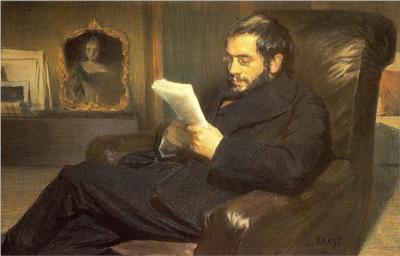
Where to see Alexandre Benois
Collection holdings are reported here; current display varies. Check with each museum before visiting.
-
22 recorded works
National Gallery of Armenia
Yerevan, Armenia
Also here (6)
-
1 recorded work
National Gallery of Art
Washington D.C., United States


-
1 recorded work
Nationalmuseum
Stockholm, Sweden
-
1 recorded work
Metropolitan Museum of Art
New York City, United States
-
1 recorded work
National Museum in Warsaw
Warsaw, Poland


Own a piece of it
Alexandre Benois prints
Hand-finished archival prints from Alexandre Benois's body of work.
 Peterhof Palace: Merchant Staircase at the Grand Palace - Alexandre Benois
From £28.00
Peterhof Palace: Merchant Staircase at the Grand Palace - Alexandre Benois
From £28.00
 Letter L (Alphabet) - Alexandre Benois
From £28.00
Letter L (Alphabet) - Alexandre Benois
From £28.00
 At the Pool of Ceres - Alexandre Benois
From £28.00
At the Pool of Ceres - Alexandre Benois
From £28.00
 Interieur - Alexandre Benois
From £28.00
Interieur - Alexandre Benois
From £28.00
 Versailles. Fountain of Bacchus in the winter - Alexandre Benois
From £28.00
Versailles. Fountain of Bacchus in the winter - Alexandre Benois
From £28.00
 Peterhof Palace. Vases at the channel - Alexandre Benois
From £37.00
Peterhof Palace. Vases at the channel - Alexandre Benois
From £37.00
 Breton Landscape - Alexandre Benois
From £28.00
Breton Landscape - Alexandre Benois
From £28.00
 Military Parade of Emperor Paul in front of Mikhailovsky Castle - Alexandre Benois
From £28.00
Military Parade of Emperor Paul in front of Mikhailovsky Castle - Alexandre Benois
From £28.00
Can't travel? Bring Alexandre Benois home.
See all Alexandre Benois prints →Frequently Asked Questions
Where can I see Alexandre Benois's work?
Alexandre Benois (1870[1]-1960[1]) was a prolific artist, designer, and critic. Museums with holdings of his work include the Musée des Arts Décoratifs, the Musée du Louvre, the Musée d’Orsay, and the Musée du Petit Palais, all in Paris. Other French museums with his works are the Musée des Beaux-Arts in Nancy, the Musée des Beaux-Arts in Nantes, and the Musée d’Art Moderne in Strasbourg. Outside France, it may be possible to view Benois's work at the Hermitage in Saint Petersburg. From 1918[1] to 1926, Benois headed the Picture Gallery there. Benois created pictures in watercolour, gouache, pastel and, from 1905, oils. His artworks include the series *The Last Walks of Louis XIV* (1897-98) and the *Versailles Series* (1905-06). He also produced many views of old Saint Petersburg and its suburbs (1900-02). Benois also designed over sixty productions in Paris, London, Milan, New York, and Vienna, including more than twenty for La Scala.What should I know about Alexandre Benois's prints?
Alexandre Nikolayevich Benois (born in Saint Petersburg, 1870[1]; died in Paris, 1960[1]) was the youngest of nine sons of an academician of architecture. He studied law, but also took art classes. Unsatisfied, he left after four months and began studying with his brother Albert, an academician of watercolour painting. Benois travelled extensively in Europe. He contributed to exhibitions from 1892[1] onward. From 1895 to 1899, he curated Princess Tenisheva’s collection. He was an organiser and the ideological leader of the World of Art association and an initiator of the art journals Mir iskusstva (World of Art) and Khudozhestvenniye sokrovishcha Rossii (The Art Treasures of Russia); he edited the latter from 1901 to 1903. Benois produced pictures in watercolour, gouache, and pastel. From 1905, he used oils, forming series such as The Last Walks of Louis XIV (1897-98) and the Versailles Series (1905-06). He designed publications, including Pushkin’s Queen of Spades and Bronze Horseman. He created drawings and tailpieces for the journals The World of Art, The Art Treasures of Russia, and Zolotoye runo (The Golden Fleece). In 1904, he produced a series of drawings called Toys, which were issued as postcards. After 1926, Benois lived in Paris.Why are Alexandre Benois's works important today?
Alexandre Benois (1870[1]-1960[1]) holds a position of importance as a figure who bridged Russian[1] art with that of western Europe. A member of the World of Art movement, he was critical of artistic individualism, and sought a synthesis of styles. Benois was born in Saint Petersburg, and studied at the Academy of Arts. However, he was dissatisfied with the teaching there. He travelled extensively, spending time in Italy, Switzerland, Spain, and France. He was one of the organisers of the World of Art association, and an initiator of the art journals *Mir iskusstua* and *Khudozhestvenniye sokrovishcha Rossii*. His work in the theatre is a significant aspect of his career. From 1900[1] onwards, Benois was active as a stage designer. In 1908, he designed the costumes and decor for Sergei Diaghilev’s production of *Boris Godunov* in Paris. Later, from 1927 to 1935, he was the chief artist in Ida Rubinstein’s troupe. Benois designed over sixty productions in cities such as Paris, London, Milan, and New York.What techniques or materials did Alexandre Benois use?
Alexandre Benois worked in diverse media, including watercolours, gouache, tempera, and oils. He was also a stage designer; this theatrical work influenced his approach to painting. Benois was associated with the *Mir iskusstva* movement, which advocated for artistic freedom and valued individual expression. He often combined media to achieve particular effects. For example, he might use watercolour washes to create atmosphere, then add details with gouache or tempera. Benois's style often featured historical themes and settings, which he rendered with careful attention to detail. He was known for his skill in depicting architectural elements and costumes. His work shows an interest in colour and light, and he often used contrasting colours to create visual interest.Who did Alexandre Benois influence?
Alexandre Benois, born in St Petersburg in 1870[1], was the ideological leader of the World of Art association, and co-editor of its journal. He also started other art journals. His colleagues in the group included Sergei Diaghilev and Lev Bakst, with whom he shared an awareness of the disintegration of contemporaneous social and cultural values. Benois was opposed to individualism, and sought a synthesist framework in art. Because of this, he had an interest in theatre and ballet, designing costumes and decor for Sergei Diaghilev’s 1908[1] Paris production of *Boris Godunov*. He contributed to many ballet and opera presentations in the West. Although not a symbolist in the same way as Konstantin Balmont, Zinaida Gippius, Dmitrii Merezhkovsky, and Andrei Bely, Benois did share some of their core ideas. He reacted against the sociopolitical tendencies of realist art. Benois described Henri Matisse as the new "Byzantinism of our age". He observed that an "entire school of artists in St Petersburg" were following Matisse's example.Who influenced Alexandre Benois?
Alexandre Benois's artistic development was shaped by a number of factors. His elder brother Albert, an academician of watercolour painting, guided his early practice. He also travelled extensively, visiting Italy, Switzerland, and Spain in 1890[1] and 1894; and working in Paris, Versailles, and Normandy from 1896 to 1898 and 1905 to 1907. These travels exposed him to a range of artistic styles and traditions. Benois co-founded the World of Art association in 1898 and was co-editor of its journal. Although not a symbolist in the same way as some of his associates (such as Konstantin Balmont), he shared some of their core ideas. These included a devotion to past cultures, particularly seventeenth-century France, and a rejection of the sociopolitical tendencies in realist art. Benois was interested in theatre and ballet, designing costumes and decor for Sergei Diaghilev's production of *Boris Godunov* in Paris in 1908. He designed over sixty productions in Paris, London, and elsewhere.What is Alexandre Benois's most famous work?
Alexandre Benois (1870[1]-1960[1]) was a Russian[1] artist, art critic, historian, and stage designer. He was a member of the World of Art association and editor of its journal. While he produced many paintings, illustrations, and writings, he is perhaps best known for his work in the theatre. Benois designed sets and costumes for numerous ballets and operas, both in Russia and abroad. His most famous theatrical work is likely Igor Stravinsky’s ballet *Petrouchka* (1911[1]), for which Benois wrote the libretto and was involved in the direction. Other notable ballet productions include *Les Sylphides* (1909) and *Giselle* (1910). From 1927 to 1935, he was the chief artist for Ida Rubinstein’s company and designed over sixty productions in cities such as Paris, London, Milan, and Vienna. He also designed more than twenty productions for La Scala, where his son Nikolaï was a production manager.What style or movement did Alexandre Benois belong to?
Alexandre Benois, born in St Petersburg in 1870[1], co-founded the World of Art movement in 1898[1]. Though not a symbolist in the same way as some of his associates, Benois shared some of their core ideas. These included searching for a cohesive style, aesthetic devotion to past cultures (especially 17th-century France), and a rejection of realist art's sociopolitical tendencies. His writings can be interpreted as symbolist declarations. He was, however, slow to accept the 'new art', demonstrated by his censure of cubofuturism. World of Art was not an avant-garde or radical group. Despite their dislike of the realists, members such as Benois, Lev Bakst, and Konstantin Somov were traditionalists, and were unready to accept the later achievements of the neoprimitivists and cubofuturists. Nevertheless, the World of Art prepared the way for progressive elements of Russian[1] art. Their conceptions were strikingly independent of extraneous functions; a principle maintained by the second generation of World of Art artists such as Sergei Chekhonin. Benois died in Paris in 1960[1].
Sources
Where to See guide aggregates verified holdings of Alexandre Benois's works across the following collections.
- [1] wikipedia Wikipedia: Alexandre Benois Used for: biography.
- [2] book edited and translated by John E. Bowlt, Russian Art of the Avant-Garde_ Theory and Criticism 1902-1934 (The Documents of 20th-Century Art) (English and Russian Edition) Used for: biography.
- [3] book Russian art of the avant-garde : theory and criticism, 1902-1934, with 105 illustrations Used for: biography.
- [4] book Peter. Leek, Russian Painting Used for: biography.
Editorial overseen by Solis Prints. Sources verified 2026-09-30. Click a source for details, or hover over [N] in the page above to preview.
Editorial standardsMethodologyCorrectionsAI disclosureAbout the editorial team