



Arkady Rylov
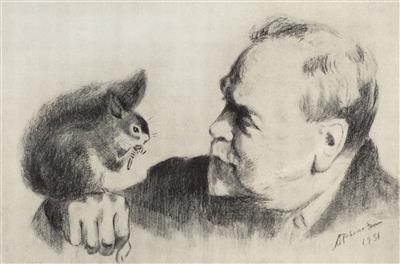
The studio Arkady Rylov maintained in Saint Petersburg became something close to a small nature reserve. Squirrels, rabbits, a monkey named Manka, uncaged birds, and even ant colonies shared the space with his canvases, an arrangement that fellow artist Mikhail Nesterov described with admiration. The studio was not an affectation: Rylov's particular quality as a landscape painter depended on that attentiveness.
Biography
Born in 1870[1] in Istobensk, Vyatka Governorate, and raised by his stepfather after his father's mental illness, Rylov trained under Arkhip Kuindzhi at the Imperial Academy of Arts from 1894[1] to 1897. Kuindzhi's mastery of light and atmosphere left a clear mark, and Rylov absorbed it alongside the mood of late 19th-century Russian[1] Symbolism[1].
His most celebrated work, *In High Azure* (1918[1]), shows wild geese banking over an open sea beneath a vast sky. The painting carries a compressed energy that Soviet critics quickly read as a symbol of revolutionary freedom, a reading that helped Rylov navigate the post-1917 cultural landscape with his career intact. *The Green Noise* (1904), depicting Slavic vessels in a luminous spring scene, showed the same capacity for nature as metaphor.
He was active in the Mir iskusstva (World of Art) group and later the Union of Russian[1] Artists before joining the Association of Artists of Revolutionary Russia. He died in 1939[1].
Timeline
- 1870Born in Istobensk, Vyatka Governorate. He was raised by his stepfather after his father's mental illness.
- 1894Began training under Arkhip Kuindzhi at the Imperial Academy of Arts, Saint Petersburg, aged 24.
- 1897Completed training at the Imperial Academy of Arts, Saint Petersburg, aged 27.
- 1904Painted "The Green Noise", depicting Slavic vessels in a spring scene.
- 1918Painted his most celebrated work, "In High Azure", showing wild geese over an open sea.
- 1939Died, aged 69.
Notable Works
Tap to view larger.
Next stop
Symbolism →
Explore the artists and ideas of Symbolism.
Related Artists


Frequently Asked Questions
What is Arkady Rylov known for?
Arkady Rylov is known for his landscape painting, particularly his ability to capture nature as metaphor. His most celebrated work is *In High Azure* (1918[1]), which depicts wild geese over an open sea and was interpreted as a symbol of revolutionary freedom.What is Arkady Rylov's most famous work?
Arkady Rylov is best known for his painting *In the Blue Expanse*, created in 1918[1]. Rylov was a Russian[1] painter, and this work is one of his most recognisable. Rylov was born in 1870[1] and died in 1939[1]. He was part of the Russian avant-garde movement. Other artists of the time included Kazimir Malevich, Natalia Goncharova, and Vladimir Tatlin. Rylov's work captures a sense of space and movement. Other notable works by Rylov include *Green Stripe* (1904), *The White Sea* (1926), and *Lenin in Razliv* (1934). These paintings demonstrate his skill with colour and composition. Rylov's artistic output includes a variety of subjects, but he is particularly known for his seascapes and depictions of the Russian countryside.What should I know about Arkady Rylov's prints?
Arkady Rylov (1870[1]-1939[1]) was a Russian[1] painter, best known for his contributions to socialist realism. He was a member of various artistic groups, including the Society named after Arkhip Kuindzhi. Rylov's prints often depict nature, reflecting his love for the Russian countryside. His work frequently features expansive vistas, skies, and forests, rendered in a realistic style. "Green Noise" (1904[1]) is one such example. After the Russian Revolution, Rylov adapted his style to align with Soviet artistic guidelines, producing works that celebrated the ideals of the new state. He taught at the Leningrad Institute of Painting, Sculpture and Architecture, influencing a generation of Soviet artists. His later works often served a propagandistic function, promoting Soviet values. Rylov's art provides insight into the transition from pre-revolutionary Russian art to the art of the Soviet era.What style or movement did Arkady Rylov belong to?
Arkady Rylov's career coincided with the rise of Symbolism[1], an artistic and literary movement that gained traction in the late 19th century. Symbolism emerged partly as a reaction against Realism and Impressionism, and against a perceived over-reliance on scientific logic and materialism. Instead, Symbolists prioritised spirituality, intuition, imagination, and the subconscious. They explored mysticism, the otherworldly, and the search for hidden meanings. Symbolism can be seen not just as a style but as a philosophy, offering a different perception of reality. Many artists connected their work to the ideas of literary Symbolism. In Russia, Mikhail Vrubel is a noted Symbolist. Symbolism influenced the decorative styles of the time, such as Art Nouveau (France), Jugendstil (Germany), and Modern in Russia. Symbolism's emphasis on imagination and the subconscious also influenced later movements such as Surrealism.What techniques or materials did Arkady Rylov use?
Arkady Rylov was a Russian[1] painter, known for his contributions to Socialist Realism. However, information about his specific techniques and materials is scarce. Some Russian artists in the late 19th and early 20th centuries, such as those involved in creating photographic substrates for paintings, used oil paints, watercolours, and pastels. The supports were often prepared with a layer of gelatin for oils, or shellac for watercolours and pastels. Some artists mixed dry powdered pigments with a medium of filtered albumin, ammonium carbonate, glycerin, liquid ammonia, and water. Others used aniline dyes dissolved in alcohol. Without further information, it is difficult to specify which of these, or other, techniques Rylov employed. More research is needed to detail the materials and methods he favoured.What was Arkady Rylov known for?
Arkady Rylov is an artist connected to the ideas of Symbolism[1], which is more than just a style in literature or art; it is a philosophy, a different perception of reality, a new ideology. Symbolism was formed as a result of the revolution in science that shook and scared contemporaries. It seemed there was a rational explanation for everything in life, and there was nothing mysterious left in nature. Symbolism stood against science and technology, trying to make spirituality a priority over materialism in art. Instead of scientific logic, its followers turned to intuition, the subconscious, and imagination; forces that inspired the fight against the sovereignty of matter and the laws of physics. As for literature, Symbolism had only one big enemy: realism. The prose of everyday life, praised by the naturalistic school, was opposed in Symbolism by mysticism, the mystery of the afterworld, and the search for a hidden meaning in every event or image. Symbolism invited everyone to listen to the great strange world surrounding us, to find the meaning of life, which is possible only for the true creator.When did Arkady Rylov live and work?
Arkady Rylov was born in the village of Istobensk, in the Orlov region, on 29 January 1870[1]. He died in Leningrad on 22 June 1939[1]. Rylov studied at the St Petersburg Academy from 1908[1] to 1910, and was close to the Union of Youth, contributing to three of their exhibitions. Before this, from 1903 to 1908, he studied at the private studio of academician Lev Dmitriev-Kavkazsky. In 1912, Rylov travelled to Italy and France. From 1918, he was a professor of painting, initially at the State Art Educational Workshops (formerly the St Petersburg Academy of Arts), then at the Institute of Proletarian Fine Art. He was chairman of the Leningrad Union of Artists from 1932 to 1934.Where can I see Arkady Rylov's work?
Arkady Rylov's paintings are held by several museums in Russia. These include the State Tretyakov Gallery in Moscow, and the State Russian[1] Museum in St Petersburg. Other works can be found in regional museums. The Vyatka Art Museum holds a collection that includes work by Rylov, as well as other avant-garde artists. The Yaroslavl Art Museum also possesses works that were transferred in March 1921[1]. The Dagestan Museum of the Arts in Makhachkala may also hold his paintings. Rylov's work, like that of many contemporary artists, was distributed to regional museums as part of a programme of museum reform. This was intended to broaden access to art and culture across Russia. These reforms led to the establishment of new museums and the reorganisation of existing ones, with the aim of presenting art in ways that reflected the socio-cultural changes of the time.Who did Arkady Rylov influence?
It is difficult to identify Arkady Rylov's direct artistic descendants. Art historians suggest several possible vectors of influence within the Russian[1] art world. Mikhail Larionov, for example, worked as an assistant to Mikhail Vrubel' in 1899[1], which may have shaped his Rayist style. Pavel Mansurov astutely observed that the backgrounds in Vrubel's paintings resembled 'frost-covered windows'. Larionov may have detected latent tendencies in Vrubel's plastic form. Pavel Filonov, presenting his creative work in 1912, wrote 'Kanon i zakon' ('Canon and Law'), outlining principles of analytical art. Filonov acknowledged the potential influence of Cubo-Futurism and Picasso, but asserted that they had not influenced him any more than he had influenced them. The conceptualist artist Igor Makarevich, of Russian descent but raised in Georgia and trained in Moscow, became a star in Moscow conceptualism.Who influenced Arkady Rylov?
It is difficult to determine specific influences on Arkady Rylov from the passages provided. However, the texts do discuss the influences on other Russian[1] avant-garde artists of the period. Mikhail Larionov, a contemporary of Rylov, pointed to earlier art as containing "rudiments of Rayism". He cited Mikhail Vrubel's paintings and drawings, such as *Six-Winged Seraph* (1904[1]), as examples. Pavel Mansurov noted that Larionov worked with Vrubel' on a ceramic panel for the Hotel Metropol' in Moscow in 1899. Pavel Filonov, presenting his analytical art in 1912, distanced himself from Western Cubism and Russian Cubo-Futurism. He claimed that Picasso had not influenced him, but that he was aware of Picasso's work. These passages suggest a complex web of artistic relationships and influences within the Russian art world of the early 20th century. However, without more specific information, it is impossible to say definitively who influenced Rylov.Why are Arkady Rylov's works important today?
Arkady Rylov (1870[1]-1939[1]) was a Russian[1] painter, a member of the Society named after Arkhip Kuindzhi. Rylov's artistic importance lies in his contribution to early 20th-century Russian art, particularly his ability to capture a sense of freedom and movement in his works. His paintings often depict nature, conveying a feeling of vastness. Rylov's art provides insight into the cultural and artistic context of his time, reflecting a move away from academic constraints. His dedication to plein air painting connects him to anti-globalist and revolutionary artistic sentiments. Rylov's works offer a glimpse into the transition from traditional to more contemporary forms of artistic expression. His art is a reminder of the diverse paths artists took during a period of significant change.What was Arkady Rylov's art style?
Arkady Rylov's art style absorbed the influence of Arkhip Kuindzhi's mastery of light and atmosphere, along with the mood of late 19th-century Russian[1] Symbolism[1]. His paintings, such as *The Green Noise* (1904[1]) and *In High Azure* (1918), demonstrate his capacity for using nature as a metaphor.
Sources
Editorial draws on the following primary and tertiary references for Arkady Rylov.
- [1] wikipedia Wikipedia: Arkady Rylov Used for: biography, birth dates, death dates, identifiers, movement attribution, nationality.
- [2] book 01-2015-druck.indd Used for: stylistic analysis.
- [3] book Berghaus, Günter(Editor), 2015 Used for: stylistic analysis.
- [4] book Yevgenia Petrova (editor), Origins of the Russian avant-garde_ celebrating the 300th anniversary of St. Petersburg_ the Walters Art Museum, Baltimore (13 February-25 May 2003), Fine Arts Museums of San Francisco (29 June-21 September 2003) Used for: biography.
- [5] book J. E. Bowlt, Russian Art of the Avant Garde - Theory and Criticism 1902-1934 Used for: biography.
- [6] book Peter. Leek, Russian Painting Used for: biography.
- [7] book Esanu, Octavian(Author), Transition in Post-Soviet Art : The Collective Actions Group Before and After 1989 Used for: stylistic analysis.
Editorial overseen by Solis Prints. Sources verified 2026-09-23. Click a source for details, or hover over [N] in the page above to preview.
Editorial standardsMethodologyCorrectionsAI disclosureAbout the editorial team