



Charles Angrand
- Incoherents
- neorealism
- Pointillism
- Symbolism
Charles Angrand made his living teaching mathematics at a Paris collège, but his real occupation was working out, alongside Georges Seurat, what colour science could do for painting. Born in Normandy in 1854[1] and denied entry to the École des Beaux-Arts, he arrived in Paris in 1882[1] and quickly fell in with the circle that would become the Neo-Impressionists. He co-founded the Société des Artistes Indépendants with Seurat and Signac in 1884, and for several years his canvases kept pace with Seurat's own experiments in Divisionism.
Biography
His most cited work, *The Western Railway at its Exit from Paris* (1886[1]), applies Pointillist technique to industrial modernity with unusual restraint: no Impressionist shimmer, no decorative pleasure. A couple walking home in *Couple in the Street* (1887, Musée d'Orsay) is rendered with the same methodical dot-by-dot procedure, the figures emerging from the speckled ground with a quiet dignity. Angrand's palette ran cooler and more muted than Seurat's, lending his canvases a particular stillness.
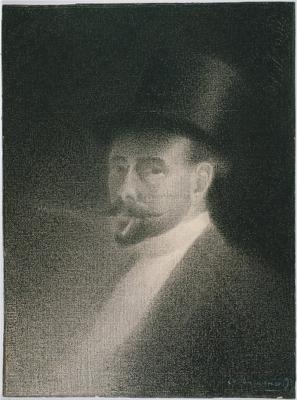
In the early 1890s he largely abandoned oil painting in favour of conté crayon drawings: large, Symbolist-inflected works in near-monochrome that drew admiration from Signac and Pissarro alike. He also contributed illustrations to the anarchist publication *Les Temps nouveaux*, suggesting political convictions that aligned with the movement's broader countercultural edges. After 1896[1] he retreated to rural Normandy, living in increasing isolation.
Around 1906[1] he resumed painting, developing a personal variant of Divisionism looser than his earlier work. He died in Rouen in 1926[1], respected by his surviving peers but largely outside the mainstream art market. Works now held at the Met, Musée d'Orsay, MFA Boston, and Cleveland Museum of Art confirm his standing as a central rather than peripheral figure of the movement.
Timeline
- 1854Born in Normandy.
- 1882Moved to Paris and joined the circle that would become the Neo-Impressionists, aged 28.
- 1884Co-founded the Société des Artistes Indépendants with Seurat and Signac.
- 1886Painted "The Western Railway at its Exit from Paris", applying Pointillist technique.
- 1887Painted "Couple in the Street".
- 1890Largely abandoned oil painting in favour of conté crayon drawings.
- 1896Retreated to rural Normandy, living in increasing isolation.
- 1906Resumed painting, developing a personal variant of Divisionism.
- 1926Died in Rouen.
Notable Works
Tap to view larger.
Next stop
Browse the movements →
Every movement in the collection, from the Renaissance to Pop art.
Charles Angrand prints
Hand-finished archival prints from Charles Angrand's body of work.
 Couple in the Street - Charles Angrand
From £37.00
Couple in the Street - Charles Angrand
From £37.00
 Hay Ricks in Normandy - Charles Angrand
From £28.00
Hay Ricks in Normandy - Charles Angrand
From £28.00
 Le Petit Port - Charles Angrand
From £28.00
Le Petit Port - Charles Angrand
From £28.00
 The Harvesters - Charles Angrand
From £28.00
The Harvesters - Charles Angrand
From £28.00
 The Western Railway at its Exit from Paris - Charles Angrand
From £28.00
The Western Railway at its Exit from Paris - Charles Angrand
From £28.00
 The Harvest - Charles Angrand
From £28.00
The Harvest - Charles Angrand
From £28.00
Related Artists


Take Charles Angrand home.
See all Charles Angrand prints →Frequently Asked Questions
What is Charles Angrand known for?
Charles Angrand is known for his contributions to the Neo-Impressionist movement, particularly his Pointillist paintings. His work *The Western Railway at its Exit from Paris* (1886[1]) is often cited, and he gained recognition from peers like Signac and Pissarro for his conté crayon drawings.What was Charles Angrand's art style?
Charles Angrand experimented with Divisionism and Pointillism[1], applying the latter to industrial subjects with restraint. His palette tended to be cooler and more muted than Seurat's, and in the early 1890s, he shifted to near-monochrome conté crayon drawings before returning to a looser variant of Divisionism around 1906[1].How did Charles Angrand die?
Charles Angrand died in 1926[1] at the age of 72.
Sources
Editorial draws on the following primary and tertiary references for Charles Angrand.
- [1] wikipedia Wikipedia: Charles Angrand Used for: biography, birth dates, death dates, identifiers, movement attribution, nationality.
- [2] book Brodskaïa, Nathalia, Impressionism and Post-Impressionism (Essential) Used for: biography, stylistic analysis.
- [3] book Post-impressionism : cross-currents in European painting Used for: biography, stylistic analysis.
- [4] book Post-impressionism : cross-currents in European painting Used for: biography, stylistic analysis.
Editorial overseen by Solis Prints. Sources verified 2026-09-22. Click a source for details, or hover over [N] in the page above to preview.
Editorial standardsMethodologyCorrectionsAI disclosureAbout the editorial team