



Austin Osman Spare
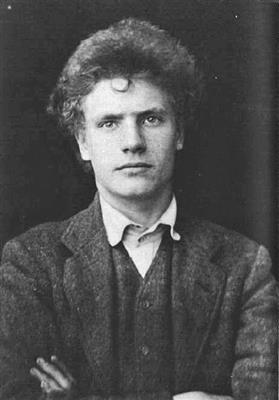
Spare showed his first drawings at the Royal Academy at seventeen, exhibited alongside painters old enough to be his grandparents, and promptly unsettled an institution that was not ready for him. Born in 1886[1] in Snow Hill, London, he had already taught himself to draw with obsessive intensity. By the time he left the Royal College of Art without qualifications in 1905[1], he was producing imagery that would spend decades looking for the right label: Symbolist, proto-Surrealist, outsider, occultist.
Biography
Earth Inferno (1905[1]) and A Book of Satyrs (1907) established the mode: precise, sinuous line-work borrowing from Beardsley and routing it through subjects Beardsley would not have touched. The Book of Pleasure (1913) is both a manual of magic and an artwork in itself, setting out his theory of sigil practice (condensing desire into abstract glyphs) alongside writing on the unconscious as a source of power.
The middle decades were difficult. His flat was destroyed in the Blitz on 10 May 1941[1]. He lived in poverty in south London, his last West End show having been at Godfrey Phillips in 1930. A comeback exhibition at the Archer Gallery in November 1947 was a commercial success, and the final decade of his life was more secure than the previous twenty years had suggested.
He died in 1956[1] from complications following a burst appendix, aged 69. Jimmy Page owns his Portrait of the Artist (1907[1]). The Viktor Wynd Museum in London maintains a permanent Spare Room. His sigil techniques, adapted by Peter J. Carroll, became the technical foundation of the chaos magic movement.
Timeline
- 1886Born in Snow Hill, London.
- 1903Exhibited drawings at the Royal Academy at 17.
- 1905Left the Royal College of Art without qualifications.
- 1905Published "Earth Inferno".
- 1907Published "A Book of Satyrs".
- 1907Painted "Portrait of the Artist".
- 1913Published "The Book of Pleasure", outlining his sigil theory.
- 1930Held his last West End show at Godfrey Phillips.
- 1941His flat was destroyed in the Blitz on 10 May.
- 1947Comeback exhibition at the Archer Gallery in November.
- 1956Died at 69 from complications following a burst appendix.
Notable Works
Tap to view larger.
Next stop
Symbolism →
Explore the artists and ideas of Symbolism.
Related Artists


Frequently Asked Questions
What is Austin Osman Spare known for?
Austin Osman Spare is known for his precise, sinuous line-work, which borrows from Aubrey Beardsley but explores different subjects. He is also known for his 1913[1] book, The Book of Pleasure, which details his theory of sigil practice and discusses the unconscious as a source of power.What is Austin Osman Spare's most famous work?
It is difficult to name one single work as Austin Osman Spare's "most famous". He did not achieve widespread public recognition during his lifetime, and his notability has largely grown posthumously among occult and art enthusiasts. Spare's artistic output spanned drawings, paintings, and writings, all interwoven with his occult philosophies. He developed personal techniques such as automatic drawing and sigilisation, aiming to access subconscious realms. His book, *The Book of Pleasure (Self-Love): The Psychology of Ecstasy* (1913[1]), details his unique magical system and aesthetic theories. While no individual piece has achieved mainstream fame, his explorations of symbolism, the subconscious, and his distinctive visual style have influenced later artists and movements, particularly in areas of surrealism and chaos magic. His works are now held in collections such as the Victoria and Albert Museum, and continue to be subjects of study.What should I know about Austin Osman Spare's prints?
Austin Osman Spare was a British[1] artist who produced a variety of prints, including etchings and possibly woodcuts. When considering Spare's prints, it is useful to understand some basic printmaking terminology. An "original print" is conceived as a print, made solely as a print, and usually produced in a limited, numbered edition, with each print signed by the artist. Each impression is created individually from a plate, block, or screen. The artist determines the edition size. The numbering (for example, 12/25) indicates the specific print number out of the total edition. The print market is unregulated, but commercial sales are subject to the Trade Descriptions Act. Claims about a print's nature must be truthful. If a print is part of a limited edition, this is usually written in pencil on the bottom margin, with the edition number on the left, the title in the centre, and the signature on the right. The number of prints pulled is sometimes limited to increase a print’s value.What style or movement did Austin Osman Spare belong to?
Austin Osman Spare is associated with Symbolism[1] and Surrealism, artistic movements that share an interest in mythology, dreams, emotion, and the unconscious. Symbolism arose in France and Europe between the 1880s and the start of the 20th century. Symbolist artists wished to go beyond the visible world and rational thought, exploring the limits of the unconscious. They aimed to evoke strong emotions through unusual colour and composition, often drawing on ancient myths. Artists such as Gustave Moreau, Odilon Redon, and Edvard Munch are considered representative of the movement. Surrealism, which emerged later, also explored hidden realities and the realm of the esoteric. Both movements can be seen as reactions against Realism and Impressionism, which focused on depicting the observable world. Instead, Symbolism and Surrealism embraced strangeness, mystery, and the otherworldly. Some scholars also connect these movements to occultist traditions and hermetic philosophies.Where can I see Austin Osman Spare's work?
It is difficult to say with certainty where works by Austin Osman Spare can be viewed permanently. However, several major museums hold collections of art deco items, and might hold works by Spare. These include the Brighton Museum & Art Gallery, the Victoria & Albert Museum, and the Geffrye Museum in London. Other UK museums include the Manchester Art Gallery and the National Museums of Scotland in Edinburgh. Outside the UK, art deco collections are held at the Los Angeles County Museum of Art (LACMA), the Metropolitan Museum of Art in New York, and the Minneapolis Institute of Arts. Other locations are the Royal Ontario Museum in Toronto, and the Wolfsonian at Florida International University in Miami Beach. As collections can move between galleries, it is always worth contacting the gallery in advance to check whether a specific work is on display.Where was Austin Osman Spare from?
Austin Osman Spare was born in London, on 30 December 1886[1]. He grew up in Smithfield, and later lived with his family in Kennington. Spare remained in London for most of his life, except for a period of military service during the First World War. After the war, he lived in various locations in south London, including Brixton and Walworth. Spare experienced periods of poverty and obscurity, but he continued to produce art and develop his occult theories. In his later years, he gained a cult following, and his work was rediscovered by a new generation of artists and occultists. Spare died in 1956[1] and is buried in Streatham Park Cemetery.Who did Austin Osman Spare influence?
Austin Osman Spare's influence appears in the work of artists associated with Surrealism, particularly from the late 1960s onward. This influence is seen in their appropriation of Surrealist techniques, themes, and poetic approaches to the paradoxical, fantastic, monstrous, and uncanny. However, these artists do not necessarily commit to political action. Examples of artists influenced by Surrealism include Derpapas, Theodoros Pantaleon, Alexandros Isaris, Alkis Ginis, Dimitris Geros, and Sarantis Karavouzis. Their work shows a visual dialogue with imagery of Dalí, René Magritte, Max Ernst, and Paul Delvaux. Petros Papavassileiou, who moved to Italy in the 1950s, developed a style of 'Orphic Surrealism' that blended cubism, abstract expressionism, and Surrealist tendencies. Marie Wilson, a Californian artist who participated in Surrealist activities in Paris during the 1950s, created automatistic drawings reminiscent of Tibetan tantras and Oceanic designs. Aube Elléouët, daughter of André Breton and Jacqueline Lamba, has been active in Surrealism since the 1950s, creating ecology-inspired collages.Who influenced Austin Osman Spare?
Austin Osman Spare was influenced by the Western esoteric tradition, which includes Hermeticism, Neo-Platonism, Rosicrucianism, Qabalah, astrology, tarot, and ceremonial magic. These traditions were synthesised in groups such as the Hermetic Order of the Golden Dawn, of which Spare was briefly a member. The Golden Dawn drew from ancient Egyptian religion, classical Greek philosophy, the Greco-Egyptian Mystery religions, Gnosticism, Jewish Kabbalah, Christian mysticism, alchemy, divination, and Enochian magic. The Order's innovation lay in crafting a single, organised framework from these diverse teachings. Spare was also associated with Aleister Crowley, and was influenced by Crowley's approach to magic. Crowley's system, the A∴A∴, integrated Hindu yoga, Buddhism, and Taoism with Western elements. Crowley streamlined magical training, making practices such as astral travel, god-name vibration, and Qabalistic correspondences accessible early on.Who was Austin Osman Spare?
Austin Osman Spare (1886[1]-1956[1]) was a British[1] artist and occultist. Although he is less widely known than his contemporary Aleister Crowley, Spare's work has had a significant effect on the development of modern occultism, particularly chaos magick. Spare initially gained recognition as a young, talented artist, exhibiting at the Royal Academy. However, he soon became more interested in exploring the occult, developing his own unique magical system, which he termed 'Kia' or 'Ki'. This system emphasised the role of the subconscious mind and the power of sigils (symbolic seals) in achieving desired outcomes. Spare's artistic work became intertwined with his occult beliefs, with his drawings and paintings often serving as visual representations of his magical ideas. Spare was associated with Aleister Crowley for a time, but he ultimately diverged from Crowley's Thelemic system, preferring to work independently. His ideas have influenced later occultists, including Kenneth Grant, and continue to be explored and reinterpreted in contemporary occult circles.Why are Austin Osman Spare's works important today?
Austin Osman Spare's art is relevant because it reflects a renewed interest in esoteric traditions. A century ago, figures such as Arthur Conan Doyle and William James supported occultism and psychical research, as did segments of the upper classes. After World War I, occultism lost cultural prestige, and its effects on the arts were forgotten. Today, occultism is often disparaged by the upper classes and art critics. They now favour modernist artistic creativity, imagination, and intuition. However, postmodern culture, driven by mass media, has led to a perceived lack of individuality and creativity. This has resulted in a resurgence of interest in therapeutic New Age wisdom and occultism as a means to address these perceived spiritual deficiencies. Spare's art, with its roots in esoteric practices, speaks to this contemporary yearning for individual expression and spiritual meaning.What was Austin Osman Spare's art style?
Spare's art style featured precise, sinuous line-work influenced by Aubrey Beardsley. His work has been categorised as Symbolist, proto-Surrealist, outsider, and occultist.
Sources
Editorial draws on the following primary and tertiary references for Austin Osman Spare.
- [1] wikipedia Wikipedia: Austin Osman Spare Used for: biography, birth dates, death dates, identifiers, movement attribution, nationality.
- [2] book guggenheim-guggenhe02solo Used for: biography.
- [3] book guggenheim-twopri00weis Used for: biography.
- [4] book Lon Milo DuQuette, Llewellyn's Complete Book of Ceremonial Magick Used for: biography, stylistic analysis.
- [5] book Adele Wagstaff, Painting the Nude in Oils Used for: biography.
Editorial overseen by Solis Prints. Sources verified 2026-09-30. Click a source for details, or hover over [N] in the page above to preview.
Editorial standardsMethodologyCorrectionsAI disclosureAbout the editorial team