



Albert Joseph Moore
Albert Joseph Moore spent his short career, he died at 52, working through a single idea with unusual intensity: reclining or sleeping female figures in classical drapery, arranged within colour harmonies so precisely calibrated they border on the musical. Born on 4 September 1841[3] in York, he was the fourteenth child of portrait painter William Moore and the younger brother of marine painter Henry Moore.
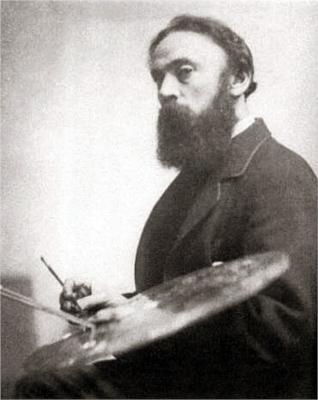
Biography
He studied at the Royal Academy Schools from 1858[3], but the decisive influence came from sustained study of the Elgin Marbles in the 1860s. Classical sculpture taught him to handle drapery as an active compositional element. His method was correspondingly painstaking: each finished painting began with a nude study, then a separate drapery study, so the relationship between body and cloth was resolved before the final canvas.
Moore became a central figure of the Aesthetic Movement, exhibiting regularly at the Grosvenor Gallery from 1877[3]. Works such as Dreamers (1879-82, Birmingham Museum and Art Gallery), Midsummer (1887, Russell-Cotes Art Gallery) and A Summer Night (1890, Walker Art Gallery, Liverpool) show the approach at its most refined: figures suspended in sleep or reverie, colour answering colour, with no narrative purpose beyond the experience of looking.
He exhibited at the Royal Academy as early as 1857[3] and continued until close to his death on 25 September 1893[3]. A retrospective at the Grafton Galleries in 1894 was organised by friends who felt his reputation deserved fuller recognition. His work is held at the Tate, the Victoria and Albert Museum, Birmingham, and Liverpool.
Timeline
- 1841Born in York, England on September 4th.
- 1857Exhibited at the Royal Academy.
- 1858Studied at the Royal Academy Schools.
- 1860Studied the Elgin Marbles.
- 1877Exhibited regularly at the Grosvenor Gallery.
- 1879Dreamers created (circa 1879-1882).
- 1887Midsummer created.
- 1890A Summer Night created.
- 1893Died on September 25th.
- 1894Retrospective at the Grafton Galleries.
Notable Works
Tap to view larger.
Where to See Albert Joseph Moore
2 museums worldwide.
-
 1 works
Art Gallery of South Australia
Adelaide, Australia
10:00–17:00 daily, closed Christmas Day · Free
-
 1 works
Blackburn Museum and Art Gallery
Blackburn, United Kingdom
Tue–Sat 11:00–16:45, closed Sun–Mon · Free
Next stop
Browse the movements →
Every movement in the collection, from the Renaissance to Pop art.
Albert Joseph Moore prints
Hand-finished archival prints from Albert Joseph Moore's body of work.
 Pansies - Albert Joseph Moore
From £28.00
Pansies - Albert Joseph Moore
From £28.00
 An Open Book - Albert Joseph Moore
From £37.00
An Open Book - Albert Joseph Moore
From £37.00
 Reclining Model - Albert Joseph Moore
From £28.00
Reclining Model - Albert Joseph Moore
From £28.00
 The Shulamite - Albert Joseph Moore
From £28.00
The Shulamite - Albert Joseph Moore
From £28.00
 Topaz - Albert Joseph Moore
From £28.00
Topaz - Albert Joseph Moore
From £28.00
 The Mother of Sisera Looked out a Window - Albert Joseph Moore
From £28.00
The Mother of Sisera Looked out a Window - Albert Joseph Moore
From £28.00
Related Artists


Take Albert Joseph Moore home.
See all Albert Joseph Moore prints →Frequently Asked Questions
What is Albert Joseph Moore known for?
Albert Joseph Moore is known for his paintings of reclining or sleeping female figures in classical drapery. He arranged these figures within colour harmonies that were precisely calibrated.What is Albert Joseph Moore's most famous work?
It is difficult to name one single work as Albert Joseph Moore's most famous, but several paintings recur in discussions of his art. Moore is known for his depictions of languid female figures in classical settings. These paintings often feature women draped in flowing robes, surrounded by flowers and luxurious fabrics. They evoke a sense of beauty and contemplation. Titles such as "Pomona", "Sappho", and "Psyche" appear in catalogues and lists of works from the period. These suggest an interest in classical mythology and themes. However, without further context, it is hard to assess which painting, if any, brought him the most attention during his career. Moore's paintings often explore themes of beauty, leisure, and the idealised female form. His work reflects the aesthetic tastes of the late 19th century, a period when classical subjects were popular.What should I know about Albert Joseph Moore's prints?
Albert Joseph Moore's classical subjects were translated into mezzotints. In 1897, Norman Hirst reproduced Moore's *Lovers* as a mezzotint, which Cadbury Jones & Co published in an edition of 400 proofs. Print publishers in England began issuing magazines devoted to etching to meet the rising demand. *The Etcher*, a London journal for etchers and collectors, ran from 1879[3] to 1883, issuing 154 plates. From 1881 to 1891, *English Etchings* commissioned etchings. Seymour Haden, an avid champion of the medium, founded the Royal Society of Painter-Etchers in 1880. By that time, the Printsellers’ Association did not require a declaration of the number of proof impressions of etchings, so full edition details are unavailable.What style or movement did Albert Joseph Moore belong to?
Albert Joseph Moore is usually associated with Aestheticism[3], a movement that valued beauty and art for their own sake, rather than for any moral or narrative content. However, some connections can be made to Symbolism, which emerged in the late 19th century. Symbolism was a reaction against Realism and Impressionism, favouring imagination and emotion. Symbolist painters used evocative colours and stylised images to convey moods and visions, sometimes depicting dreamlike or exotic scenes. Symbolism is anti-Realism and anti-Impressionism, and favours strangeness and mystery. While Moore's career began earlier, Symbolism gained artistic significance towards its end. Symbolism touched some great masters casually, without becoming their main focus. The Pre-Raphaelites are considered direct predecessors of Symbolism.What techniques or materials did Albert Joseph Moore use?
Albert Joseph Moore's technique involved a careful preparation of the painting surface. He applied a ground of wet white, which he believed gave a particular delicacy to colour and tone. This method was not entirely new; earlier artists, such as Millais, had used it to create the effect of sunlight on flesh. Moore extended this system from small areas to larger sections of his work. The process began with selecting a prepared ground for its brightness. Moore would then renovate it with fresh white mixed with a small amount of amber or copal varnish. He allowed this coat to harden thoroughly. Once dry, he completed an exact outline of the area he intended to paint. On the morning of painting, he applied a fresh coat of white (with superfluous oil removed and a small amount of varnish added) evenly with a palette knife. This coat was thin enough to allow the drawing to show through faintly. He then laid transparent and semi-transparent colours over this wet ground with light sable brushes, taking care not to disturb the ground below.What was Albert Joseph Moore known for?
Albert Joseph Moore (1841[3]-1893[3]) was an English painter associated with the Aesthetic movement. This movement favoured art created for its beauty rather than for any narrative, moral, or historical allusions. Moore's style often featured languid female figures, typically draped in classical robes and set against backgrounds of marble or flowers. His paintings often evoke a sense of calm and contemplation through their harmonious compositions and muted colours. Moore drew inspiration from classical antiquity, particularly the art and culture of ancient Greece. He adapted classical motifs and compositions to his own artistic vision. Though he lived and worked during a period dominated by Realism and Impressionism, Moore chose to pursue a distinct style, one that celebrated idealism and beauty.When did Albert Joseph Moore live and work?
Albert Joseph Moore was born in York on 4 September 1841[3]. He came from a family of painters; his father, William Moore, was a portrait and drawing master, and his brothers Henry and John Collingham Moore were also painters. Moore initially studied at York School of Design, then at the Royal Academy Schools in London. Early in his career, he was associated with the Pre-Raphaelite movement. He exhibited at the Royal Academy and the British[3] Institute from 1841[3] to 1867. Later, Moore moved away from Pre-Raphaelite themes. He developed his signature style of classically inspired figure painting, often depicting languid female figures in opulent settings. These later works show a strong interest in colour harmonies and decorative arrangements. Moore lived in London for much of his career. He died on 25 September 1893[3], and is buried in Nunhead Cemetery.Where can I see Albert Joseph Moore's work?
To view paintings by Albert Joseph Moore, you can visit several galleries and museums. In the United Kingdom, collections are held at the Manchester Art Gallery (Mosley Street, Manchester), the Brighton Museum & Art Gallery (Royal Pavilion Gardens, Brighton), and the Victoria and Albert Museum (Cromwell Road, London). Also worth a visit is the National Museum of Scotland (Chambers Street, Edinburgh). Other UK locations include the Leeds City Art Gallery and the Towneley Hall Art Gallery in Burnley. In the United States, you can find his work at the Los Angeles County Museum of Art (LACMA), the Metropolitan Museum of Art (New York), the Minneapolis Institute of Arts, the Charles Hosmer Morse Museum of American Art (Winter Park, Florida), and the Virginia Museum of Fine Arts (Richmond). The Royal Ontario Museum in Toronto, Canada, also holds pieces.Who did Albert Joseph Moore influence?
Albert Joseph Moore moved away from the Pre-Raphaelite style of his early career, and toward a fashionable aestheticism. His classical figures, rendered in gentle pastel colours, took on an ethereal quality. These were engraved in mezzotint or etched, becoming precious images sought by collectors. Robert Dunthorne issued Moore’s *Blossoms* in a limited edition of 75 etchings printed on vellum in 1883[3]. Luke Taylor’s etching ideally suited the exclusivity surrounding the print. It became a precious object intended for a small, select audience. Later Pre-Raphaelite paintings influenced the Symbolist movement. Pre-Raphaelite works were exhibited in the International Exhibitions in Paris in 1855, 1867, 1878, 1889, and 1900. Elements of late works by Dante Gabriel Rossetti and Edward Burne-Jones influenced the Aesthetic Movement, including James Whistler and Aubrey Beardsley. Burne-Jones's languid, serpentine line may well have influenced the Art Nouveau aesthetic in the 1890s.Who influenced Albert Joseph Moore?
Albert Joseph Moore's artistic development occurred during a period of change in British[3] art education. The old apprenticeship system was fading, and art academies were becoming more common. Moore sought guidance from various sources. He admired artists such as William Etty for his command of colour, but found his later work too sweet. Daniel Maclise possessed inventive genius, but Moore felt he was prone to melodrama. Charles Robert Leslie, with his naturalism and restrained colour, appealed to Moore. Moore also looked to the past for inspiration. He admired the clear forms and clean handling of the early Italian quattrocento artists, such as Francia and Mazzolini. He also studied works by Van Eyck, Holbein, Rubens, Raphael, and Titian, examining their techniques and attention to detail. He found that these masters demonstrated patient self-restraint and humility in their work, qualities often overlooked by contemporary students. Moore's goal was to create art with undying appeal, avoiding what he saw as the inane prettiness and lack of vigour in much of the art of his time.Who was Albert Joseph Moore?
Albert Joseph Moore (1841[3]-1893[3]) was an English painter known for his depictions of languid female figures in classical settings. Born in York, he came from an artistic family; his father, William Moore, was a portrait painter, and several of his siblings also became artists. Albert initially trained at York School of Design and later at the Royal Academy Schools in London. Moore's early work showed Pre-Raphaelite influences, with attention to detail and naturalistic representation. However, he gradually developed his own distinct style, characterised by an interest in classical beauty and harmonious colour arrangements. His paintings often feature women draped in flowing robes, posed against backgrounds of marble, flowers, or the sea. He aimed to create purely aesthetic works, prioritising form and colour over narrative or moral content. Though he exhibited regularly at the Royal Academy and other venues, his work sometimes met with mixed reception from critics who found it overly decorative or lacking in substance. Nevertheless, he had a devoted following and his paintings were admired by many for their beauty and refinement.Why are Albert Joseph Moore's works important today?
Albert Joseph Moore (1841[3]-1893[3]) moved away from his early Pre-Raphaelite style. He embraced aestheticism, painting classical figures in soft, gentle colours. These works, when reproduced as etchings or mezzotints, became prized images. Moore's paintings suited the aesthetic preferences of the time, fitting into the category of "pleasant and agreeable art" that complemented domestic interiors. His pieces offered a harmonic arrangement of colours and lines for effect, aligning with a broader artistic movement that valued colour and line above subject matter. Robert Dunthorne recognised the appeal of Moore's aesthetic, publishing Moore’s *Blossoms* as a limited edition of 75 etchings on vellum in 1883[3]. Luke Taylor’s etching was well suited to the exclusivity surrounding the print. This made it a precious object intended for enjoyment by a small, select audience. Moore's work reflects a shift in artistic taste towards pieces that were decorative and harmonious. They were intended to blend seamlessly into the home.
Sources
Editorial draws on the following primary and tertiary references for Albert Joseph Moore.
- [1] museum Art Gallery of South Australia Used for: museum holdings.
- [2] museum Blackburn Museum and Art Gallery Used for: museum holdings.
- [3] wikipedia Wikipedia: Albert Joseph Moore Used for: biography, birth dates, death dates, identifiers, movement attribution, nationality.
- [4] book Beard, Lee, 1973- author, Butler, Adam, author; Van Cleave, Claire, author; Fortenberry, Diane, author; Stirling, Susan, author, Beard, Lee, 1973- author, Butler, Adam, author; Van Cleave, Claire, author; Fortenberry, Diane, author; Stirling, Susan, author - The Art Book_ New Edition, Mini Format Used for: biography.
- [5] book Post-impressionism : cross-currents in European painting Used for: biography.
- [6] book Post-impressionism : cross-currents in European painting Used for: biography.
Editorial overseen by Solis Prints. Sources verified 2026-09-30. Click a source for details, or hover over [N] in the page above to preview.
Editorial standardsMethodologyCorrectionsAI disclosureAbout the editorial team