



About Frank Bowling
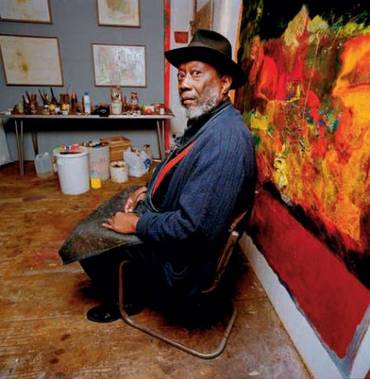
a seamstress's son from British Guiana who won the RCA silver medal with Hockney, stencilled continents onto poured colour, and became the first Black Royal Academician
Where to see Frank Bowling
Ranked by works you can see in person.
-
5 works
Metropolitan Museum of Art
New York City, United States
-
 3 works
Tate
London, United Kingdom

-
2 works
Whitney Museum of American Art
New York City, United States
-
1 works
San Francisco Museum of Modern Art
San Francisco, United States
-
1 works
Museum of Fine Arts Boston
Boston, United States
-
1 works
Dallas Museum of Art
Dallas, United States
-
1 works
Museum of Modern Art
New York City, United States
-
1 works
RISD Museum
Providence, United States
-
1 works
Minneapolis Institute of Art
Minneapolis, United States
-
 1 works
Saint Louis Art Museum
St. Louis, United States


Frequently Asked Questions
Where can I see Frank Bowling's work?
Frank Bowling's paintings are held in numerous public and private collections. These include institutions in the United Kingdom, the United States, and elsewhere. In the UK, you can find his work at the Tate Gallery, the Victoria and Albert Museum, and the Royal College of Art, all in London. Outside London, the Scottish National Gallery of Modern Art in Edinburgh also holds pieces by Bowling. In the United States, major museums with Bowling's work include the Metropolitan Museum of Art[6] and the Museum of Modern Art[3] in New York. Further afield, his paintings have been acquired by institutions such as the National Gallery of Jamaica in Kingston. Major exhibitions of Bowling's work have also increased his visibility. A retrospective at Tate Britain in 2019 presented paintings from throughout his career. Such exhibitions often travel, increasing opportunities to view his art. Check museum websites for current exhibition schedules.Where is Frank Bowling from?
Frank Bowling was United Kingdom, born in 1934.What should I know about Frank Bowling's prints?
Frank Bowling's prints, like those of many artists, exist in a marketplace with specific conventions. Printmakers often create 'limited editions', where the artist decides the number of prints produced. This decision isn't usually due to technical limits but is a choice made by the artist. Each print in a limited edition is numbered, titled, and signed, usually in pencil, following informal but respected conventions. These markings add value, assuring buyers that the print conforms to its description. The edition number is written on the bottom left margin of the print, the title in the centre, and the signature on the right. An 'original print' is conceived and executed solely as a print, often in a numbered edition, and signed by the artist. Each print is made from a plate, stone, screen, or block created for that purpose. There isn't one 'original' from which copies are made; each is individually inked and pulled, making it a 'multi-original' medium.Why are Frank Bowling's works important today?
Frank Bowling's art is important because it contributes to a more complete understanding of modernism. His career demonstrates cross-cultural dialogues between Caribbean and European artists. Bowling, a Guyanese-British artist, engaged with European and American counterparts, even when his work was undervalued by museums. During the mid-1960s, London was a centre for artists of diverse backgrounds. Bowling, along with artists from South Asia, Nigeria, and Taiwan, created and exhibited innovative works. Spaces such as the New Vision Centre and Signals London supported modernist practices. Later, Western art institutions structurally marginalised non-white artists. Despite critical recognition, many artists were unable to secure institutional representation. Recent research has revealed that cross-cultural formations of modernity were underway from the beginning of the modern age. The contributions of black artists to art and culture in Europe and the Americas were recognised belatedly, after centuries of delay. Bowling's work, and the work of other artists from the Black Atlantic, requires a changed disposition toward the past.Who is Frank Bowling?
Frank Bowling was born in Guyana, in the Caribbean, and moved to London when he was nineteen.Frank Bowling facts?
Frank Bowling was born in Guyana, in the Caribbean. He moved to London when he was nineteen.What techniques or materials did Frank Bowling use?
Frank Bowling is known for his experimental approach to materials and techniques. He moved away from traditional brushwork. Instead, he explored methods of pouring, dripping, and staining the canvas with acrylic paints. Bowling often manipulates the canvas itself. He tilts it to control the flow of paint, creating layered, textured surfaces. In some works, he embedded objects, such as polystyrene foam, into the paint. This adds a sculptural dimension to his paintings. His interest in colour is evident in his use of layered glazes and translucent pigments. These create luminous effects. Bowling also developed a method of applying paint using a modified power sander, which allowed him to create smooth, blended areas of colour. He has also used gel medium to add texture and depth. His innovative use of materials and techniques has expanded the possibilities of abstract painting.Who did Frank Bowling influence?
Frank Bowling, a Caribbean artist and abstract painter, engaged in cross-cultural dialogues with European and American artists. However, his work was often unseen and undervalued within modern art museums. Questions of difference became less urgent with the advent of inclusion, and dissenting critique was toned down. Many younger black artists were often mute when it came to the politics of race within their practice. This created a pervasive form of discursive closure through an ideology of multicultural presentism. Inclusionism expanded geographical coverage beyond the West, yet reproduced dehistoricised conceptions of difference. Bowling articulated cross-cultural dialogues with his European and American counterparts. His work gave shape and direction to a newly globalised account of modernism’s cross-cultural genesis.
Sources
Where to See guide aggregates verified holdings of Frank Bowling's works across the following collections.
- [1] museum Museum of Fine Arts Boston Used for: museum holdings.
- [2] museum Whitney Museum of American Art Used for: museum holdings.
- [3] museum Museum of Modern Art Used for: museum holdings.
- [4] museum RISD Museum Used for: museum holdings.
- [5] museum Minneapolis Institute of Art Used for: museum holdings.
- [6] museum Metropolitan Museum of Art Used for: museum holdings.
- [7] book guggenheim-britishartnowame00wald Used for: biography.
- [8] book guggenheim-richardhamilton00hami Used for: biography.
- [9] book Landauer, Susan, The not-so-still life : a century of California painting and sculpture Used for: biography.
Editorial overseen by Solis Prints. Sources verified 2026-08-29. Click a source for details, or hover over [N] in the page above to preview.
Editorial standardsMethodologyCorrectionsAI disclosureAbout the editorial team