



About Chen Hongshou
Chinese · 1598–1652
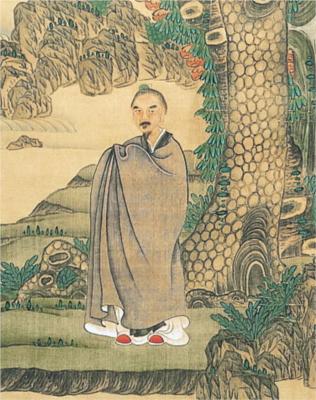
Late Ming master of figure painting and illustration whose archaic style and Shui Hu Ye Zi woodblock albums made him one of the seventeenth century's most influential Chinese[1] artists.
Museums5
Countries3
Most worksSeattle Art Museum, Seattle · 14 works
Loading map…
Where to see Chen Hongshou
Ranked by works you can see in person.
-
14 works
Seattle Art Museum
Seattle, United States
-
8 works
Metropolitan Museum of Art
New York City, United States


-
2 works
Yale University Art Gallery
New Haven, United States
-
1 works
National Gallery of Victoria
Melbourne, Australia
-
1 works
National Museum in Warsaw
Warsaw, Poland


Frequently Asked Questions
Where can I see Chen Hongshou's work?
Chen Hongshou's work can be viewed in several museums around the world. Within China, the Shanghai Museum holds at least two examples: a painting made for Qian Dongshu, emulating a work by Li Liufang; and an album of art and inscriptions. The Palace Museum in Beijing, also known as Gugong Gongli Bowuyuan, has a comprehensive collection of Chinese[1] art. The Shanghai Art Museum also displays treasured artefacts. The National Palace Museum in Taipei houses treasures from the Forbidden City. Outside of China, the Ashmolean Museum at the University of Oxford has a collection of early Chinese ceramics and seals, plus a growing collection of contemporary Chinese painting. The British Museum in London has an extensive collection of Chinese antiquities, paintings, and porcelain. The Brunei Gallery, part of the School of Oriental and Asian Studies (SOAS) at the University of London, has historical and contemporary art from Asia.Why are Chen Hongshou's works important today?
Chen Hongshou, born in 1599[1], was a painter and designer during the late Ming dynasty. Although from a scholar-official family, he did not find success in government and instead supported himself through his art. He died in 1652[1]. Chen's work is valued for its emotional expression and its challenge to artistic norms. His Self-Portrait, Artist Inebriated, dated 1627, shows his state of mind during the chaotic time when the Manchus threatened the Ming dynasty. He expresses his fears and his solace in drinking. Chen's art references classical poets, politicians, painters, calligraphers, and philosophers. These references served to connect him with his peers through shared cultural knowledge. However, his art was not simply repetition; it used archaism to challenge the status quo. Chen's artistic development demonstrates a need to seek alternatives to brushwork orthodoxies. He preferred the chisel, transferring his handling of the "iron brush" from seal carving to calligraphy and teapot production. He also favoured "boneless" and finger-painting techniques in his paintings, moving beyond the brush to a more direct form of image-making.Who influenced Chen Hongshou?
Like many artists, Chen Hongshou was subject to multiple influences. One approach to dealing with influence is to merge it with another, blending two sources to create something new. Originality can be defined as the unique intersection of multiple influences; a combination that one artist alone can accomplish. Monet, for example, escaped one influence by discovering another, Johan Barthold Jongkind. Monet had said that Jongkind was 'dead to painting', lost to drink and madness, but in the interim, Jongkind had recovered and resumed painting more vigorously than ever. The two met by chance in 1862. Jongkind began to advise the young talent, replacing Boudin as his primary mentor. Monet said, 'From then on he was my true master, and it is to him that I owe the definitive education of my eye.' They worked together outdoors, Jongkind happy to find a disciple of the same essence as himself. The Normandy painters Boudin and Jongkind are among the direct influences on the Impressionists.What is Chen Hongshou's most famous work?
Chen Hongshou (1598[1]-1652[1]) was a Chinese[1] painter of the late Ming and early Qing dynasties. He is known for figure painting and also for his flower-and-bird studies. Chen's individual paintings are difficult to single out for special attention. However, his *Boating on West Lake* scroll is a well-known work. It is a handscroll painting on silk, datable to 1650[1], and now held in the collection of the Princeton University Art Museum. Chen Hongshou is perhaps best known for his woodblock prints. He produced illustrations for plays and novels, including *Romance of the Western Chamber* and *Water Margin*. These woodblock prints circulated widely and were very influential on later artists and popular taste. His prints are characterised by strong, simple lines and dramatic compositions. They helped to establish Chen's reputation and are considered an important part of his artistic output.What style or movement did Chen Hongshou belong to?
Chen Hongshou (1768-1822[1]) was a Qing dynasty artist who worked in diverse media. He is known for seal carving, calligraphy, painting, and even teapot design. Chen's artistic practice moved away from orthodox brushwork. He explored the "boneless" method of painting, which used washes alone to depict form, without relying on outlines. He also experimented with finger painting, eliminating the brush as an intermediary between the artist and the artwork. His turn to these methods reflects an emphasis on the tactile nature of art, and offered an alternative to traditional brushwork techniques. Chen's painting output seems to have increased after he was awarded the title of presented scholar (jinshi) in 1802. In 1811, he became a district magistrate in Liyang, Jiangsu Province. During his time there, he produced many teapots in collaboration with craftspeople.What was Chen Hongshou known for?
Chen Hongshou (1598[1]-1652[1]) was a Chinese[1] painter of the late Ming and early Qing dynasties. He is known for figure painting and flower-and-bird painting, as well as his woodblock prints. Chen gained a reputation for his individualistic style. His art often featured exaggerated forms and unconventional compositions. His work broke away from the more academic styles of his time. He developed a personal approach to traditional subjects. Chen's figure paintings often depicted historical and literary figures. These characters were rendered with a distinctive, archaic quality. His flower-and-bird paintings combined realism with expressive brushwork. Chen also produced illustrations for books and albums. These prints helped to spread his style to a wider audience. His artistic achievements had an impact on later generations of Chinese painters, particularly those who valued personal expression.What is Chen Hongshou known for?
Chen Hongshou is known for his figure painting, which deliberately borrowed from Tang and Song woodblock conventions. He is also known for his book illustrations, such as the woodblock-printed albums Shui Hu Ye Zi and Bo Gu Ye Zi, which reached audiences beyond the scroll-collecting elite and influenced later printmakers across East Asia.
Sources
Where to See guide aggregates verified holdings of Chen Hongshou's works across the following collections.
- [1] wikipedia Wikipedia: Chen Hongshou Used for: biography.
- [2] book Martin J. Powers, Katherine R. Tsiang (eds.), A Companion to Chinese Art (Blackwell Companions to Art History) Used for: biography, stylistic analysis.
- [3] book Steuber, Jason(Editor);Markowitz, Yvonne J, China_ 3,000 Years of Art and Literature Used for: biography.
- [4] book Michael J. Hatch;, Networks of Touch Used for: biography, stylistic analysis.
Editorial overseen by Solis Prints. Sources verified 2026-09-24. Click a source for details, or hover over [N] in the page above to preview.
Editorial standardsMethodologyCorrectionsAI disclosureAbout the editorial team