



About Marina Abramovic
Serbian · 1946–present
- Performance Art
- Contemporary
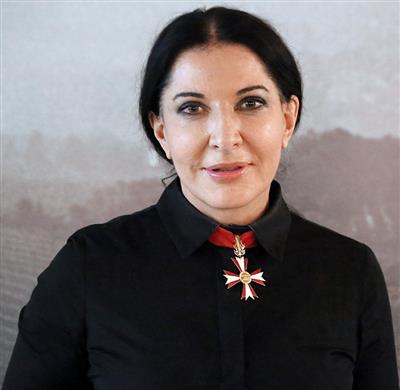
Marina Abramović is a Serbian performance artist known for pushing physical and mental limits in her challenging works.
Museums5
Countries4
Largest reported holdingStedelijk Museum voor Actuele Kunst, Ghent · 8 recorded works
Loading map…
Where to see Marina Abramovic
Collection holdings are reported here; current display varies. Check with each museum before visiting.
-
8 recorded works
Stedelijk Museum voor Actuele Kunst
Ghent, Belgium
-
5 recorded works
Musée National d'Art Moderne
Paris, France


-
2 recorded works
M HKA - Museum van Hedendaagse Kunst Antwerpen
Antwerp, Belgium
-
1 recorded work
Stedelijk Museum Amsterdam
Amsterdam, Netherlands
-
1 recorded work
Solomon R. Guggenheim Museum
New York City, United States


Frequently Asked Questions
Where can I see Marina Abramovic's work?
Marina Abramovic's performance art has been exhibited in many major museums and galleries worldwide. These include the Museum of Modern Art (MoMA) in New York, the Tate Modern in London, and the Stedelijk Museum in Amsterdam. Her work has also been shown at the Museum of Contemporary Art (MOCA) in North Miami and the National Gallery in London. Abramovic's art often involves site-specific installations and performance pieces, so the locations where her work can be seen may vary. Some of her pieces are part of permanent collections, while others are exhibited temporarily. Check museum websites and exhibition listings for current displays. Additionally, documentation of past performances, including videos and photographs, can often be found in museum archives and online resources.What should I know about Marina Abramovic's prints?
Marina Abramović is known for performance art, and her prints often relate to these performances. Collecting her photographs involves understanding the different types of prints and their condition. Edition sizes and numbers affect the price of a print. Handmade prints, signed prints, and unique prints are generally more valuable, as are editions with good provenance. "Vintage" prints, made soon after the negative is created, also fetch higher prices. In 2019, a photographic work by Abramović sold for over a million Rand (South African currency). This shows that there is a market for her photographic work. Collectors should be aware of editioning conventions, where the edition claim is written as a pair of numbers on the left bottom margin of the print. The title of the print is written in the middle of the bottom margin, and the signature is on the right. These descriptions are always signed in pencil.Why are Marina Abramovic's works important today?
Marina Abramović, born in Belgrade in 1946, is a performance artist whose work since the early 1970s has explored the relationship between artist and audience. Her performances often test emotional, intellectual, and physical limits. Abramović studied at the academies of fine arts in Belgrade and Zagreb. She abandoned painting and drawing, preferring to use her own body in her art. In 1975, she met German artist Ulay (Frank Uwe Laysiepen), and they began creating art together. Audience participation is central to Abramović's art. One performance involved her sitting passively while people manipulated her body with items such as a whip, a rose, and a gun. In 2002, she spent twelve days and nights in the Sean Kelly Gallery in New York, where visitors could observe her every move. She did not eat or speak during this time. In 2010, she sat in an extended performance called *The Artist Is Present*, sitting opposite an empty chair and locking eyes with members of the public.What techniques or materials did Marina Abramovic use?
Marina Abramović (born in 1946) is a performance artist who explores the relationship between artist and audience. Her performances often test her own limits, as well as those of her audience, emotionally, intellectually, and physically. Abramović's work often incorporates pain and blood, and it examines the limitations of the human body. Before using her own body as her artistic medium, Abramović studied at the Academy of Fine Arts in Belgrade and at the Academy of Fine Arts in Zagreb. She had found comfort in painting and drawing from an early age; however, she abandoned these techniques after being inspired by the happenings of Joseph Beuys. In 1973, she presented her first performances while teaching art in Serbia. In 2010, Abramović performed *The Artist Is Present*, an extended performance that lasted almost three months. For eight hours a day, she sat opposite an empty chair, and viewers were invited to sit and lock eyes with her.Who did Marina Abramovic influence?
Marina Abramović (born in 1946) is a performance artist who explores the connection between artist and audience. Her performances often test her own physical and mental limitations, as well as those of her audience. Abramović's work examines the body, ritualising simple actions to achieve heightened consciousness in both herself and her viewers. She has stated that art should be disturbing and open the viewer's eyes, and that art has to be spiritual. Her interest in spirituality extends to Tibetan Buddhism and shamanism, although she does not adhere to any specific tradition. Her performances include *Works with Ulay*, *Seven Easy Pieces*, and *The Artist Is Present*. In *The Artist Is Present* (2010), she sat in an extended performance for eight hours a day for almost three months. During this time, viewers sat opposite her in an empty chair, locking eyes with her. Abramović studied at the Academy of Fine Arts in Belgrade and Zagreb. She was inspired by Joseph Beuys's happenings. She has also worked as a visiting professor in Paris, Berlin, Hamburg, and Brunswick.Who influenced Marina Abramovic?
Marina Abramovic's artistic development involved a range of influences. As a child in post-war Yugoslavia, she was exposed to socialist realism. This early exposure shaped her understanding of art as a tool for communication, and she was creating her own paintings by age 14. Later, Abramovic moved towards performance art, influenced by the work of Joseph Beuys. Beuys's concept of "social sculpture" encouraged her to think about art as a way to transform society. She also drew inspiration from the Viennese Actionists, a group of artists known for their radical and often violent performances. Their willingness to push boundaries and challenge social norms resonated with Abramovic's own desire to explore the limits of the body and mind. Additionally, Abramovic has cited the impact of indigenous cultures and their rituals on her work. Her travels to places like Australia and Brazil exposed her to spiritual practices that informed her performances. These diverse influences contributed to Abramovic's unique approach to art, which combines personal experience, physical endurance, and audience participation.What is Marina Abramovic's most famous work?
Marina Abramovic is best known for her performance art, often pushing the limits of her physical and mental endurance. One of her most talked-about pieces is *Rhythm 0*, performed in Naples in 1974. In this six-hour performance, Abramovic stood still while audience members were invited to interact with her using a selection of objects, some harmless, others potentially dangerous. Another significant work is *The Artist Is Present*, which took place at the Museum of Modern Art in New York in 2010. For the duration of the exhibition, Abramovic sat silently in the museum's atrium, and visitors were invited to sit opposite her and engage in non-verbal communication. This work explored the relationship between artist and audience, presence, and the nature of performance itself. The piece drew large crowds and generated considerable media attention, solidifying Abramovic's position as a major figure in contemporary art. It also became known for a surprise reunion with Ulay, her former partner and collaborator, who sat opposite her as part of the performance.What style or movement did Marina Abramovic belong to?
Marina Abramović, born in Belgrade in 1946, is a pioneering figure in performance art. Since the early 1970s, she has explored the relationship between artist and audience, often challenging both emotionally, intellectually, and physically. Abramović's work frequently involves enacting and ritualising everyday activities. Audience participation is central to her art; in one performance from 1974, she sat passively while people manipulated her body with items such as a whip, a rose, and a gun. She focuses on the limitations of the human body, the possibilities of the mind, and connections between people. Pain and blood are sometimes elements in her performances. In 2002, Abramović spent twelve days and nights living in the Sean Kelly Gallery in New York, without eating or speaking. Visitors were invited to watch her every move, their voyeuristic presence forming part of the work. In 2010, she performed "The Artist Is Present" for almost three months, sitting opposite an empty chair and meeting the gaze of approximately 1,000 strangers.
Sources
Where to See guide aggregates verified holdings of Marina Abramovic's works across the following collections.
- [1] book Beard, Lee, 1973- author, Butler, Adam, author; Van Cleave, Claire, author; Fortenberry, Diane, author; Stirling, Susan, author, Beard, Lee, 1973- author, Butler, Adam, author; Van Cleave, Claire, author; Fortenberry, Diane, author; Stirling, Susan, author - The Art Book_ New Edition, Mini Format Used for: biography.
- [2] book Susie Hodge, I Know an Artist: The Inspiring Connections Between the World's Greatest Artists Used for: biography.
- [3] book Hodge, Susie, 1960- author, The short story of women artists : a pocket guide to movements, works, breakthroughs, & themes Used for: biography.
Editorial overseen by Solis Prints. Sources verified 2026-09-30. Click a source for details, or hover over [N] in the page above to preview.
Editorial standardsMethodologyCorrectionsAI disclosureAbout the editorial team