

About Bram Bogart
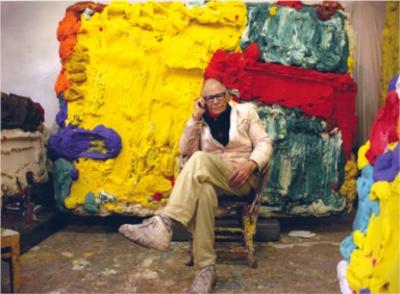
Dutch-born Belgian[1] painter who built sculptural abstractions from mortar, chalk, and raw pigment rather than conventional oil on canvas.
Where to see Bram Bogart
Collection holdings are reported here; current display varies. Check with each museum before visiting.
-
7 recorded works
King Baudouin Foundation
Brussels, Belgium
-
5 recorded works
Centraal Museum
Utrecht, Netherlands


-
4 recorded works
Groeningemuseum
Bruges, Belgium
-
3 recorded works
Museum Boijmans Van Beuningen
Rotterdam, Netherlands
-
2 recorded works
Stedelijk Museum voor Actuele Kunst
Ghent, Belgium
-
1 recorded work
Buffalo AKG Art Museum
Buffalo, United States
-
1 recorded work
Royal Museum of Fine Arts Antwerp
Antwerp, Belgium
-
1 recorded work
Museum van Bommel van Dam
Venlo, Netherlands
-
1 recorded work
Museum Belvédère
Heerenveen, Netherlands
-
1 recorded work
Stichting Museum Bommel Van Dam
Venlo, Netherlands


View all 13 museums
-
1 recorded work
Indianapolis Museum of Art
Indianapolis, United States
-
1 recorded work
Mu.ZEE - Kunstmuseum aan Zee
Ostend, Belgium
-
1 recorded work
National Gallery of Victoria
Melbourne, Australia


Frequently Asked Questions
Where can I see Bram Bogart's work?
To view works by Bram Bogart, consider museums that feature 20th-century art. These include institutions in Europe and North America. Within Belgium, the Brangwyn Museum in Bruges and the Clockarium Museum in Brussels may hold relevant pieces. In France, the Musée d’Art et d’Industrie in Roubaix and the Musée des Beaux-Arts in Nancy are possibilities. The Musée des Arts Décoratifs in Paris is another option. In the United States, museums such as the Charles Hosmer Morse Museum of American Art (Winter Park, Florida), the Los Angeles County Museum of Art, the Metropolitan Museum of Art and the Museum of Modern Art (both in New York), the Minneapolis Institute of Arts, the Virginia Museum of Fine Arts (Richmond), and the Wolfsonian at Florida International University (Miami Beach) may hold works by the artist. In Canada, the Royal Ontario Museum in Toronto could be a place to view his art. Within the United Kingdom, the Bakelite Museum, Brighton Museum & Art Gallery, Geffrye Museum, Manchester Art Gallery, the National Museums of Scotland (Royal Museum), and the Victoria & Albert Museum may also have pieces.What techniques or materials did Bram Bogart use?
Bram Bogart was known for his distinctive impasto technique, which involved creating thick, textured surfaces on his canvases. He achieved this by mixing oil paint with materials such as mortar, chalk, and even glue. This mixture allowed him to apply paint in substantial, almost sculptural layers. Bogart often worked on a large scale, using his hands and palette knives to manipulate the heavy paint mixture. His approach was physical, and he built up surfaces through repeated applications, creating a sense of depth and dimension. The resulting works have a tactile quality, inviting viewers to engage with the artwork on a sensory level. His innovative use of materials and techniques set him apart from many of his contemporaries.Who did Bram Bogart influence?
It is difficult to identify specific artists who were directly influenced by Bram Bogart. However, we can discuss the general reception and influence of earlier Dutch masters, such as Frans Hals and Rembrandt, on later artists. Since the late 19th century, art criticism has often considered Hals in relation to later artistic movements. His influence on painters has had a significant impact on the history of Western art. However, focusing solely on the art he inspired, rather than its sources, removes it from its temporal and cultural context. After the mid-19th century, Rembrandt surpassed other early painters. His image, as created by critics, presented him as an independent observer who infused his soul into his work. Some artists remained close to Rembrandt's expressiveness, while others echoed his iconography from a distance. Painters such as Delacroix, Decamps, Bonvin, and Vollon interpreted and copied Rembrandt's paintings. Wilhelm Busch, though influenced by Isaac van Ostade, painted in the same spirit. Rembrandt's method and manner provided models for modern formal solutions. Critics such as Delacroix, Gautier, Vosmaer, and van Gogh praised Rembrandt's colour and light.What is Bram Bogart's most famous work?
Bram Bogart is not known for one single, definitive work. Instead, he is recognised for his distinctive approach to abstract expressionism, characterised by thick application of paint. Born in Delft, the Netherlands, in 1921[1], Bogart moved to Paris in 1961[1]. There, he developed his signature style of painting, using a mixture of mortar, oil paint, varnish, and siccatives, applied in thick layers to the canvas. These impasto works became his trademark. Although he produced art for over six decades, Bogart's style remained consistent. His works from the 1960s onwards are all of a similar type: heavily textured, abstract compositions with a strong emphasis on materiality. Titles such as *New York Painting* (1967) and *Summer Painting* (1988) are representative of his wider output. He represented Belgium at the Venice Biennale in 1971. Bogart died in 2012[1], leaving behind a substantial body of work, all exploring the possibilities of paint as a sculptural medium.What style or movement did Bram Bogart belong to?
Bram Bogart (1921[1]-2003[1]) is associated with matter painting, also known as *matiérisme*. This style moved away from traditional painting techniques. Instead, it emphasised the physical properties of paint itself. Bogart's works are characterised by thick, heavily textured surfaces. He achieved this effect by mixing paint with materials such as mortar, chalk, and varnish. The result is a three-dimensional quality, where the paint appears sculpted onto the canvas. Although Bogart's work shares some similarities with abstract expressionism, particularly in its emphasis on gesture and non-representational forms, it is distinct. Abstract expressionism often retains a sense of illusionistic space, whereas Bogart's matter paintings assert the objecthood of the canvas. His practice aligns more closely with EuropeanInformel tendencies, a parallel development that also valued spontaneity and materiality. Other artists associated with this broad grouping include Jean Fautrier and Alberto Burri, all of whom experimented with unconventional materials and techniques to challenge traditional notions of painting.What is Bram Bogart known for?
Bram Bogart is known for developing his own medium using a compound of mortar, powdered chalk, raw pigment, siccative, and varnish. He built works on large wooden supports, applying the mixture in heavy slabs, resulting in constructions between painting and low-relief sculpture.What was Bram Bogart's art style?
Bogart's early work moved through Cubism and figurative painting before he turned to abstraction in the 1950s. By 1961[1], he had developed his signature style of building works on large wooden supports with a compound of mortar, powdered chalk, raw pigment, siccative, and varnish.
Sources
Where to See guide aggregates verified holdings of Bram Bogart's works across the following collections.
- [1] wikipedia Wikipedia: Bram Bogart Used for: biography.
- [2] book Masterpieces of western art : a history of art in 900 individual studies from the Gothic to the present day Used for: biography.
- [3] book Metropolitan Museum Of Art, Metropolitan Museum Of Art - Dutch Painting, the Golden Age_ an Exhibition of Dutch Pictures of the Seventeenth Century, under the High Patronage of Her Majesty the Queen of the Netherlands - Metropolitan Museum of Art, Toledo Museum of Art, Art Used for: biography.
- [4] book National Gallery of Art, National Gallery of Art - Painting in the Dutch Golden Age - A Profile of the Seventeenth Century Used for: biography.
- [5] book John Michael Montias, Vermeer and His Milieu _ A Web of Social History Used for: biography.
- [6] book John Michael Montias, Vermeer and His Milieu _ A Web of Social History Used for: biography.
- [7] book John Michael Montias, Vermeer and His Milieu _ A Web of Social History Used for: biography.
Editorial overseen by Solis Prints. Sources verified 2026-09-30. Click a source for details, or hover over [N] in the page above to preview.
Editorial standardsMethodologyCorrectionsAI disclosureAbout the editorial team