



About A. R. Penck
- neo-expressionism
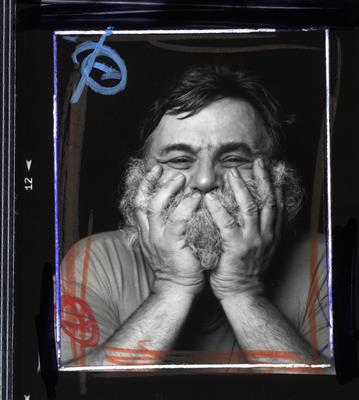
German Neo-Expressionist born Ralf Winkler in Dresden, whose sign-based paintings were shown in the West for fifteen years before he could leave East Germany himself.
Where to see A. R. Penck
Collection holdings are reported here; current display varies. Check with each museum before visiting.
-
16 recorded works
Musée d'art moderne de Paris
Paris, France
Also here (6)
-
9 recorded works
Museum Ludwig
Cologne, Germany


-
5 recorded works
Museum Boijmans Van Beuningen
Rotterdam, Netherlands
-
4 recorded works
Groninger Museum
Groningen, Netherlands
-
3 recorded works
Van Abbemuseum
Eindhoven, Netherlands
-
2 recorded works
Städel Museum
Frankfurt, Germany
-
2 recorded works
Stedelijk Museum Amsterdam
Amsterdam, Netherlands
-
2 recorded works
Wallraf–Richartz Museum
Cologne, Germany
-
2 recorded works
Kunsthaus Zürich
Zurich, Switzerland
-
2 recorded works
Harvard Art Museums
Cambridge, United States


View all 21 museums
-
2 recorded works
Busch–Reisinger Museum
Cambridge, United States
-
2 recorded works
Metropolitan Museum of Art
New York City, United States
-
2 recorded works
Saint Louis Art Museum
St. Louis, United States
-
2 recorded works
Tate
London, United Kingdom
-
1 recorded work
Buffalo AKG Art Museum
Buffalo, United States
-
1 recorded work
Museum of Modern Art
New York City, United States
-
1 recorded work
Museum Frieder Burda
Baden-Baden, Germany
-
1 recorded work
National Gallery of Victoria
Melbourne, Australia
-
1 recorded work
The Museum of Art, Kōchi
Kochi, Japan
-
1 recorded work
Fukuoka Art Museum
Fukuoka, Japan
Also here (3)
-
0 recorded works
National Gallery of Art
Washington D.C., United States


Frequently Asked Questions
Where can I see A. R. Penck's work?
A. R. Penck's art appears in many public collections. Major holdings of his paintings and sculptures are located in Germany, where he lived and worked for much of his career. You can find his pieces at the Museum Ludwig in Cologne, which has a selection of his paintings from the 1960s through the 1980s. The Städel Museum in Frankfurt also holds examples of his work. In Dresden, the Albertinum possesses a number of Penck's paintings and sculptures, offering a look into his artistic development. Outside Germany, several international museums include Penck's creations. The Tate Modern in London has paintings by Penck in its collection. The Museum of Modern Art (MoMA) in New York also owns a number of his works, providing further opportunities to view his art. These institutions allow a broad audience to engage with Penck's output.What should I know about A. R. Penck's prints?
A. R. Penck (born Ralf Winkler) was a German artist known for his paintings, sculpture, and printmaking. His prints often feature his signature "Standart" figures: simplified, stick-like figures that communicate complex ideas about society, communication, and the human condition. Penck's printmaking techniques included woodcuts, linocuts, and screenprints. His style is characterised by bold lines, simplified forms, and a raw, energetic quality. Penck's prints frequently explore themes of political division, social commentary, and the search for meaning in a fragmented world. Living in East Germany until 1980[1], his work often reflected the tensions of the Cold War era. His prints are not always technically perfect; this is part of their appeal. Penck embraced a deliberately crude aesthetic, reflecting his interest in primal forms of expression and his rejection of artistic conventions. He often combined text and image in his prints, creating a visual language that is both immediate and thought-provoking. Penck's prints offer insight into his unique artistic vision and his engagement with important social and political issues.Why are A. R. Penck's works important today?
A. R. Penck (born Ralf Winkler, in Dresden, 1939[1]) was a German artist whose paintings, sculptures, and prints engaged with questions of communication, social order, and political power. Penck's works are important because they offer a visual language for grappling with complex systems. His 'Standart' paintings, produced from the late 1960s, feature stick figures and symbolic imagery. These works can be understood as attempts to create a universal, accessible means of conveying information, reflecting concerns about the division of Germany and the restrictions on free expression in the East. His practice also involved music and performance, expanding the possibilities for artistic communication. Penck’s works invite viewers to consider how meaning is constructed and disseminated in society, and the role of the artist in challenging established norms. Penck died in Zurich in 2017[1].What techniques or materials did A. R. Penck use?
A. R. Penck, born Ralf Winkler, employed a range of techniques and media in his artistic practice. Penck's early work involved painting and drawing, often on canvas or paper. He developed a distinctive style characterised by simplified, stick-like figures and symbols. Penck's materials included acrylic paint, charcoal, and occasionally found objects. He was interested in the immediacy of expression, so he often worked quickly and spontaneously. This approach led to a raw, energetic quality in his art. Later in his career, Penck expanded his repertoire to include sculpture, printmaking, and even music. His sculptures frequently used wood and bronze. His prints often echoed the imagery of his paintings. Throughout his career, Penck maintained a consistent visual language, using basic forms to explore complex ideas about communication, information, and the human condition. He aimed to create a universal symbolic system in his work.Who did A. R. Penck influence?
A. R. Penck, born Ralf Winkler, engaged with artistic and political themes in East Germany before moving to the West in 1980[1]. His influences ranged from Rembrandt and Picasso to German Expressionists. Penck explored information and communications theory, incorporating these ideas into his art. His work examines the problematic nature of communication. Penck's method involves a cycle of self-presentation through signs and messages, resulting in reified representations open to reflection. While it is difficult to assess direct influence, Penck collaborated with Jörg Immendorff. Penck's work has been compared to that of Joseph Beuys, in their shared interest in the power of language. Penck's exploration of self-expression and the complexities of communication may have resonated with artists exploring similar themes in the late 20th century. His move to the West, and subsequent exhibitions, exposed his ideas to a broader audience.What is A. R. Penck's most famous work?
It is difficult to name a single "most famous" work by A. R. Penck, as his notability arises from his distinctive style and exploration of themes rather than one specific piece. Penck, who also used pseudonyms such as Mike Hammer, sought an "anti-style" that challenged prevailing tastes. His paintings often feature simple, stylised figures and symbols arranged around a central axis. These signs, which he termed "standard", recur across his body of work, allowing for repetition and variation. His work, *Ein mogliches System (A = Ich)* (A Possible System [A = I]) of 1965[1], is one example of his artistic approach. Penck was interested in systems, information, and communication theory. He explored language and the science of information through self-expression. He combined painting, poetry and music as experiments in structuring multiple messages. Penck's paintings use symbols, figures, colours and shapes to convey messages, some recognisable, others improvised.What style or movement did A. R. Penck belong to?
A. R. Penck (born Ralf Winkler) is associated with several styles, including Neo-Expressionism and the broader category of contemporary art. He developed his own symbolic visual language. Penck began his artistic career in East Germany, where his work was considered unofficial. His style during this period was influenced by artists like Paul Klee and, later, by the cybernetics theories of Max Bense. He was part of the East German art scene, producing paintings and sculptures that often carried coded messages of social and political commentary. After moving to West Germany in 1980[1], Penck became associated with the Neo-Expressionist movement. This style was characterised by a return to figurative painting, bold colours, and emotionally charged subject matter. Penck's work from this period often featured his signature "Standart" figures: simplified, stick-like figures that he used to explore themes of communication, information, and social structures. He exhibited internationally and gained recognition for his distinctive style, which combined elements of primitivism, modernism, and his own unique symbolism.What was A. R. Penck known for?
A. R. Penck (born Ralf Winkler) was a German artist best known for his paintings, sculptures, and prints. He developed a distinctive style featuring simplified, stick-figure-like forms and symbolic imagery. Penck's work often explored themes of communication, social systems, and political power. Living in East Germany until 1980[1], his art engaged with the complexities of Cold War division and state control. His "Standart" paintings, begun in the 1960s, used abstract figures to represent models of social organisation. These figures, which he called "Menschen, die wie Standards aussehen" (people who look like standards), became a recurring motif in his output. After moving to West Germany, Penck continued to develop his visual vocabulary. He was associated with the Neo-Expressionist movement, and he exhibited internationally. Penck also experimented with music, collaborating with free jazz musicians, reflecting his interest in improvisation and non-hierarchical structures. His diverse practice included woodcuts and bronze sculpture, all marked by his unique symbolic language.
Sources
Where to See guide aggregates verified holdings of A. R. Penck's works across the following collections.
- [1] wikipedia Wikipedia: A. R. Penck Used for: biography.
- [2] book Ernst Hans Gombrich, Fritz Saxl, Aby Warburg _ an intellectual biography Used for: biography, stylistic analysis.
- [3] book guggenheim-refigur00kren Used for: biography.
- [4] book Masterpieces of western art : a history of art in 900 individual studies from the Gothic to the present day Used for: biography.
Editorial overseen by Solis Prints. Sources verified 2026-09-30. Click a source for details, or hover over [N] in the page above to preview.
Editorial standardsMethodologyCorrectionsAI disclosureAbout the editorial team