

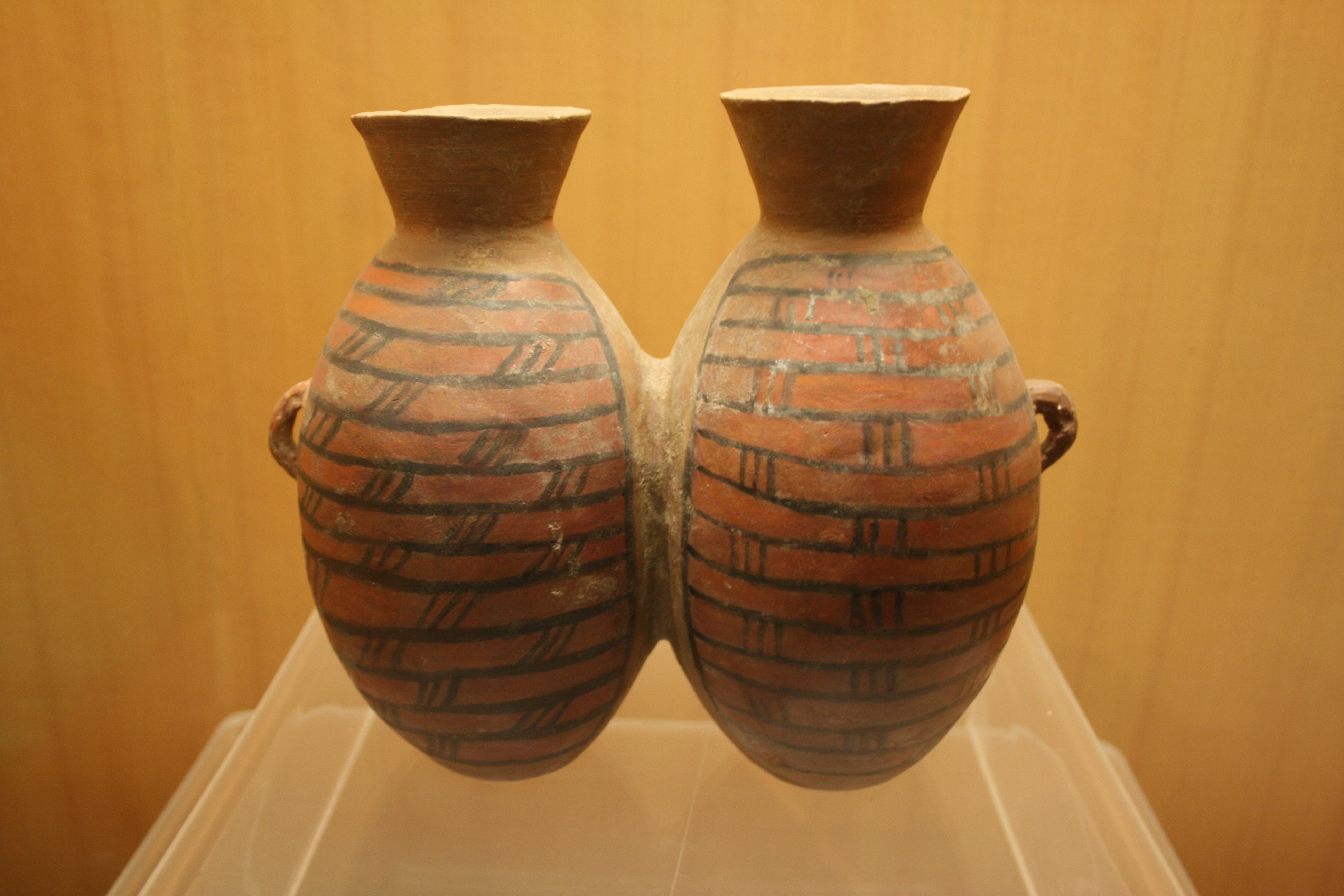
Eight thousand years before anyone in China put brush to silk, Neolithic artisans were already making objects of startling sophistication. Their pottery basins carried painted designs of fish, cranes, and geometric abstractions. Their jade pendants were ground and polished to a warm lustre using nothing more than abrasive sand and rotational tools. These were not crude first attempts. They were the beginning of the longest unbroken tradition of decorative art in the world.
Painted Earth
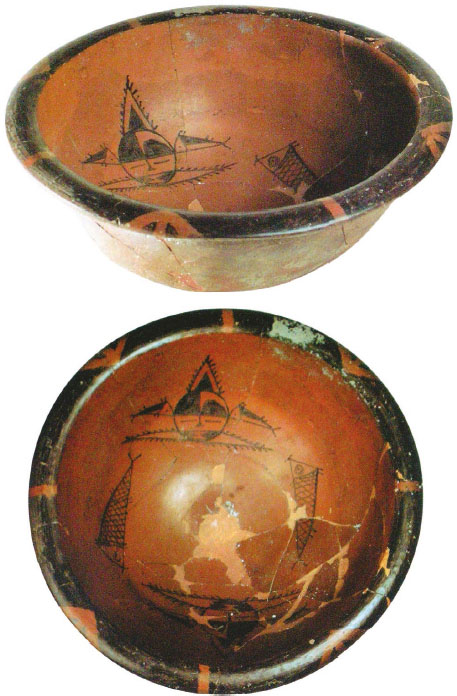
The earliest Chinese decorative arts were pottery. Across the Yellow River drainage basin, the Yangshao Culture (roughly 5000 to 3000 BC) produced painted wares that remain remarkable for their confidence. At the Banpo site near modern Xi'an, excavators found a pottery basin painted with mask and fish motifs, used as a cover for a child's burial urn. The design is not tentative; it balances symmetry with expressive abstraction.
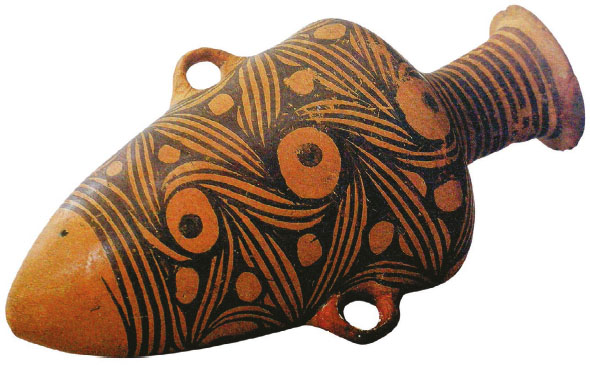
The Majiayao Culture (roughly 3000 to 2000 BC), further up the Yellow River in modern Gansu, produced the most abundant and varied painted pottery of any Neolithic Chinese culture. Their amphorae carry bold swirl patterns in black pigment, with a directness that feels almost modern. One amphora from the Majiayao site has an ovoid body tapering to a narrow base: a practical design for fetching water, where the narrow bottom could be set upright in soft earth.
Pottery from the Dawenkou and Longshan cultures of Shandong developed in parallel, with their own character. But it was the painted wares of the Yellow River cultures that set the standard. When viewed from above rather than from the side, some painted basins reveal entirely different patterns: zigzag lines resolve into flower petals, and the rim becomes the centre of an eight-lobed design. The potters were thinking in three dimensions.
Stone Turned Sacred
Jade is extraordinarily hard. Cutting and polishing it with Neolithic tools required patience measured in weeks, not hours. The stone had to be drilled and ground on rotational machinery using a paste of diamond sand. Despite these difficulties, the jade craft was well developed by the late Neolithic. Artisans chose stones carefully for their colour and texture, and the finished objects were polished to a warm lustre with finely carved patterns.
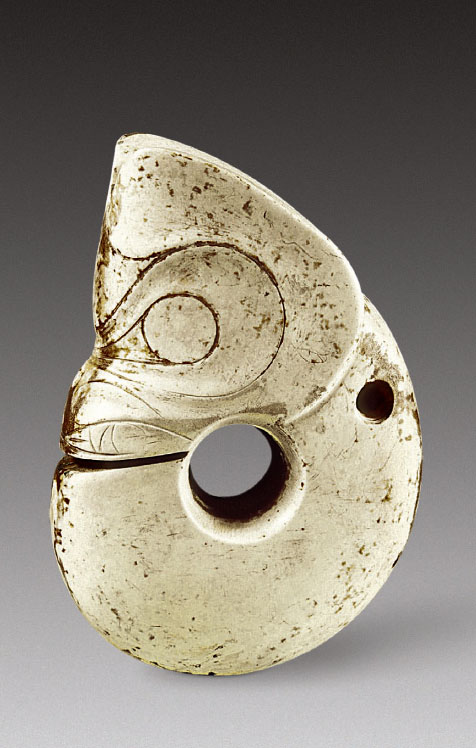
The Hongshan Culture (roughly 4700 to 2900 BC) in the northeast produced some of the earliest known jade objects, including stylised beast-form pendants that scholars have variously called "hog-dragons." A jade dragon pendant from the same culture, now in the National Museum of China, stands 26 centimetres tall: a substantial and deliberate piece of work.

The Liangzhu Culture (roughly 3300 to 2200 BC), scattered around Taihu Lake, produced the most celebrated Neolithic jade. Their signature objects are the cong (a square tube with a cylindrical interior) and the bi (a disc with a central hole), both used in rituals. The largest known cong weighs 6,500 grams. Its incised decoration, featuring human and animal masks in strict symmetry, is so fine that it rivals modern microscopic carving. Researchers believe these animal-faced motifs mark the beginning of a ritual practice centred on spirit beings: an artistic impulse that would persist through every subsequent dynasty.
What makes these objects extraordinary is not just their age, but what they imply. Somebody, more than five thousand years ago, decided that the practical business of survival was not enough. Clay needed to carry meaning. Stone needed to become sacred. That decision, repeated across millennia and across the breadth of China, is the foundation everything else was built on.


