

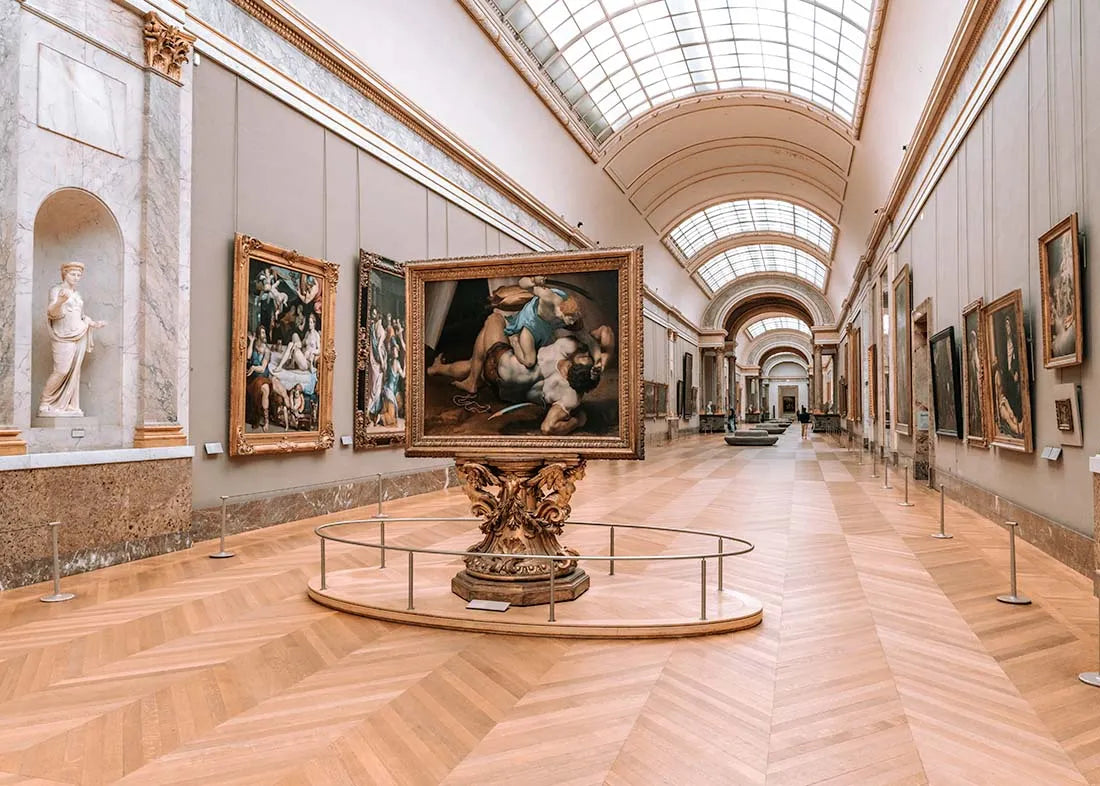
For centuries, the concept of the "Grand Tour" inspired artists, writers, and collectors to travel across the continent, absorbing the culture of the best art galleries in Europe. These institutions are not merely repositories of history; they are the original style guides for maximalist interiors. With their floor-to-ceiling hangings, rich velvet backdrops, and gilded frames, museums like the Louvre and the Uffizi offer the ultimate lesson in curating a space that feels both timeless and personal.
Today, you do not need a royal commission to create a gallery-worthy home. By looking at how these historic institutions display their treasures, we can find endless inspiration for our own walls. Here is our curated guide to the most inspiring galleries in Europe and how to bring their aesthetic into your living room.
The Louvre, Paris: The Art of the Salon Wall
No list of the best art galleries in Europe is complete without the Louvre. Before it was a museum, it was a palace, and its aesthetic reflects that grandeur. The Grande Galerie, famously depicted by Hubert Robert, showcases the "salon style" of hanging art-where paintings are stacked in rows, often touching, to create a wall of colour and narrative.
To recreate this Parisian maximalism, do not be afraid to mix genres. A Henri Matisse print can sit comfortably beside a classical landscape. The key is to treat the wall as a single canvas rather than a display for individual isolated works. Use matching frames to unify the collection, or mix vintage gold with modern black for an eclectic feel.
The Uffizi Gallery, Florence: The Tribuna Aesthetic
Florence is the cradle of the Renaissance, and the Uffizi is its heart. The famous Tribuna room was designed not just to store art, but to overwhelm the senses with beauty. As seen in Johann Zoffany's famous painting, the walls were crimson, the ceilings encrusted with pearl shells, and paintings were displayed alongside sculpture and furniture.
The Uffizi teaches us that art is not just for walls. It interacts with the furniture and objects around it. When planning your space, consider how a framed Ohara Koson print might look above a velvet armchair, or how a series of botanical prints by A. J. Wendel can complement a wooden sideboard. This layered approach creates a room that feels lived-in and cultivated over time.
The Belvedere, Vienna: Gold and Secession
If the Louvre is about volume, the Belvedere in Vienna is about opulence. Home to the world's largest collection of Gustav Klimt paintings, the Upper Belvedere is a masterclass in combining art with architecture. The gold leaf on Klimt's canvases echoes the baroque stucco of the palace itself.
For a touch of Viennese glamour, incorporate metallic elements into your gallery wall. A print like The Kiss naturally commands attention, but you can enhance the effect by placing it on a dark, moody wall colour-midnight blue or charcoal-which makes the gold tones pop, much like they do in the dim, reverent halls of the museum.
The Rijksmuseum, Amsterdam: Dutch Detail
The Rijksmuseum offers a different kind of drama. Designed by Pierre Cuypers, the building is a cathedral to the arts, mixing Gothic and Renaissance influences. Inside, the focus is on the interplay of light and shadow, characteristic of the Dutch Golden Age. The galleries here are famous for their dark grey and teal walls, which allow the intricate details of still lifes and portraits to shine.
To capture this look, consider the lighting of your room. Directed picture lights or soft lamps can create the intimate atmosphere found in these Dutch galleries. Pair this mood with detailed works, such as the intricate patterns of William Morris prints or the precise lines of Katsushika Hokusai, to draw the eye in.
The V&A, London: The Arts & Crafts Home
Finally, we look closer to home at the Victoria and Albert Museum. As a champion of the Arts and Crafts movement, the V&A (and its stunning Morris Room) reminds us that art should be part of everyday life. William Morris himself believed that one should "have nothing in your house that you do not know to be useful, or believe to be beautiful."
Incorporating Strawberry Thief or other textile-inspired prints into your home decor pays homage to this philosophy. It bridges the gap between high art and functional design, proving that the best art galleries in Europe are not just destinations to visit, but blueprints for living beautifully.


