

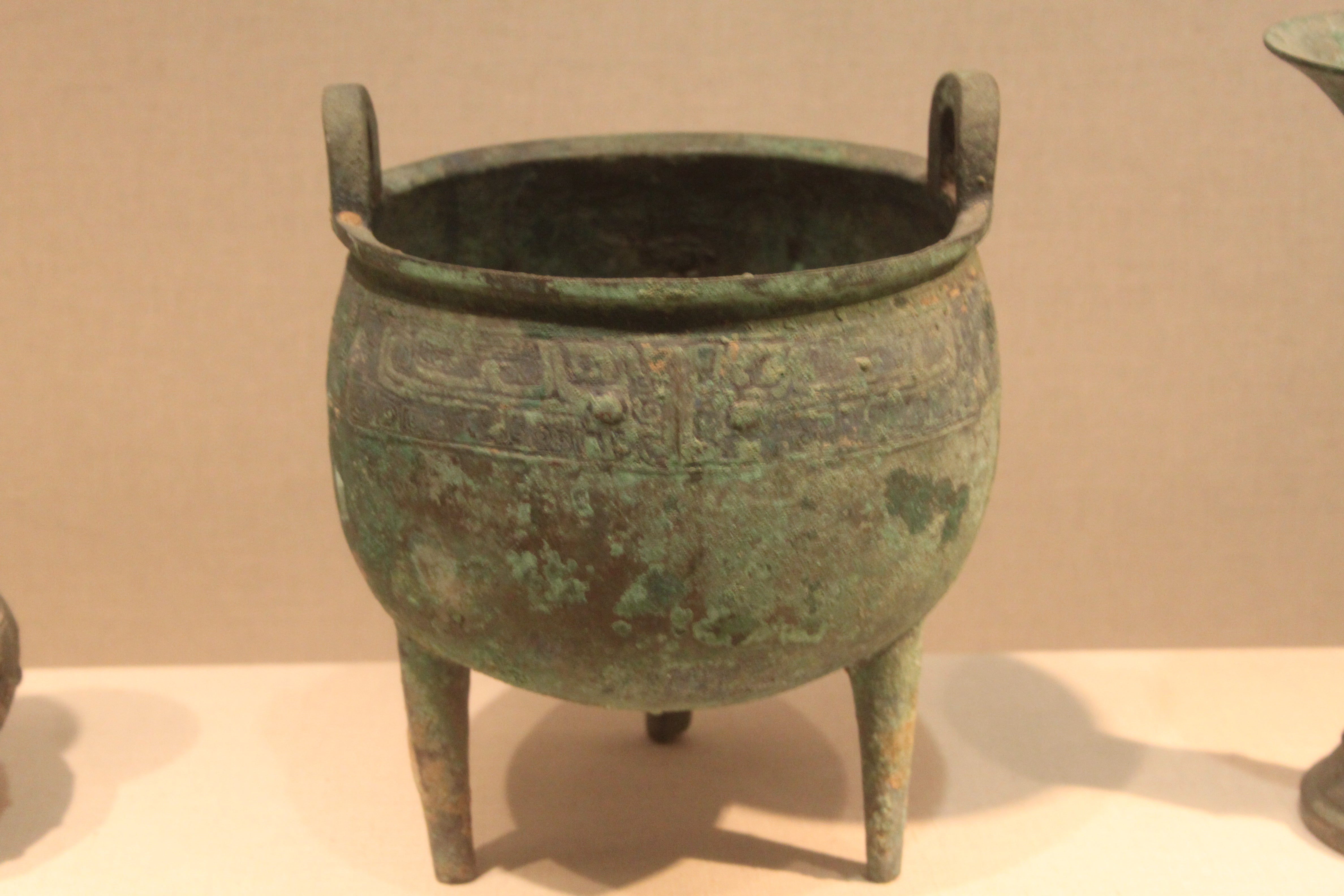
The Shang dynasty (roughly 1600 to 1046 BC) did not make bronze vessels for decoration. They made them for talking to the dead. Wine was poured from owl-shaped ewers into goblets ringed with spirit faces. Food was cooked in cauldrons whose surfaces crawled with mythical beasts. These were objects of political and religious power, and their artistry was in service of something larger than aesthetics.
The Tomb of Lady Fuhao
In 1976, archaeologists excavating at Yin Ruins near Anyang, Henan, discovered the intact tomb of Fuhao, believed to be a consort of the Shang king Wu Ding. Inside were 468 bronze objects. Three quarters of them were wine vessels, a detail that tells you something about the Shang court's relationship with alcohol and ritual.
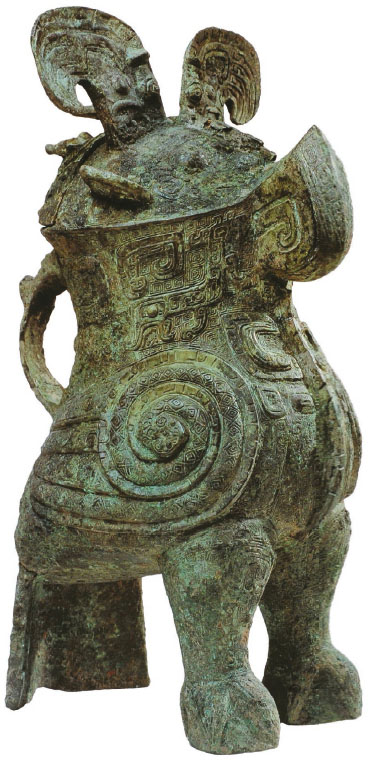
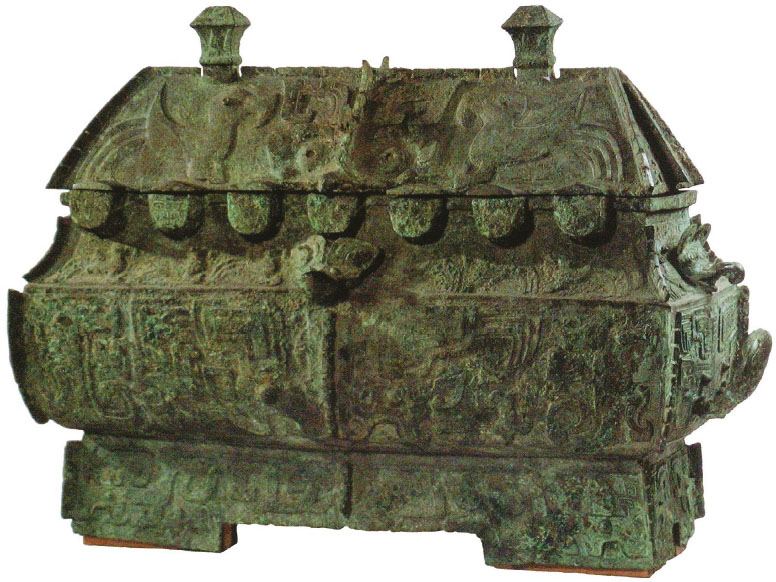
The owl-shaped wine vessel above is at once representational and strange. It is clearly an owl, but an owl filtered through a sensibility that valued the uncanny over the naturalistic. The Shang favoured forms that were, in the words of one scholar, "hauntingly outlandish." A double-chambered container from the same tomb is designed in the form of a miniature palace and has been used by modern historians as a guide to reconstructing Shang architecture.
Faces in the Metal
The defining motif of Shang bronze is the taotie: a symmetrical mask formed by two kui dragons in profile, placed face to face. These masks appear on virtually every significant Shang bronze, positioned prominently on the widest part of the vessel. Below them, dense fields of square spirals called leiwen ("thunder pattern") fill every remaining surface.
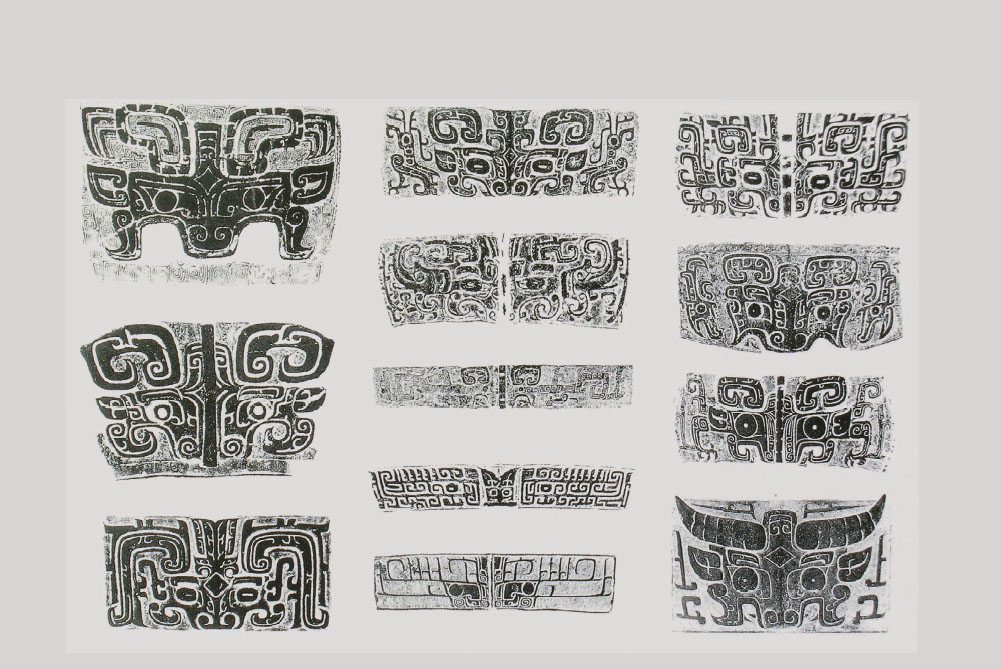
The effect is deliberate intimidation. These were not vessels for quiet domestic meals. They were instruments of state religion, used in ceremonies where shamanistic power was invoked. The taotie mask stares outward without a body, a face that belongs to no single animal. Modern interpretations connect it to Shang belief in spirit-beings whose favour had to be courted through ritual.
Shang bronze-casting technology was extraordinary. A technique of sectional moulds allowed parts to be cast separately and then assembled, freely movable or detachable. The shapes were either square or bulbous, and their complex decoration consisted of raised bands and parts cast in the round, producing a three-dimensional quality that flat decoration could never achieve.
The Masks of Sanxingdui
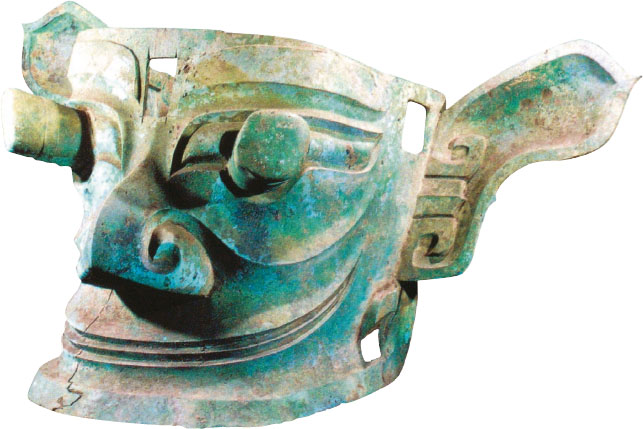
In 1986, two sacrificial pits at Sanxingdui in Sichuan revealed a parallel bronze tradition entirely unlike the Anyang court style. The finds included an upright human figure 2.62 metres tall, a bronze tree 3.84 metres high, and masks of extraordinary scale. The mask above measures 1.34 metres across, with protruding cylindrical eyes that scholars link to the legendary King Cancong of the ancient Shu kingdom, described in contemporary chronicles as having "bulging eyes."
Sanxingdui proved that Shang bronze culture was not monolithic. While the Anyang court produced vessels of regulated, hierarchical purpose, the Shu kingdom produced objects that seem closer to visions than to state protocol. Both traditions, separated by geography but contemporary in time, used bronze to reach beyond the ordinary world. They simply had different ideas about what they might find there.


