


Charlotte Salomon was born in Berlin in 1917 to a wealthy Jewish family. Her mother, Franziska, killed herself when Charlotte was nine, by jumping from a window. Charlotte was told that her mother had died of influenza. The truth about the suicide, and about the long history of suicides in the maternal line of Charlotte's family, was kept from her until she was twenty-three. She was then told everything in a single afternoon by her grandfather, who was about to commit suicide himself.
Between 1940 and 1942, in the small French Mediterranean town of Villefranche-sur-Mer where she had fled with her grandparents, Salomon painted 769 gouaches on individual sheets of paper. The gouaches were numbered, arranged into a sequence, and given titles. The whole work, which Salomon called Leben? oder Theater? (Life? or Theatre?), tells the story of her life and family up to the moment of her grandfather's revelation. She finished it in the spring of 1942. She gave the work to a French doctor for safekeeping. She was deported to Auschwitz in October 1943 and killed on arrival. She was twenty-six and five months pregnant.
Berlin
Salomon's father, Albert, was a surgeon and a respected academic in Berlin. After the death of his first wife, he married a singer named Paula Lindberg. Paula effectively became Charlotte's mother and stepmother, and Charlotte's relationship with her was both close and competitive.
Charlotte attended the Vereinigte Staatsschulen, the Berlin united state art schools, from 1936 to 1938. She was the only Jewish student admitted in 1936, and she was admitted only by an administrative oversight: her application had not been flagged as Jewish, and by the time the school realised, she had already enrolled. She studied painting and won the school's prize for best student in 1938. She was barred from accepting the prize in person because of her race.
By 1938 the family situation in Berlin had become impossible. Charlotte's grandparents had fled to the south of France in 1933. After Kristallnacht (November 1938), Albert and Paula sent Charlotte to join her grandparents in the south of France. She left Berlin on 1 January 1939 and never saw her father or stepmother again. Both survived the war; both returned to Berlin afterwards.
The Suicides
The history that Charlotte's grandfather revealed to her in 1940 was as follows. Her mother Franziska had committed suicide in 1926. Her aunt Charlotte (Charlotte's namesake) had committed suicide in 1913. Her grandmother had attempted suicide several times. Several other women in the family across three generations had killed themselves. The pattern was being kept secret from Charlotte because the family worried she would conclude that the same fate awaited her.
The grandfather told her the whole history because he had decided to kill himself. He had become depressed in the south of France, was certain the Nazis would eventually reach Villefranche, and could not bear waiting. He intended to die that evening. He wanted Charlotte to understand the family she came from.
The grandfather did kill himself that night. Charlotte spent the next eighteen months in the south of France, with her grandmother (who soon died of cancer) and increasingly alone. The whole of Leben? oder Theater? was conceived and painted in this period.
What She Painted
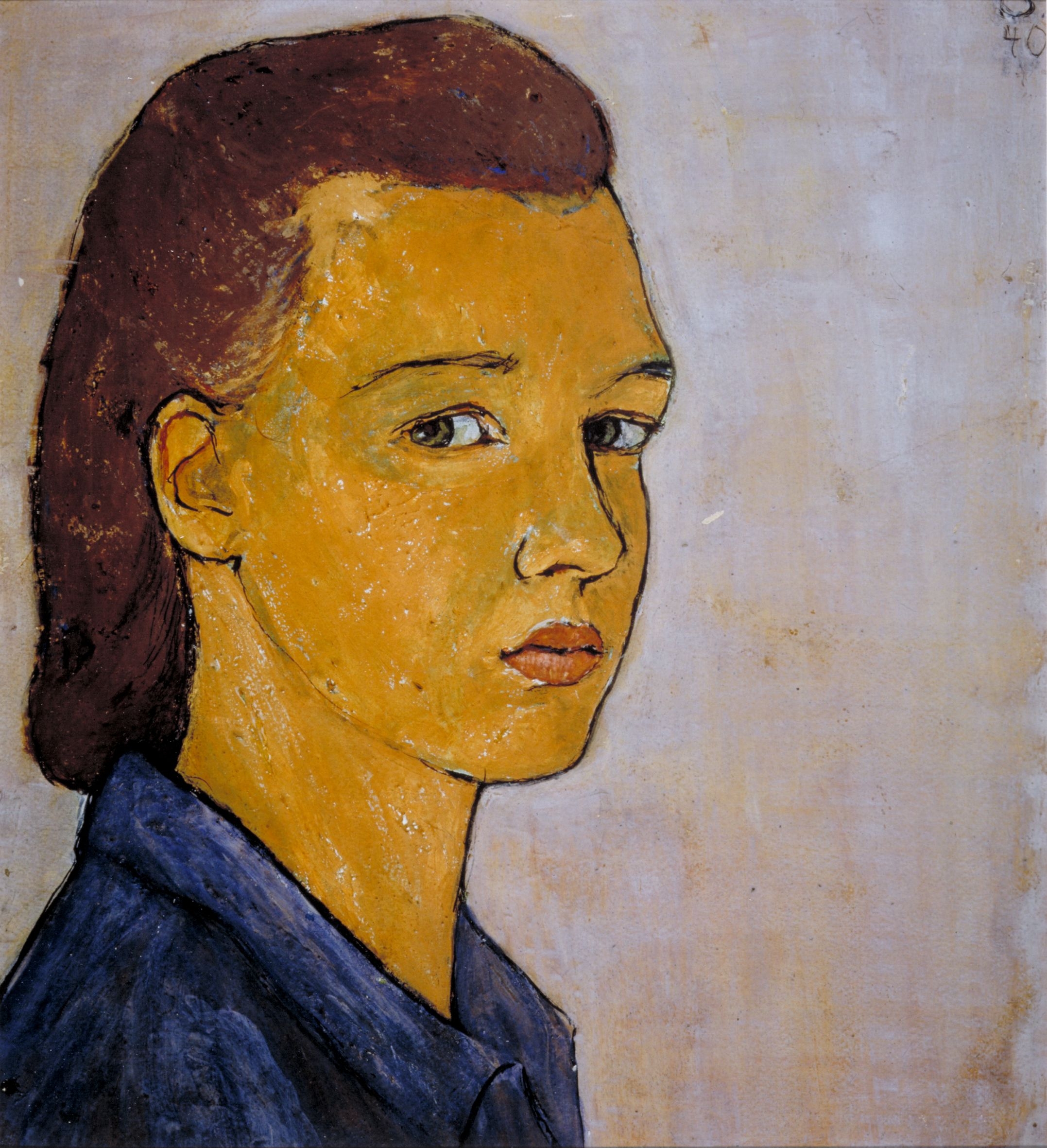
The work is 769 individual gouache sheets, approximately 32 by 25 centimetres each, painted in tempera. They are numbered in pencil at the top right. They are designed to be read in sequence: as a kind of graphic novel before graphic novels existed, or a film told entirely in painted frames.
The narrative tells the story of Salomon's family from the late nineteenth century onward, focused on the women: the suicides, the marriages, the relocations, the secrets. Salomon used fictional names for everyone, but the figures are recognisable. Her mother is called Franziska. Her stepmother is called Paulinka. The grandfather is called Daberlohn (a play on "Tagelöhner," day-labourer). Charlotte herself is called Charlotte Kann.
The technique is unusual. Salomon used a limited palette: yellow, red, blue, black, white, with small variations. The figures are simplified, almost cartoonish, but the compositions are sophisticated. The earlier sheets show single scenes; the later sheets layer multiple scenes onto a single sheet, with text written across them and figures repeating across the surface. The whole work moves from a relatively conventional narrative style at the beginning to an increasingly fluid, almost cinematic visual language by the end.
Salomon wrote text directly onto the gouaches: descriptions, dialogue, musical references (she indicated specific songs from operas, popular music, and German lieder that she wanted to accompany the reading of each section). The intended experience of the work is multi-sensory: image, text, and music all simultaneously.
The End
Salomon married Alexander Nagler, a refugee from Vienna, in June 1943. The couple were living in Nice. By this point southern France had been occupied by Nazi Germany, and the round-up of Jews was systematic. On 24 September 1943, Salomon and Nagler were arrested by the Gestapo at their home. They were transferred first to Drancy, the holding camp outside Paris, and then deported to Auschwitz on 7 October 1943.
Charlotte Salomon was killed in the gas chamber on arrival at Auschwitz on 10 October 1943. She was twenty-six and five months pregnant. Alexander Nagler was killed in Auschwitz on 1 January 1944.
What Survived
Before the arrest, Salomon had given the complete Leben? oder Theater? to the French doctor Georges Moridis, who had been treating her family in Villefranche. She told him, "This is my whole life." He kept the work hidden through the rest of the war.
After the liberation, Moridis returned the work to Salomon's father Albert, who had survived in Amsterdam. Albert and his wife eventually donated the entire 769-sheet work, plus Salomon's letters and surviving smaller drawings, to the Joods Historisch Museum (Jewish Historical Museum) in Amsterdam in 1971. The work has been held there since.
What Took So Long
Salomon's work was not widely known until the 1960s. The first major publication was a 1962 selection in a German art journal. The first full exhibition (with all 769 sheets shown together) was at the Joods Historisch Museum in 1981. The work has slowly entered the canon since.
The reception has been complicated by two questions. The first is whether Salomon's grandfather assaulted her sexually before his death; a 1990 letter from Salomon, written in 1943, claims that he did. The letter was kept private by the family for decades and was published only in 2015. The second question is what to make of Salomon's work as a Holocaust testimony: she completed it before her deportation, before the full scale of the Final Solution was clear, and the work does not address the Holocaust directly. It is a record of a German Jewish family's pre-Holocaust history, made by a woman about to be killed by the Holocaust.
The 2017 Royal Academy exhibition Charlotte Salomon: Life? or Theatre? (London) was the largest international showing of the work. The 2023 Centre Pompidou-Metz retrospective, which combined the gouaches with photographic and archival material, brought new audiences. Salomon is now considered one of the central figures in the early-twentieth-century narrative tradition that anticipates the modern graphic novel.
What the Work Argues
The title Leben? oder Theater? is a question. Is what Salomon shows life, or is it theatre? Both, the work suggests. The family history is true; the way she has rendered it (with theatrical staging, song cues, cinematic framing) is invented. The truth of the work is in the structure she has imposed on the chaos: the decision to look at her own family's pattern of suicide and ask what it meant for her own future.
The 769 sheets are an attempt by a twenty-three-year-old painter to understand her own life by painting it. The painter died at twenty-six. The work continues. The Joods Historisch Museum in Amsterdam allows visitors to examine the sheets one by one, in the sequence Salomon numbered them. The whole work takes approximately three hours to read.


