


The Royal Academy in early nineteenth-century London held its annual exhibition for two months every summer. The paintings were hung in the Great Room at Somerset House, then later at the new Trafalgar Square building from 1837. In the three days before the exhibition opened, members of the Academy were allowed to come in and varnish their pictures: clean off the dust, freshen the colours, and (in practice) make last-minute revisions to the work itself. These were the Varnishing Days, and they were where the public reputation of British landscape painting was decided.
On Varnishing Day in 1832, John Constable was at the Academy working on The Opening of Waterloo Bridge from Whitehall Stairs, a painting he had spent the previous decade preparing. His picture was 130 by 218 centimetres, a riot of crimson barge cloths, gold ceremonial uniforms, and white sky over the Thames. Hung directly next to it, on the same line, was J.M.W. Turner's Helvoetsluys, a grey seascape of Dutch warships in a calm sea.
The Buoy
The story is recorded in C. R. Leslie's Memoirs of the Life of John Constable, published in 1843, six years after Constable's death. Leslie was at the Academy that morning and saw what happened.
Turner came in late, looked at the two paintings hanging side by side, walked back to the storage room, and returned with his palette and a brush. He stood in front of Helvoetsluys for several minutes without speaking. Then he loaded a brush with red lead, walked up to his own painting, and applied a single bright red dab to the centre of the grey sea. He stepped back, looked at the result, picked up his palette, and walked out without speaking to anyone.
The red dab read as a buoy. Against Turner's grey palette, it was almost violently visible. Hung next to Constable's red-and-gold spectacle, the buoy now pulled the eye of any visitor walking through the room directly into Turner's painting first. The crimson barges in Constable's picture, the centrepiece of his composition, became visual support for Turner's one dab of paint.
Constable returned shortly after. He looked at what Turner had done, and said: "He has been here, and fired a gun."
What Turner Did Next
The story has a coda that is often left out. Turner returned to the Academy on the morning of the public opening, two days later, with a single sable brush. He worked on the dab for about a minute. Leslie describes him "passing the brush again over the spot, lightly and tentatively, as if shaping it." When he stepped back, the dab had been worked into the form of a small painted buoy, with rope and waterline visible.
Leslie's account ends there. Turner did not explain. He never publicly discussed the incident. The painting Helvoetsluys hangs today in the Tokyo Fuji Art Museum, and the buoy is still there in the centre of the grey sea.
What Was at Stake
Constable and Turner were almost exact contemporaries. Constable was born in 1776, Turner in 1775. Both had been admitted to the Royal Academy schools as young men. Both had spent their working lives painting British landscape. Both had, by 1832, become the two living British painters who would define what landscape painting could be for the rest of the century.
Their reputations had developed differently. Turner had been a child prodigy. He was admitted to the Academy schools at fourteen, exhibited at the Royal Academy from the age of fifteen, was elected an Associate at the youngest possible age, and was a full Academician by twenty-six. By 1832, he had been a Royal Academician for thirty years.
Constable had had a slower career. He was not admitted as an Associate until 1819, when he was forty-three. He became a full Academician only in 1829, in his fifty-third year, and only by a single vote. The Hay Wain (1821), now considered his most famous painting, had hung at the Royal Academy in 1821 to faint praise and had failed to sell. It was eventually bought by a French dealer for the equivalent of £250 and shown at the 1824 Paris Salon, where it won a gold medal and influenced Delacroix.
What the Painters Were Doing
By 1832, the two painters had been moving in opposite stylistic directions for a decade. Constable was committed to the close observation of specific places: the Stour Valley in Suffolk where he had grown up, the area around Hampstead Heath where he lived in his later years, the cathedral at Salisbury. His paintings were built from extensive plein-air sketches and developed at the easel over months. The Hay Wain shows a specific stretch of the River Stour at a specific moment, with weather and light correct for that moment.
Turner was moving toward an art of atmospheric effect divorced from any specific location. His paintings of the 1820s and 1830s show ships, harbours, and landscapes that are increasingly subordinated to the effects of light and weather. By the 1840s, the late watercolours and oils would dissolve almost entirely into colour, with the subject becoming a kind of armature for the chromatic event.
The Varnishing Day buoy was a comment on this difference. Constable's painting had been built from specific observation; Turner's grey sea was a more abstracted vision. The single dab of red was Turner saying, in effect: my painting can absorb a single intervention and remain itself. Constable's painting could not survive a similar intervention. The two approaches were not equivalent.
The Long Quarrel
The buoy was not the only flashpoint between them. The two painters had circled each other for years. Constable had voted against Turner's election to several Academy committees. Turner had made disparaging remarks about Constable's painting in conversation. Both knew the other was a serious rival, and both treated the other with the careful hostility of equals.
The buoy story has survived, while most of the other flashpoints have been forgotten, because the buoy captures something specific about the difference between them. Turner could not paint Constable's kind of picture, and Constable could not paint Turner's. The buoy was a moment in which Turner deliberately stepped onto Constable's territory and demonstrated that, on Constable's own wall, Turner's grey could win.
What Survived
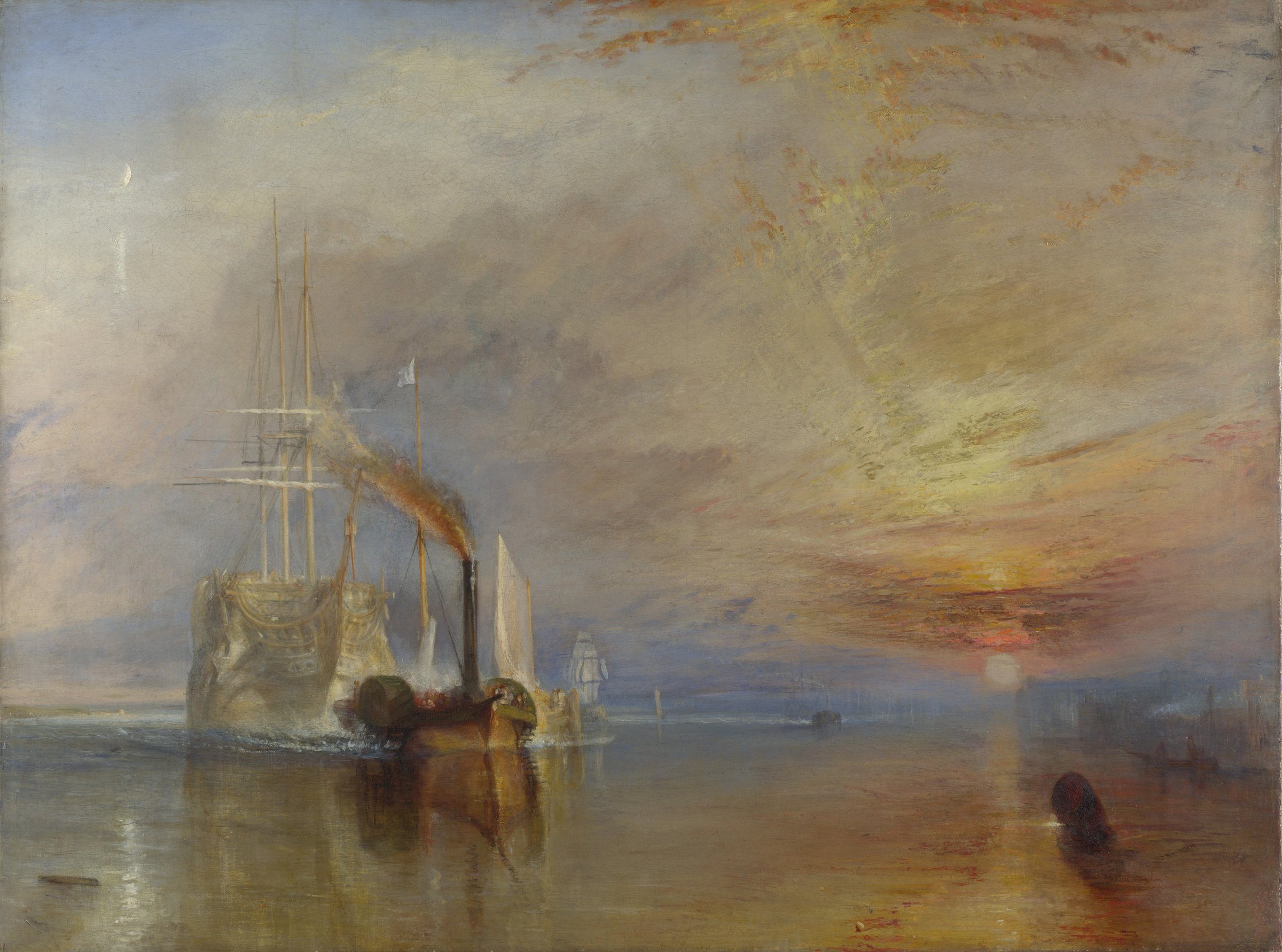
The Opening of Waterloo Bridge hangs in the Tate Britain. Helvoetsluys hangs in Tokyo. The Hay Wain is in the National Gallery. The Fighting Temeraire is in the same building.
Constable died in 1837, aged sixty, of indigestion. Turner died in 1851, aged seventy-six, in a Chelsea cottage where he had been living under an assumed name. Both bequeathed substantial bodies of work to the nation. The Constable estate produced the holdings now spread between the Victoria and Albert Museum and the National Gallery. The Turner bequest, larger and more contentious, eventually produced the Clore Gallery at Tate Britain and the Turner Prize.
The buoy is still on Helvoetsluys. It is approximately one centimetre across. The painting around it is now nearly two hundred years old, and the red has darkened slightly, but the dab is still visible from across the room. It is the smallest piece of paint in British art that has ever done more work.


