

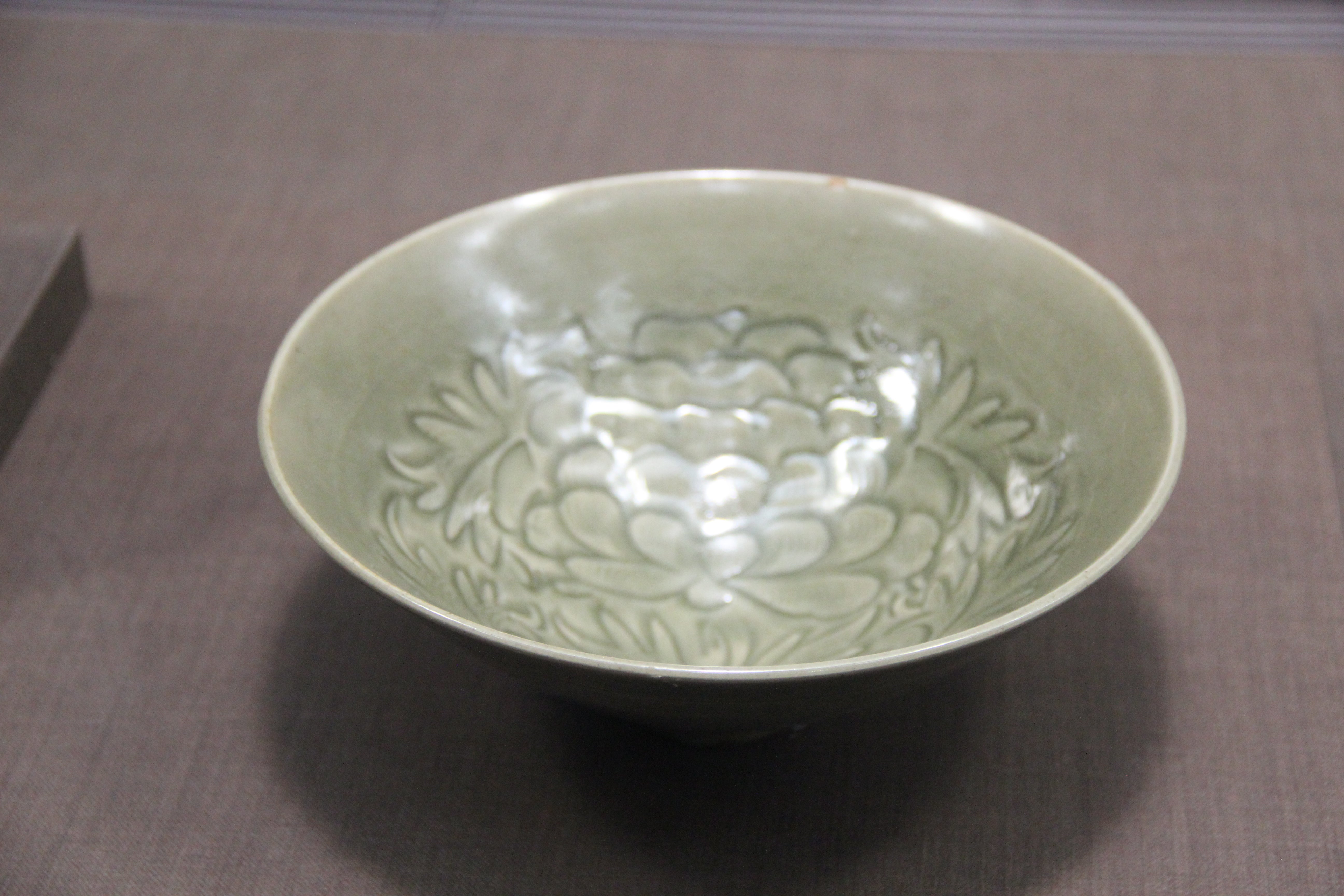
The Song dynasty (960–1279) produced ceramics that Chinese collectors have prized above all others for nearly a thousand years. Where the Tang dynasty before it favoured bold colours and foreign-influenced designs, the Song pursued something harder to achieve: the appearance of effortlessness.
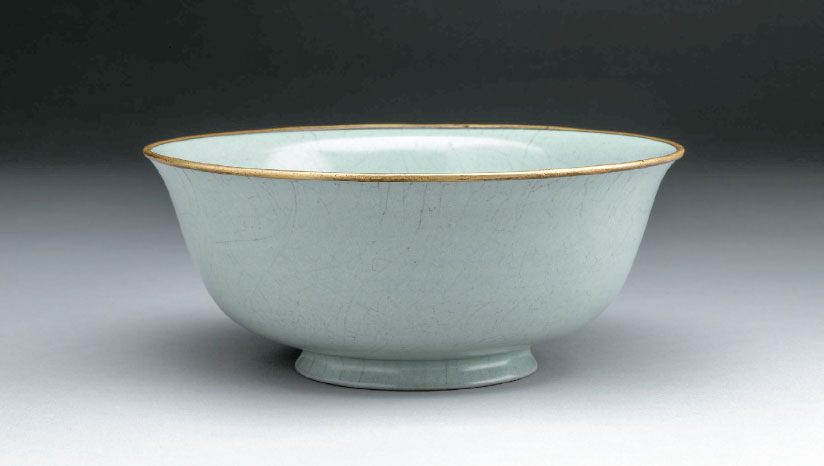
Song potters did not decorate their way to greatness. Their finest works are almost bare, relying instead on form, glaze, and a quality the Chinese call ya, a word that sits somewhere between elegance and restraint. A Ru kiln celadon bowl in the British Museum has no painted pattern, no carved relief, no gilding. It is simply a bowl with a blue-grey glaze so fine that it looks like solidified sky. Agate was ground into the glaze mixture, a detail confirmed by modern scientific testing.
This was ceramics as philosophy.
The Great Kilns
Song China supported hundreds of kilns, with the densest clusters in present-day Henan and Zhejiang provinces. Technical advances of the era included the lime-alkali glaze (which produced a thicker, more lustrous coating), improved kiln design, and the use of huozhao (firing samples) that allowed better control of temperature and atmosphere. A handful of kilns became legendary, each developing a distinct character.
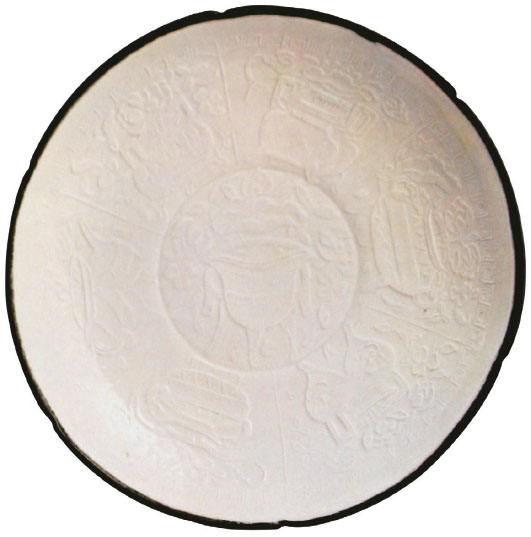
Ding kilns built their reputation on white porcelain with a milky, translucent glaze. Some pieces carried incised or impressed patterns; others were left plain. Ding potters invented stacked firing (bowls fired mouth-downward in stacks), which dramatically increased output but left an unglazed rim. This was concealed with a metal band, a practical fix that became a decorative feature in its own right.
Ru kilns and Guan (official) kilns both produced celadon wares with a thick, lustrous glaze and a distinctive network of fine cracks. This crackle, caused by the body and glaze shrinking at different rates during cooling, was initially considered a defect. Song potters recognised its beauty and began inducing it deliberately. The resulting wares, plain except for their glaze and crackle pattern, represent the peak of the Song aesthetic: jade-like surfaces, unadorned forms, and quiet authority.
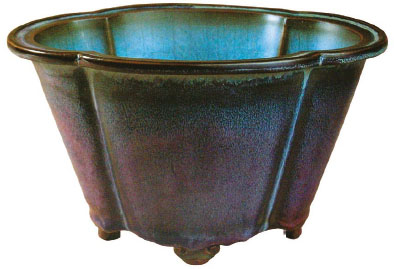
Jun kilns went in a different direction. Their opalescent stoneware came in lavender blue, often suffused with irregular streaks of crimson purple. This colouration was produced by copper oxide through reduction firing, a technique in which the kiln atmosphere is starved of oxygen at a specific moment. The results were unpredictable; no two pieces looked the same.
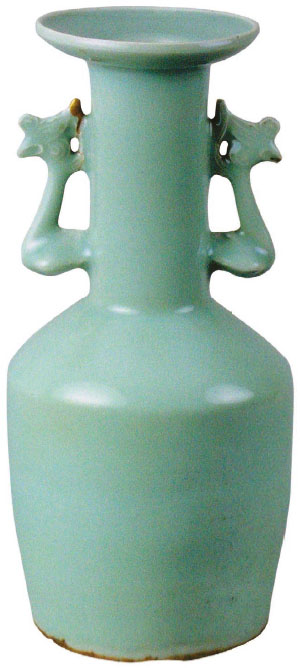
Longquan kilns in the south produced celadon that rivalled the imperial kilns. The most prized glazes were fenqing (a greyish green) and meiziqing (plum-green, a warm translucent tone).
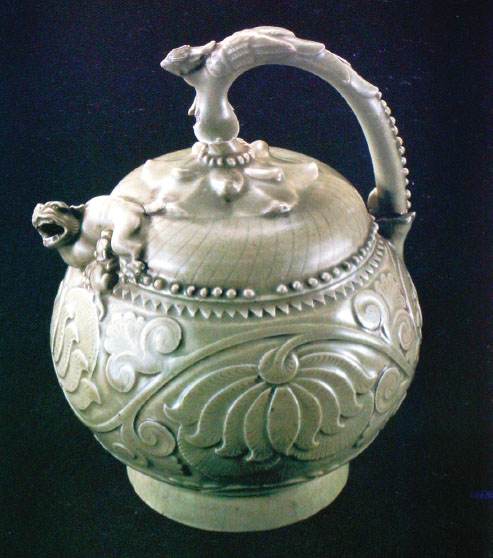
Yaozhou kilns were known for finely potted celadon with fluently carved or densely stamped patterns. The pot above has an ingenious design: a tube runs from a hole in the base to near the top, allowing it to be filled from the bottom and turned upright without spilling.
Black Glaze and the Tea Bowl
Not all Song ceramics pursued pale restraint. Jian kilns in Fujian province made black-glazed tea bowls that became objects of near-religious significance during the Song tea-drinking culture.
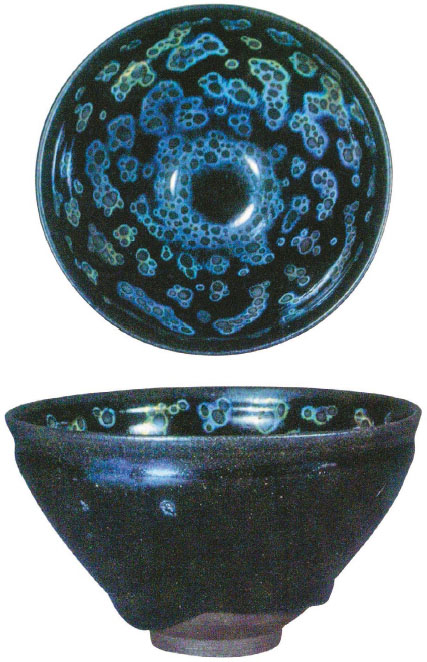
The best Jian ware has dense silvery markings in its black glaze, produced by the crystallisation of iron oxide during firing. These markings were described as "hare's fur" when they appeared as fine streaks, and "oil spots" when they formed as scattered silvery dots. The Japanese, who imported these bowls and treasured them for centuries, called the rarest iridescent effect yohen temmoku.
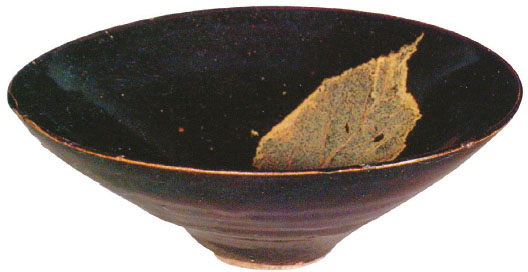
Jizhou kilns developed their own approach. One technique involved pressing a real leaf onto the clay body, applying a coat of glaze, and firing the piece. The leaf burned away, leaving its silhouette against the dark ground.
Why the Song Aesthetic Matters
Song ceramics represented a conscious rejection of excess. Where Tang decorative arts had absorbed Persian, Sogdian, and Central Asian influences with enthusiasm, Song potters turned inward. The result was work of a distinctly Chinese character, free of obvious foreign borrowing.
This preference for monochrome over polychrome, for smooth surfaces over applied decoration, for forms that let the material speak, was not limited to ceramics. Song silver was gilt all over rather than decorated in patches. Jacquard weaves used yarns of similar colours. Jade was polished to let its natural colour emerge rather than being inlaid with contrasting stones.
A thousand years on, the Song potters' argument holds: sometimes the most difficult thing to achieve is the appearance of having done very little at all.


