



About Filippo De Pisis
1896–1956
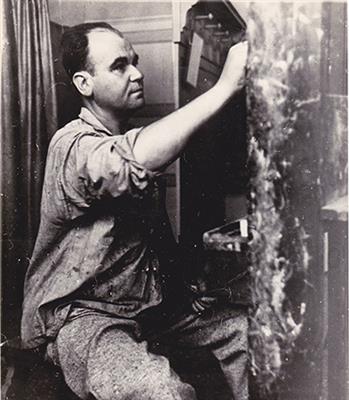
Italian painter who moved between Rome, Paris, and Venice producing luminous, loosely handled cityscapes and still lifes touched by the Metaphysical tradition.
Museums6
Countries5
Largest reported holdingMusée d'art moderne de Paris, Paris · 2 recorded works
Loading map…
Where to see Filippo De Pisis
Collection holdings are reported here; current display varies. Check with each museum before visiting.
-
2 recorded works
Musée d'art moderne de Paris
Paris, France
Also here (6)
-
1 recorded work
National Museum of Fine Arts, Argentina
Buenos Aires, Argentina
Also here (6)


-
1 recorded work
São Paulo Museum of Art
São Paulo, Brazil
-
1 recorded work
Detroit Institute of Arts
Detroit, United States
-
1 recorded work
Belvedere
Vienna, Austria
-
1 recorded work
Musée Carnavalet
Paris, France


Frequently Asked Questions
Where can I see Filippo De Pisis's work?
Filippo De Pisis (born Luigi Filippi Tibertelli in Ferrara, 1896[1]; died in Milan, 1956[1]) is known for still-life works, cityscapes, and marine paintings. De Pisis's work can be viewed in several Italian galleries. The Galleria Internazionale d’Arte Moderna di Ca’ Pesaro in Venice holds his painting The Cardinal. During his lifetime, De Pisis exhibited with the Novecento group in Milan during 1926[1] and 1929. He was part of the Italiani di Parigi, and this group was presented at the Venice Biennale in 1930. His work was also featured at the Venice Biennale in 1948 and 1954. De Pisis spent fourteen years in Paris from 1925. His first solo exhibition was in Paris at the Galerie au Sacre du Printemps in 1926.What should I know about Filippo De Pisis's prints?
Filippo De Pisis (born Luigi Tibertelli, 1896[1]-1956[1]) was an Italian painter known for his poetic and melancholic still lifes, cityscapes, and landscapes. Although he is best known as a painter, De Pisis also produced prints, mainly etchings and lithographs. These prints often echo the themes and style of his paintings, featuring delicate lines, subtle colours, and a dreamlike atmosphere. De Pisis's prints frequently depict motifs such as flowers, shells, and everyday objects, rendered with a light touch and a sense of transience. His cityscapes often capture the quiet solitude of urban settings, while his landscapes evoke a sense of nostalgia and longing. Collectors of De Pisis's prints appreciate them for their intimate scale, their poetic sensibility, and their reflection of the artist's unique vision. While not as widely known as his paintings, De Pisis's prints offer a valuable insight into his artistic practice and his exploration of themes of memory, beauty, and the passage of time.Why are Filippo De Pisis's works important today?
Filippo De Pisis (born Luigi Tibertelli de Pisis in Ferrara, 1896[1]; died Milan, 1956[1]) is important for his contribution to Italian modernism, particularly his development of a distinctive style within the Metaphysical art movement and later his poetic, melancholic still lifes. Initially associated with Giorgio de Chirico's Metaphysical school, De Pisis brought his own sensibility to the style. While sharing the movement's interest in dreamlike imagery and unsettling juxtapositions, De Pisis infused his work with a more personal and lyrical quality. Later in his career, De Pisis moved away from Metaphysical painting, developing a more individual style characterised by delicate brushwork, muted colours, and a sense of transience. His still lifes, often featuring flowers, shells, or other everyday objects, evoke a feeling of nostalgia and quiet contemplation. These works are valued for their sensitive handling of light and texture, and for their ability to invest ordinary subjects with emotional resonance.What techniques or materials did Filippo De Pisis use?
Filippo De Pisis employed a range of techniques and materials that reflect his unique artistic vision. He is best known for his still-life paintings, often featuring objects like seashells, flowers, and everyday items rendered with a delicate touch. De Pisis favoured oil paints, applying them in thin layers to create a sense of lightness and transparency. His brushwork was often loose and gestural, contributing to the ethereal quality of his compositions. He sometimes incorporated unconventional materials, such as feathers or collage elements, into his paintings, adding texture and visual interest. In addition to oils, De Pisis also worked with watercolour and tempera, exploring different media to achieve varied effects. His colour palette was typically muted and subtle, with an emphasis on pastel tones and soft gradations. He often left areas of the canvas bare, allowing the ground to show through and further enhancing the airy atmosphere of his works.Who did Filippo De Pisis influence?
It is difficult to identify specific artists who were directly influenced by Filippo De Pisis, as sources do not emphasise his role as a teacher or leader of a movement. However, some connections can be drawn from the context of his life and work. De Pisis was exposed to the work of the early Florentine masters. He was influenced by Filippino Lippi, Ghirlandaio, and Dutch masters. His treatment of colour shows the influence of Leonardo da Vinci. His work was admired by the Surrealists. The lack of information regarding De Pisis's direct influence may be due to a broader trend. After Giotto, fifteenth-century humanists struggled to find a similarly structured pattern of influence in painting.Who influenced Filippo De Pisis?
Filippo de Pisis (born Luigi Filippi Tibertelli in Ferrara, 1896[1]) was influenced by several artists and movements. During his time at the University of Bologna (1916[1]-1919[1]), he encountered Futurist ideas through the poet Corrado Govoni. The arrival of Giorgio de Chirico and Alberto Savinio in Ferrara in 1915 also proved influential. With Carlo Carrà, they established the Metaphysical 'school'. De Pisis's early lyrical prose and poetry reflected the melancholic mood of the de Chirico brothers. Moving to Rome in 1919, de Pisis began painting and became acquainted with Armando Spadini and the Valori Plastici circle. This environment aided the development of his still-life style, which combined disparate objects with a sensuous quality reminiscent of Metaphysical painting. A move to Paris in 1925 further shaped his artistic direction. He admired Eugène Delacroix, Édouard Manet, Camille Corot, Henri Matisse, and the Fauves. This admiration manifested in his increasingly gestural paint application and use of colour. In Venice, in 1944, he drew inspiration from Francesco Guardi and other eighteenth-century Venetian artists.What is Filippo De Pisis's most famous work?
It is difficult to name one single work as Filippo De Pisis's most famous. He produced a varied body of work throughout his career, and his reputation has varied since his death. De Pisis is best known for his still-life paintings, particularly those featuring everyday objects: flowers, shells, and food. These paintings often have a melancholic, dreamlike quality, achieved through a muted colour palette and loose brushwork. He also produced cityscapes, portraits, and landscapes. His work often evokes a sense of transience and fragility. De Pisis's paintings are characterised by a distinctive style that blends elements of Impressionism, Metaphysical painting, and the Italian Novecento movement. He developed a unique artistic language that set him apart from his contemporaries.What style or movement did Filippo De Pisis belong to?
Filippo De Pisis (born Luigi Filippi Tibertelli in Ferrara, 1896[1]) engaged with several styles during his career. Initially, he was drawn to Futurism, becoming acquainted with its ideas through the poet Corrado Govoni. Between 1915[1] and 1917, De Pisis, along with de Chirico and Carrà, formed the core of the Metaphysical school in Ferrara. His early lyrical prose and poetry showed the influence of the de Chirico brothers’ melancholic style. After moving to Rome in 1919, he began painting, developing a characteristic still-life style that evoked the mood of Metaphysical painting. In 1925, De Pisis moved to Paris, where he lived for fourteen years. His admiration for artists like Delacroix, Manet, Corot, Matisse, and the Fauves led to a more gestural painting style and brighter colours. He also associated with the Italiani di Parigi, a group that included de Chirico, Savinio, and Campigli. Later in life, he drew inspiration from eighteenth-century Venetian masters like Francesco Guardi.
Sources
Where to See guide aggregates verified holdings of Filippo De Pisis's works across the following collections.
- [1] wikipedia Wikipedia: Filippo De Pisis Used for: biography.
- [2] book guggenheim-futurismmodernfo00solo Used for: biography.
- [3] book guggenheim-italianartnowame00wald Used for: biography.
- [4] book Braun, Emily, 1957-; Asor Rosa, Alberto; Royal Academy of Arts (Great Britain), Italian art in the 20th century : painting and sculpture, 1900-1988 Used for: biography.
Editorial overseen by Solis Prints. Sources verified 2026-10-14. Click a source for details, or hover over [N] in the page above to preview.
Editorial standardsMethodologyCorrectionsAI disclosureAbout the editorial team