



Filippo De Pisis
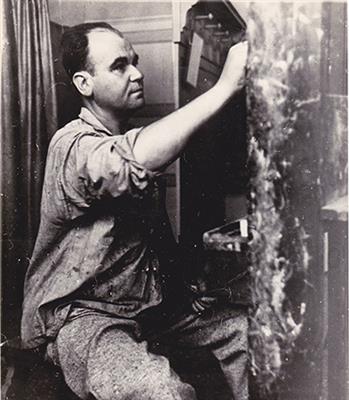
Filippo De Pisis was born Luigi Filippo Tibertelli in Ferrara in 1896[1] and changed his name to something more enigmatic before he was thirty, which is broadly representative of his approach to most things. He published a poetry collection, La città dalle 100 meraviglie, in 1920[1]. He kept a parrot named Coco. In Venice, he employed gondoliers dressed in black-and-gold livery. He was one of the more extravagant presences in the interwar Italian art world.
Biography
He moved to Rome in 1919[1] and began painting, his early sensibility shaped by the Metaphysical painters — Giorgio de Chirico and Carlo Carrà — whose interest in dreamlike dislocation left a permanent trace on his work. He spent much of the 1920s and 1930s moving between Rome, Paris, and Venice, absorbing Post-Impressionist technique in France and developing his signature subjects: cityscapes, maritime scenes, and still lifes of flowers rendered with a loose, rapid touch that gave them an in-the-moment quality verging on the provisional.
What distinguished his work was an appetite for strange spatial juxtapositions — objects placed in relation to one another in ways that unsettled the eye without quite tipping into Surrealism. His still lifes in particular carry a disquiet that the breezy handling seems designed to mask. His work appeared at the Venice Biennale during his lifetime and was shown posthumously there as well.
In 1948[1], his health deteriorated. He entered a clinic in Bologna and moved the following year to Villa Fiorita, a nursing home in Brugherio specialising in neurological disorders, where he remained until his death in Milan on 2 April 1956[1]. He was fifty-nine.
Timeline
- 1896Born Luigi Filippo Tibertelli in Ferrara.
- 1919Moved to Rome and began painting, influenced by Metaphysical painters such as Giorgio de Chirico and Carlo Carrà.
- 1920Published a poetry collection, "La città dalle 100 meraviglie".
- 1920Changed his name to Filippo De Pisis, before he was thirty.
- 1920Kept a parrot named Coco.
- 1948His health deteriorated, at 52.
- 1948Entered a clinic in Bologna.
- 1949Moved to Villa Fiorita, a nursing home in Brugherio specialising in neurological disorders.
- 1956Died in Milan on 2 April, aged 59. Cause of death not mentioned.
Notable Works
Tap to view larger.
Next stop
Browse the movements →
Every movement in the collection, from the Renaissance to Pop art.
Related Artists


Frequently Asked Questions
What is Filippo De Pisis's most famous work?
It is difficult to name one single work as Filippo De Pisis's most famous. He produced a varied body of work throughout his career, and his reputation has varied since his death. De Pisis is best known for his still-life paintings, particularly those featuring everyday objects: flowers, shells, and food. These paintings often have a melancholic, dreamlike quality, achieved through a muted colour palette and loose brushwork. He also produced cityscapes, portraits, and landscapes. His work often evokes a sense of transience and fragility. De Pisis's paintings are characterised by a distinctive style that blends elements of Impressionism, Metaphysical painting, and the Italian Novecento movement. He developed a unique artistic language that set him apart from his contemporaries.What should I know about Filippo De Pisis's prints?
Filippo De Pisis (born Luigi Tibertelli, 1896[1]-1956[1]) was an Italian painter known for his poetic and melancholic still lifes, cityscapes, and landscapes. Although he is best known as a painter, De Pisis also produced prints, mainly etchings and lithographs. These prints often echo the themes and style of his paintings, featuring delicate lines, subtle colours, and a dreamlike atmosphere. De Pisis's prints frequently depict motifs such as flowers, shells, and everyday objects, rendered with a light touch and a sense of transience. His cityscapes often capture the quiet solitude of urban settings, while his landscapes evoke a sense of nostalgia and longing. Collectors of De Pisis's prints appreciate them for their intimate scale, their poetic sensibility, and their reflection of the artist's unique vision. While not as widely known as his paintings, De Pisis's prints offer a valuable insight into his artistic practice and his exploration of themes of memory, beauty, and the passage of time.What style or movement did Filippo De Pisis belong to?
Filippo De Pisis (born Luigi Filippi Tibertelli in Ferrara, 1896[1]) engaged with several styles during his career. Initially, he was drawn to Futurism, becoming acquainted with its ideas through the poet Corrado Govoni. Between 1915[1] and 1917, De Pisis, along with de Chirico and Carrà, formed the core of the Metaphysical school in Ferrara. His early lyrical prose and poetry showed the influence of the de Chirico brothers’ melancholic style. After moving to Rome in 1919, he began painting, developing a characteristic still-life style that evoked the mood of Metaphysical painting. In 1925, De Pisis moved to Paris, where he lived for fourteen years. His admiration for artists like Delacroix, Manet, Corot, Matisse, and the Fauves led to a more gestural painting style and brighter colours. He also associated with the Italiani di Parigi, a group that included de Chirico, Savinio, and Campigli. Later in life, he drew inspiration from eighteenth-century Venetian masters like Francesco Guardi.What techniques or materials did Filippo De Pisis use?
Filippo De Pisis employed a range of techniques and materials that reflect his unique artistic vision. He is best known for his still-life paintings, often featuring objects like seashells, flowers, and everyday items rendered with a delicate touch. De Pisis favoured oil paints, applying them in thin layers to create a sense of lightness and transparency. His brushwork was often loose and gestural, contributing to the ethereal quality of his compositions. He sometimes incorporated unconventional materials, such as feathers or collage elements, into his paintings, adding texture and visual interest. In addition to oils, De Pisis also worked with watercolour and tempera, exploring different media to achieve varied effects. His colour palette was typically muted and subtle, with an emphasis on pastel tones and soft gradations. He often left areas of the canvas bare, allowing the ground to show through and further enhancing the airy atmosphere of his works.What was Filippo De Pisis known for?
Filippo De Pisis (born Luigi Tibertelli de Pisis in Ferrara, 1896[1]; died Milan, 1956[1]) is known for his distinctive style of Italian modernism. He combined elements of Metaphysical painting and the Parisian avant-garde. De Pisis's early work showed the influence of Giorgio de Chirico, particularly in its dreamlike imagery. He moved to Paris in 1925[1], where he encountered movements such as Surrealism. This exposure led to a loosening of his style and an increased interest in still life and cityscapes. His mature paintings often feature sparse arrangements of objects such as flowers, shells, and taxidermied animals, rendered with a delicate touch. These works evoke a sense of melancholy and transience. De Pisis also produced numerous paintings of Paris and other European cities, capturing their atmosphere with a light, feathery brushstroke. Although he worked across a range of subjects, his poetic sensibility and unique handling of paint are consistent features of his output.When did Filippo De Pisis live and work?
Luigi Filippi Tibertelli (who later adopted the surname De Pisis) was born on 11 May 1896[1] in Ferrara. He studied painting with several instructors, including Odoardo Domenichini, and wrote poetry during his adolescence. By 1915[1], he had assembled a collection of butterflies and wild flowers, which he donated to the university of Padua. De Pisis moved to Rome in 1919 and began painting, becoming associated with the Valori Plastici circle. By 1925, he had moved to Paris, where he lived for fourteen years. While in Paris, De Chirico presented De Pisis’s first solo show at the Galerie au Sacre du Printemps in 1926. He continued to exhibit in Italy, including with the Novecento in Milan in 1926 and 1929. Upon the outbreak of the Second World War, De Pisis returned to Milan. By 1944, he had settled in Venice. His work was featured at the Venice Biennale in 1948 and 1954. He died in Milan in 1956[1].Where can I see Filippo De Pisis's work?
Filippo De Pisis (born Luigi Filippi Tibertelli in Ferrara, 1896[1]; died in Milan, 1956[1]) is known for still-life works, cityscapes, and marine paintings. De Pisis's work can be viewed in several Italian galleries. The Galleria Internazionale d’Arte Moderna di Ca’ Pesaro in Venice holds his painting The Cardinal. During his lifetime, De Pisis exhibited with the Novecento group in Milan during 1926[1] and 1929. He was part of the Italiani di Parigi, and this group was presented at the Venice Biennale in 1930. His work was also featured at the Venice Biennale in 1948 and 1954. De Pisis spent fourteen years in Paris from 1925. His first solo exhibition was in Paris at the Galerie au Sacre du Printemps in 1926.Where was Filippo De Pisis from?
Filippo De Pisis was born Luigi Filippi Tibertelli in Ferrara, Italy, on 11 May 1896[1]. He later adopted the surname de Pisis, his family's ancestral name. De Pisis showed artistic and literary interests from a young age. He wrote poetry and studied painting with several instructors, including Odoardo Domenichini. He also collected rare objects, old books, butterflies, and wildflowers, which he donated to the University of Padua in 1915[1]. Around 1915, De Pisis was placed in a Venice psychiatric hospital for observation due to a nervous disorder, which exempted him from military service. From 1916 to 1919, he divided his time between Ferrara and the University of Bologna, studying literature and philosophy. He met Giorgio de Chirico and Carlo Carrà, forming the nucleus of the Metaphysical school. In 1919, he moved to Rome and began painting, developing his characteristic still-life style.Who did Filippo De Pisis influence?
It is difficult to identify specific artists who were directly influenced by Filippo De Pisis, as sources do not emphasise his role as a teacher or leader of a movement. However, some connections can be drawn from the context of his life and work. De Pisis was exposed to the work of the early Florentine masters. He was influenced by Filippino Lippi, Ghirlandaio, and Dutch masters. His treatment of colour shows the influence of Leonardo da Vinci. His work was admired by the Surrealists. The lack of information regarding De Pisis's direct influence may be due to a broader trend. After Giotto, fifteenth-century humanists struggled to find a similarly structured pattern of influence in painting.Who influenced Filippo De Pisis?
Filippo de Pisis (born Luigi Filippi Tibertelli in Ferrara, 1896[1]) was influenced by several artists and movements. During his time at the University of Bologna (1916[1]-1919[1]), he encountered Futurist ideas through the poet Corrado Govoni. The arrival of Giorgio de Chirico and Alberto Savinio in Ferrara in 1915 also proved influential. With Carlo Carrà, they established the Metaphysical 'school'. De Pisis's early lyrical prose and poetry reflected the melancholic mood of the de Chirico brothers. Moving to Rome in 1919, de Pisis began painting and became acquainted with Armando Spadini and the Valori Plastici circle. This environment aided the development of his still-life style, which combined disparate objects with a sensuous quality reminiscent of Metaphysical painting. A move to Paris in 1925 further shaped his artistic direction. He admired Eugène Delacroix, Édouard Manet, Camille Corot, Henri Matisse, and the Fauves. This admiration manifested in his increasingly gestural paint application and use of colour. In Venice, in 1944, he drew inspiration from Francesco Guardi and other eighteenth-century Venetian artists.Who was Filippo De Pisis?
Luigi Filippi Tibertelli (1896[1]-1956[1]), who adopted the name Filippo de Pisis, was an Italian painter and poet. Born in Ferrara, he showed an early interest in the arts, studying painting with several instructors, including Odoardo Domenichini. He also wrote poetry. De Pisis surrounded himself with rare objects and books; he collected butterflies and wild flowers, which he donated to the University of Padua in 1915[1]. De Pisis studied literature and philosophy at the University of Bologna from 1916 to 1919. There, he met Giorgio Morandi and was introduced to Futurist circles by Corrado Govoni. In 1915, Giorgio de Chirico and Alberto Savinio arrived in Ferrara; with de Pisis and Carlo Carrà, they formed the core of the Metaphysical school. Moving to Rome in 1919, de Pisis began painting. He became part of the Valori Plastici circle and befriended Armando Spadini. Developing his still-life style, he combined varied objects with a loose style reminiscent of Metaphysical painting. A literary element remained central, with motifs of books, poetry fragments, or references to earlier artists. In 1925, he moved to Paris, where he admired artists such as Eugène Delacroix, Édouard Manet, Camille Corot, Henri Matisse, and the Fauves. He adopted a more gestural painting style and brighter colours. He painted still lifes, cityscapes, and nudes. De Chirico presented de Pisis’s first solo exhibition in Paris in 1926.Why are Filippo De Pisis's works important today?
Filippo De Pisis (born Luigi Tibertelli de Pisis in Ferrara, 1896[1]; died Milan, 1956[1]) is important for his contribution to Italian modernism, particularly his development of a distinctive style within the Metaphysical art movement and later his poetic, melancholic still lifes. Initially associated with Giorgio de Chirico's Metaphysical school, De Pisis brought his own sensibility to the style. While sharing the movement's interest in dreamlike imagery and unsettling juxtapositions, De Pisis infused his work with a more personal and lyrical quality. Later in his career, De Pisis moved away from Metaphysical painting, developing a more individual style characterised by delicate brushwork, muted colours, and a sense of transience. His still lifes, often featuring flowers, shells, or other everyday objects, evoke a feeling of nostalgia and quiet contemplation. These works are valued for their sensitive handling of light and texture, and for their ability to invest ordinary subjects with emotional resonance.
Sources
Editorial draws on the following primary and tertiary references for Filippo De Pisis.
- [1] wikipedia Wikipedia: Filippo De Pisis Used for: biography, birth dates, death dates, identifiers, movement attribution, nationality.
- [2] book guggenheim-futurismmodernfo00solo Used for: biography.
- [3] book guggenheim-italianartnowame00wald Used for: biography.
- [4] book Braun, Emily, 1957-; Asor Rosa, Alberto; Royal Academy of Arts (Great Britain), Italian art in the 20th century : painting and sculpture, 1900-1988 Used for: biography.
Editorial overseen by Solis Prints. Sources verified 2026-10-21. Click a source for details, or hover over [N] in the page above to preview.
Editorial standardsMethodologyCorrectionsAI disclosureAbout the editorial team